United States: Senate confirms two nominees, shifting FERC to Republican majority

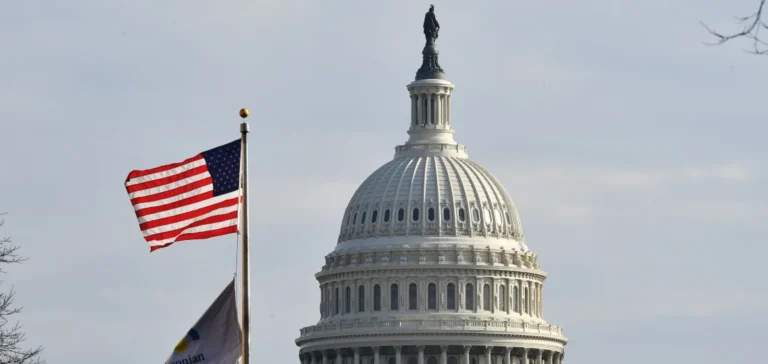
The US Senate has confirmed two new commissioners to the Federal Energy Regulatory Commission, creating a Republican majority that could reshape the regulatory approach to national energy infrastructure.

Share:

Comprehensive energy news coverage, updated nonstop

Annual subscription

8.25$/month*

*billed annually at 99$/year for the first year then 149,00$/year ​

Unlimited access • Archives included • Professional invoice

OTHER ACCESS OPTIONS

Monthly subscription

Unlimited access • Archives included

5.2$/month*
then 14.90$ per month thereafter

FREE ACCOUNT

3 articles offered per month

FREE

*Prices are excluding VAT, which may vary depending on your location or professional status

Since 2021: 35,000 articles • 150+ analyses per week

The United States Federal Energy Regulatory Commission (FERC) has shifted to a Republican majority following the Senate’s confirmation of Laura Swett and David LaCerte. With a 51-47 vote, the upper chamber approved their appointments, altering the balance of this five-member authority for the first time in several years. This change could influence the regulator’s decisions through 2026, the duration of LaCerte’s term, while Swett’s mandate extends until 2030.

Laura Swett, currently a partner at Vinson & Elkins, previously worked in FERC’s Office of Enforcement and served with former Republican commissioners. David LaCerte held roles at the White House before joining Baker Botts, where he focused on Clean Air Act matters, regulatory compliance and environmental safety.

A new direction expected for gas infrastructure

With three Republican commissioners now in place, FERC could adopt a more favourable stance toward interstate pipeline projects. This approach may facilitate approval processes amid rising energy demand, driven in part by data centre growth and artificial intelligence. The Interstate Natural Gas Association of America welcomed the return to a full FERC roster, calling it a positive signal for infrastructure investors.

This majority shift comes as the executive branch increases oversight of independent agencies. A presidential order signed in February now requires these entities to submit major regulations to the White House for review. The order’s impact on FERC’s autonomy remains uncertain, though some analysts believe it could redefine the agency’s role in shaping national energy policy.

Institutional independence and technology arbitration

During their confirmation hearings, both Swett and LaCerte affirmed their commitment to resource neutrality, in line with the Federal Power Act. However, LaCerte expressed openness to revisiting the Humphrey’s Executor precedent, which has for nearly a century limited the president’s ability to remove federal agency members at will. This position raises questions about the extent of FERC’s independence in the coming years.

In a statement, Todd Snitchler, President and CEO of the Electric Power Supply Association, stressed the importance of regulatory stability. He noted that clear rules are essential to attract private capital needed to modernise the electric grid and support industrial growth.

Staffing pressures and uncertainty over leadership

According to FERC’s operational continuity plan, the agency had 1,478 employees in August, down from the 1,539 positions budgeted for fiscal year 2025. Additionally, 28 positions are currently funded through the Inflation Reduction Act, and approximately 55 staff members are participating in an administration-led deferred resignation programme. Both new commissioners stated their intent to maintain staffing levels despite structural constraints.

It remains unclear whether current FERC Chairman David Rosner, a Democrat, will be replaced by one of the new appointees. The White House has not commented on any potential internal reorganisation. Once decided, the outcome could further influence the Commission’s strategic direction, especially in balancing industrial and regulatory priorities.

The Norwegian government establishes a commission to anticipate the decline of hydrocarbons and assess economic options for the country in the coming decades.
Kazakhstan plans to allocate 3 GW of wind and solar projects by the end of 2026 through public tenders, with a first 1 GW tranche in 2025, amid efforts to modernise its power system.
Hurricanes Beryl, Helene and Milton accounted for 80% of electricity outages recorded in 2024, marking a ten-year high according to federal data.
The French Energy Regulatory Commission introduces a temporary prudential control on gas and electricity suppliers through a “guichet à blanc” opening in December, pending the transposition of European rules.
The Carney–Smith agreement launches a new pipeline to Asia, removes oil and gas emission caps, and initiates reform of the Pacific north coast tanker ban.
The gradual exit from CfD contracts is turning stable assets into infrastructures exposed to higher volatility, challenging expected returns and traditional financing models for the renewable sector.
The Canadian government introduces major legislative changes to the Energy Efficiency Act to support its national strategy and adapt to the realities of digital commerce.
Quebec becomes the only Canadian province where a carbon price still applies directly to fuels, as Ottawa eliminated the public-facing carbon tax in April 2025.
New Delhi launches a 72.8 bn INR incentive plan to build a 6,000-tonne domestic capacity for permanent magnets, amid rising Chinese export restrictions on critical components.
The rise of CfDs, PPAs and capacity mechanisms signals a structural shift: markets alone no longer cover 10–30-year financing needs, while spot prices have surged 400% in Europe since 2019.
Germany plans to finalise the €5.8bn ($6.34bn) purchase of a 25.1% stake in TenneT Germany to strengthen its control over critical national power grid infrastructure.
The Ghanaian government is implementing a reform of its energy system focused on increasing the use of local natural gas, aiming to reduce electricity production costs and limit the sector's financial imbalance.
On the 50th anniversary of its independence, Suriname announced a national roadmap including major public investment to develop its offshore oil reserves.
In its latest review, the International Energy Agency warns of structural blockages in South Korea’s electricity market, calling for urgent reforms to close the gap on renewables and reduce dependence on imported fossil fuels.
China's power generation capacity recorded strong growth in October, driven by continued expansion of solar and wind, according to official data from the National Energy Administration.
The 2026–2031 offshore programme proposes opening over one billion acres to oil exploration, triggering a regulatory clash between Washington, coastal states and legal advocacy groups.
The government of Mozambique is consolidating its gas transport and regasification assets under a public vehicle, anchoring the strategic Beira–Rompco corridor to support Rovuma projects and respond to South Africa’s gas dependency.
The British system operator NESO initiates a consultation process to define the methodology of eleven upcoming regional strategic plans aimed at coordinating energy needs across England, Scotland and Wales.
The Belém summit ends with a technical compromise prioritising forest investment and adaptation, while avoiding fossil fuel discussions and opening a climate–trade dialogue likely to trigger new regulatory disputes.
The Asian Development Bank and the Kyrgyz Republic have signed a financing agreement to strengthen energy infrastructure, climate resilience and regional connectivity, with over $700mn committed through 2027.

All the latest energy news, all the time

Annual subscription

8.25$/month*

*billed annually at 99$/year for the first year then 149,00$/year ​

Unlimited access - Archives included - Pro invoice

Monthly subscription

Unlimited access • Archives included

5.2$/month*
then 14.90$ per month thereafter

*Prices shown are exclusive of VAT, which may vary according to your location or professional status.

Since 2021: 30,000 articles - +150 analyses/week.