France: Court Blocks Wind Project to Protect Historic Menhirs

The Nantes administrative court of appeal annulled the authorization to build three wind turbines in Porspoder, citing the impact on the archaeological heritage due to the proximity of the Kergadiou menhirs, classified as historical monuments.

Share:

Comprehensive energy news coverage, updated nonstop

Annual subscription

8.25$/month*

*billed annually at 99$/year for the first year then 149,00$/year ​

Unlimited access • Archives included • Professional invoice

OTHER ACCESS OPTIONS

Monthly subscription

Unlimited access • Archives included

5.2$/month*
then 14.90$ per month thereafter

FREE ACCOUNT

3 articles offered per month

FREE

*Prices are excluding VAT, which may vary depending on your location or professional status

Since 2021: 35,000 articles • 150+ analyses per week

The Nantes administrative court of appeal has annulled the environmental permit for the installation of three wind turbines in Porspoder, in the Finistère region. This decision, rendered on October 1, 2024, highlights the challenges related to the development of renewable energies in areas with significant heritage value. The project, initially authorized by the Finistère prefect in July 2022, was challenged due to its proximity to the Kergadiou menhirs, which are over 4000 years old and classified as historical monuments.

Conflict Between Historical Heritage and Energy Development

The Kergadiou menhirs, located just 540 meters from the site of the third planned wind turbine, have been listed as historical monuments since 1883. The court ruled that the installation of these wind turbines would have a degrading visual impact on these archaeological landmarks, thus altering the perception and scale of these megaliths within their environment. This conflict between heritage preservation and energy project implementation is a recurring issue in France, where infrastructure development must balance the demands of energy transition with the protection of cultural assets.

The court also highlighted that other megalithic sites, located within a radius of 1,000 to 1,750 meters, would be affected by the wind turbine installation, including the Traon-Igou menhirs, the Mesdoun menhirs, and the Mezou Poulyot dolmen. Local heritage preservation associations, such as the Association for the Protection of the Aber Ildut and the Association for the Safeguarding of Iroise Landscapes, supported the appeals filed by residents to cancel this project.

Local Opposition and Overlooked Negative Opinions

The prefect’s decision to maintain the project despite numerous negative opinions was a major point of contention. The architect of French historical buildings, the municipalities of Plourin and Lanildut, as well as the investigating commissioner, had all expressed concerns about the project’s impact on the landscape and heritage. The site, located at an altitude of 50 meters and three kilometers from the coast, offered direct visibility to several of the region’s emblematic landmarks, including the Iroise Marine Natural Park, the islands of Ouessant and Molène, and the Four lighthouse.

According to the court, the presence of wind turbines would have disrupted the readability of the protected landscapes of the Saint-Laurent peninsula and the Landunvez tourist route. This decision reflects a broader trend where courts are increasingly prioritizing the protection of heritage sites over industrial projects, particularly in regions like Brittany, where historical heritage is closely tied to local identity.

Impact on Wind Energy Development in France

The cancellation of this wind project is not an isolated case. France has experienced several similar incidents, where wind farm deployment has been suspended or halted due to its impact on heritage or on landscape conservation. This creates a paradoxical situation for renewable energy developers, who must navigate between the imperatives of the energy transition and local regulatory constraints. The current legal context could potentially slow down the expansion of onshore wind energy, at a time when the country aims to strengthen its renewable production capacity to meet its decarbonation targets.

In 2023, over 40 wind projects were blocked by similar court decisions, highlighting the need for developers to better anticipate heritage risks when planning new projects. This situation has led to a revision of environmental assessment procedures to better integrate heritage issues at the early stages of project development.

Industry players are now calling for a clearer legislative framework to reduce legal uncertainties and facilitate the development of infrastructures while respecting cultural heritage. This case underscores the importance of finding a balance between the growth of renewable energies and the preservation of historical elements that shape local landscapes.
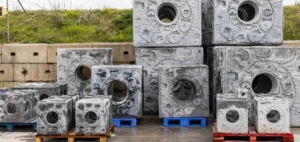
RWE and TotalEnergies will install 66 Reef cubes® around the foundations of 11 turbines at the OranjeWind wind farm, marking one of the largest applications of artificial reefs in the North Sea.
Swedish energy group Vattenfall introduces "Rewind", an interactive platform designed to commercially repurpose technical parts from dismantled wind turbines.
The rapid growth of onshore wind in Southeast Asia is at risk due to inflexible public policies and inadequate power transmission infrastructure.
Enefit Green has sold its only wind farm in Finland to Canadian fund TD Greystone Infrastructure Fund, refocusing operations on the Baltic states and Poland in a regional concentration strategy.
McDonald’s UK commits to purchasing all electricity from the Douglas West Extension Wind Farm, a 66 MW project developed by Capital Dynamics in Scotland, under a long-term agreement managed by ENGIE.
Swedish developer OX2 acquires three onshore wind projects totalling 235 MW in Romania, pushing its portfolio beyond 1.1 GW in a rapidly growing market.
Danish group Vestas is expanding its blade plant in Poland and creating more than 300 jobs to supply turbines to Germany, the leading onshore wind market in Europe.
The UK government has approved the development consent for the 480 MW Morecambe offshore wind farm, a project led by Copenhagen Infrastructure Partners and scheduled to enter construction in 2027.
Infinity Power has started work on its 200 MW wind project in Ras Ghareb, strengthening its position in the African market with technical support from China's POWERCHINA Huadong.
A partnership between the European Investment Bank and Crédit Agricole CIB aims to generate up to €8 billion in wind energy investments across the European Union through a bank guarantee mechanism.
With a €600mn ($652mn) contribution, the European Investment Bank becomes the main lender of the BC-Wind offshore wind project developed by Ocean Winds off the Polish coast.
Cadeler has taken delivery of its tenth wind turbine installation vessel, Wind Mover, delivered ahead of schedule and immediately deployed in Europe, strengthening its capabilities amid rising industrial demand.
Levanta Renewables partners with Triconti Windkraft Group to develop an onshore wind farm in Quezon province, scheduled to begin operations in 2028.
BW Ideol Projects Company acquires a minority stake in the Méditerranée Grand Large project, strengthening its partnership with EDF power solutions and Maple Power in the Mediterranean floating offshore wind sector.
Octopus Energy joins a global initiative to accelerate renewable energy deployment in Africa, committing $450mn through its Power Africa programme to supply electricity to more than one million people.
Australian energy provider Snowy Hydro has secured long-term agreements with Aula Energy and TagEnergy, adding 120 MW of wind power and 105 MW of battery storage to its national portfolio.
The He Dreiht offshore wind farm delivers its first MWh as the German auction model stalls, offering EnBW and its institutional investors a strategic showcase.
The Irish government has provisionally awarded development rights for the Tonn Nua offshore site to the Ørsted-ESB joint venture under a 20-year contract supporting a 900 MW project.
Nordex Group will supply six turbines to upgrade a 34.2 MW wind farm in Caparroso, financed by the European Union under the NextGenerationEU plan.
The Spanish group continues its asset rotation strategy by transferring its French onshore wind and solar portfolio to Technique Solaire, reinforcing its focus on offshore and regulated networks.

All the latest energy news, all the time

Annual subscription

8.25$/month*

*billed annually at 99$/year for the first year then 149,00$/year ​

Unlimited access - Archives included - Pro invoice

Monthly subscription

Unlimited access • Archives included

5.2$/month*
then 14.90$ per month thereafter

*Prices shown are exclusive of VAT, which may vary according to your location or professional status.

Since 2021: 30,000 articles - +150 analyses/week.