Onshore wind in Southeast Asia held back by rigid policies and congested grids
The rapid growth of onshore wind in Southeast Asia is at risk due to inflexible public policies and inadequate power transmission infrastructure.
| Sectors | Wind Energy, Onshore |
|---|---|
| Themes | Regulation & Governance, Public Policy |
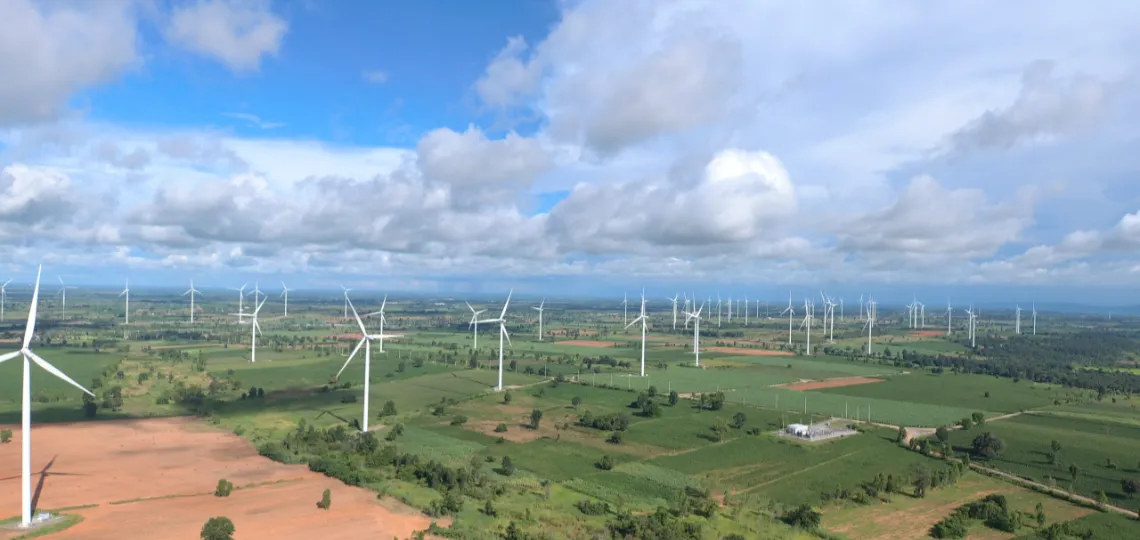
Onshore wind capacity in Southeast Asia is expected to reach 26 gigawatts (GW) by 2030, up from 6.5 GW in 2024, according to Rystad Energy AS. However, this growth is threatened by the lack of dynamic regulatory mechanisms and underprepared power networks, according to analysts from Rystad Energy AS and the Institute for Energy Economics and Financial Analysis (IEEFA).
Support policies under review
In Vietnam, the feed-in tariff (FIT) scheme launched in 2018 triggered a surge of wind projects. Grant Hauber, strategic energy finance adviser for Asia at IEEFA, stated that the policy led to grid congestion and regulatory instability. The government’s approach of accepting every project without capacity limits overwhelmed planning capabilities.
Rohit Patel, vice president for renewables and power at Rystad Energy AS, noted that emerging markets should adopt policies that adjust based on investor response. He recommends gradually lowering tariff caps in periods of strong market demand.
Transition to auctions encouraged
Both experts advocate for multi-year capacity award schedules to stabilise the sector and avoid cycles of overheating followed by stagnation. They also suggest a gradual move from fixed tariffs to competitive auction systems, which are seen as more efficient for realistic price setting and cost control.
In the Philippines, initial momentum in the sector slowed after the FIT programme ended in 2016 without a replacement mechanism. According to Patel, this gap led to a freeze in onshore wind investment.
Insufficient grid infrastructure
Grid integration remains a key issue across the region. Hauber emphasised the need for pre-planned grid connections to avoid delays caused by infrastructure unavailability. He cited India’s Solar Park model, where authorities identify sites, build transmission backbones and secure land rights before tendering.
Patel noted that Vietnam’s strategy, which leaves grid connection to project developers, results in uncoordinated construction and long commissioning delays.
According to Hauber, early interconnection planning and land acquisition allow developers to focus solely on offering the most competitive prices. He believes this model significantly reduces project risk and supports stronger cost control.