Spain approves 300 renewable energy projects worth USD 18 billion

The Spanish government authorizes the construction of nearly 300 renewable energy projects, representing an investment of $18 billion, to add 28 gigawatts of capacity.

Share:

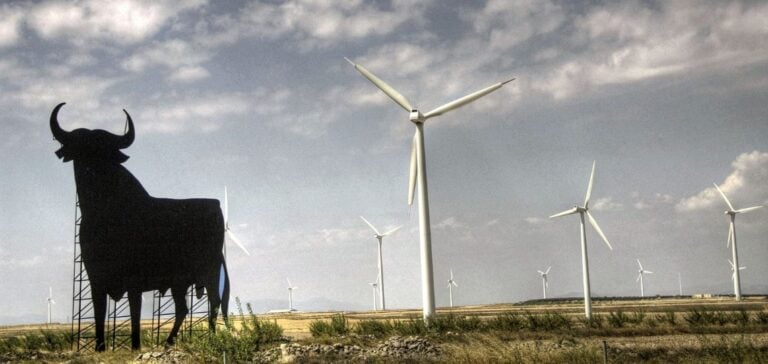
Taureau d'Osborne sur fond d'éoliennes

Comprehensive energy news coverage, updated nonstop

Annual subscription

8.25$/month*

*billed annually at 99$/year for the first year then 149,00$/year ​

Unlimited access • Archives included • Professional invoice

OTHER ACCESS OPTIONS

Monthly subscription

Unlimited access • Archives included

5.2$/month*
then 14.90$ per month thereafter

FREE ACCOUNT

3 articles offered per month

FREE

*Prices are excluding VAT, which may vary depending on your location or professional status

Since 2021: 35,000 articles • 150+ analyses per week

The Iberian country reinforces its position as a leader in renewable energies with the recent approval of almost 300 energy projects.
The initiative, announced by the Ministry of Energy, represents an investment of over 17 billion euros ($18.4 billion) and aims to add 28 gigawatts (GW) of installed capacity.

Energy ambitions and investments

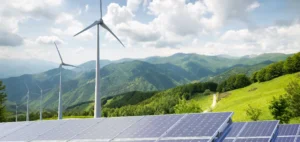
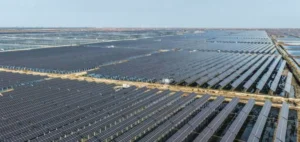
This program mainly includes photovoltaic power plants, 43 wind farms and a hydroelectric plant.
These projects capitalize on Spain’s geographical advantages: abundant sunshine, windy areas and fast-flowing rivers.
The aim is to increase the proportion of renewable electricity to 81% by 2030, compared with around 50% at present.
The kingdom’s energy transition is part of a broader strategy to reduce greenhouse gas emissions, in line with commitments made within the framework of the European Union.
This transformation is supported by public and private investment, demonstrating a strong commitment to a green and sustainable economy.

Economic and environmental impact

Renewable energy projects will have a significant impact on the national economy, creating thousands of jobs during the construction and operation phases.
Rural areas in particular will benefit from these new economic opportunities.
The construction of these modern infrastructures will also stimulate local development and improve existing infrastructures.
On the environmental front, the increase in renewable energy capacity will significantly reduce CO2 emissions.
Indeed, every gigawatt added to existing capacity will help reduce dependence on fossil fuels and limit the Iberian Peninsula’s carbon footprint.

Technology and innovation

The newly approved projects incorporate state-of-the-art technologies.
Photovoltaic plants will use high-efficiency solar cells and solar tracking systems to maximize energy production.
The wind farms will be equipped with advanced turbines capable of exploiting lower wind speeds, thereby increasing energy production.
The planned hydroelectric plant will use innovative water management, combining storage and power generation.
This approach will optimize the use of water resources, while minimizing environmental impact.
These technological innovations reinforce the country’s position as a leader in the field of renewable energies.
Government support for these projects underlines the importance of collaboration between the public and private sectors in achieving climate goals.
By working with international partners, the nation shares best practices and strengthens its local technical capabilities.
These developments testify to the authorities’ determination to move towards a greener economy.
Energy transition is both an environmental necessity and a major economic opportunity, fostering sustainable and inclusive growth.
The implementation of these projects positions the nation as a model for other countries to follow, showing that it is possible to reconcile economic development with environmental protection.


Amid rising public spending, the French government has tasked two experts with reassessing the support scheme for renewable electricity and storage, with proposals expected within three months.
National operator PSE partners with armed forces to protect transformer stations as critical infrastructure faces sabotage linked to foreign interference.
The Norwegian government establishes a commission to anticipate the decline of hydrocarbons and assess economic options for the country in the coming decades.
Kazakhstan plans to allocate 3 GW of wind and solar projects by the end of 2026 through public tenders, with a first 1 GW tranche in 2025, amid efforts to modernise its power system.
Hurricanes Beryl, Helene and Milton accounted for 80% of electricity outages recorded in 2024, marking a ten-year high according to federal data.
The French Energy Regulatory Commission introduces a temporary prudential control on gas and electricity suppliers through a “guichet à blanc” opening in December, pending the transposition of European rules.
The Carney–Smith agreement launches a new pipeline to Asia, removes oil and gas emission caps, and initiates reform of the Pacific north coast tanker ban.
The gradual exit from CfD contracts is turning stable assets into infrastructures exposed to higher volatility, challenging expected returns and traditional financing models for the renewable sector.
The Canadian government introduces major legislative changes to the Energy Efficiency Act to support its national strategy and adapt to the realities of digital commerce.
Quebec becomes the only Canadian province where a carbon price still applies directly to fuels, as Ottawa eliminated the public-facing carbon tax in April 2025.
New Delhi launches a 72.8 bn INR incentive plan to build a 6,000-tonne domestic capacity for permanent magnets, amid rising Chinese export restrictions on critical components.
The rise of CfDs, PPAs and capacity mechanisms signals a structural shift: markets alone no longer cover 10–30-year financing needs, while spot prices have surged 400% in Europe since 2019.
Germany plans to finalise the €5.8bn ($6.34bn) purchase of a 25.1% stake in TenneT Germany to strengthen its control over critical national power grid infrastructure.
The Ghanaian government is implementing a reform of its energy system focused on increasing the use of local natural gas, aiming to reduce electricity production costs and limit the sector's financial imbalance.
On the 50th anniversary of its independence, Suriname announced a national roadmap including major public investment to develop its offshore oil reserves.
In its latest review, the International Energy Agency warns of structural blockages in South Korea’s electricity market, calling for urgent reforms to close the gap on renewables and reduce dependence on imported fossil fuels.
China's power generation capacity recorded strong growth in October, driven by continued expansion of solar and wind, according to official data from the National Energy Administration.
The 2026–2031 offshore programme proposes opening over one billion acres to oil exploration, triggering a regulatory clash between Washington, coastal states and legal advocacy groups.
The government of Mozambique is consolidating its gas transport and regasification assets under a public vehicle, anchoring the strategic Beira–Rompco corridor to support Rovuma projects and respond to South Africa’s gas dependency.
The British system operator NESO initiates a consultation process to define the methodology of eleven upcoming regional strategic plans aimed at coordinating energy needs across England, Scotland and Wales.

All the latest energy news, all the time

Annual subscription

8.25$/month*

*billed annually at 99$/year for the first year then 149,00$/year ​

Unlimited access - Archives included - Pro invoice

Monthly subscription

Unlimited access • Archives included

5.2$/month*
then 14.90$ per month thereafter

*Prices shown are exclusive of VAT, which may vary according to your location or professional status.

Since 2021: 30,000 articles - +150 analyses/week.