Chinese Prime Minister on Strategic Visit to Australia for Lithium

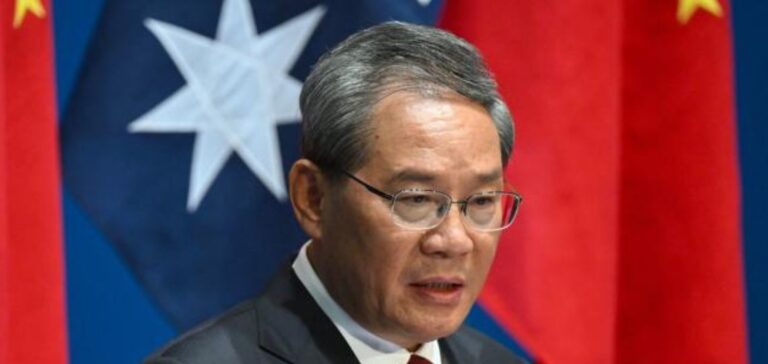
Chinese Premier Li Qiang concludes his visit to Australia with an inspection of the Tianqi lithium refinery, underlining the strategic importance of Australian minerals for China.

Share:

Visite stratégique chinoise Australie

Comprehensive energy news coverage, updated nonstop

Annual subscription

8.25£/month*

*billed annually at 99£/year for the first year then 149,00£/year ​

Unlimited access • Archives included • Professional invoice

OTHER ACCESS OPTIONS

Monthly subscription

Unlimited access • Archives included

5.2£/month*
then 14.90£ per month thereafter

FREE ACCOUNT

3 articles offered per month

FREE

*Prices are excluding VAT, which may vary depending on your location or professional status

Since 2021: 35,000 articles • 150+ analyses per week

Chinese Premier Li Qiang has completed a four-day visit to Australia, marked by a strategic visit to a lithium refinery in Perth. This visit testifies to China’s growing interest in Australian mineral resources, essential for the production of electric vehicles. Tianqi Lithium Energy Australia, a majority Chinese-owned company, was at the center of this attention, underlining the importance of Australian lithium to the Chinese supply chain. Australia is the world’s leading lithium producer, accounting for 52% of global production. Most of this lithium is exported to China for refining, mainly for use in electric vehicle batteries. This situation reinforces the mutual dependence between the two nations in the green technology sector.

Tensions and Foreign Investment

Chinese investment in Australia is a sensitive subject. In March, Australian Finance Minister Jim Chalmers forced five Chinese shareholders to sell their shares in Northern Minerals, citing national security concerns. Northern Minerals, a producer of dysprosium, a critical element for high-performance magnets in electric vehicles, holds a strategic position in Western Australia. Marina Zhang, Associate Professor at the University of Technology Sydney, explains that the Western perception of Chinese investment as a threat contrasts with Beijing’s position as a contributor to development and environmental protection. The professor stresses the difficulty of developing supply chains independent of China in the short to medium term.

Innovative Initiatives and Diplomatic Relations

Alongside the lithium refinery, Li Qiang visited a green hydrogen research center east of Perth, part of a mining group owned by billionaire Andrew Forrest. This center is dedicated to the development of future fuels produced from renewable energies. Andrew Forrest welcomed the lifting of export surcharges on many Australian products, stressing the importance of maintaining good trade relations with China. Despite the diplomatic advances, Li Qiang’s visit was not without controversy. Australian journalist Cheng Lei, detained in China for over three years, accused Chinese diplomats of deliberately blocking her access to the cameras at the press conference in Canberra. The Australian authorities expressed their concern to the Chinese embassy, adding a note of tension to the official visit. Li Qiang’s visit to Australia highlights the strategic importance of Australia’s natural resources for China and the ongoing diplomatic challenges between the two nations. While China continues to invest heavily in mineral resources, Australia seeks to balance economic benefits with national security concerns.
The Turkish president suggested to Vladimir Putin a limited ceasefire targeting Ukrainian ports and energy facilities to reduce risks to strategic assets and pave the way for negotiations.
New Delhi and Moscow strengthen their energy corridor despite US tariff and regulatory pressure, maintaining oil flows supported by alternative logistical and financial mechanisms.
The United States strengthens its energy presence in the Eastern Mediterranean by consolidating a gas corridor through Greece to Central Europe, to the detriment of Russian flows and Chinese logistical influence over the Port of Piraeus.
Paris and Beijing agree to create a bilateral climate task force focused on nuclear technologies, renewable energy and maritime sectors, amid escalating trade tensions between China and the European Union.
Ankara plans to invest in US gas production to secure LNG supply and become a key supplier to Southern Europe, according to the Turkish Energy Minister.
Three Russian tankers targeted off the Turkish coast have reignited Ankara’s concerns about oil and gas supply security in the Black Sea and the vulnerability of its subsea infrastructure.
Bucharest authorises an exceptional takeover of Lukoil’s local assets to avoid a supply shock while complying with international sanctions. Three buyers are already in advanced talks.
European governments want to add review and safeguard mechanisms to the trade deal with Washington to prevent a potential surge of US imports from disrupting their industrial base.
The Khor Mor gas field, operated by Pearl Petroleum, was hit by an armed drone, halting production and causing power outages affecting 80% of Kurdistan’s electricity capacity.
Global South Utilities is investing $1 billion in new solar, wind and storage projects to strengthen Yemen's energy capacity and expand its regional influence.
British International Investment and FirstRand partner to finance the decarbonisation of African companies through a facility focused on supporting high-emission sectors.
Budapest moves to secure Serbian oil supply, threatened by Croatia’s suspension of crude flows following US sanctions on the Russian-controlled NIS refinery.
Moscow says it wants to increase oil and liquefied natural gas exports to Beijing, while consolidating bilateral cooperation amid US sanctions targeting Russian producers.
The European Investment Bank is mobilising €2bn in financing backed by the European Commission for energy projects in Africa, with a strategic objective rooted in the European Union’s energy diplomacy.
Russia faces a structural decline in energy revenues as strengthened sanctions against Rosneft and Lukoil disrupt trade flows and deepen the federal budget deficit.
Washington imposes new sanctions targeting vessels, shipowners and intermediaries in Asia, increasing the regulatory risk of Iranian oil trade and redefining maritime compliance in the region.
OFAC’s licence for Paks II circumvents sanctions on Rosatom in exchange for US technological involvement, reshaping the balance of interests between Moscow, Budapest and Washington.
Finland, Estonia, Hungary and Czechia are multiplying bilateral initiatives in Africa to capture strategic energy and mining projects under the European Global Gateway programme.
The Brazilian president calls for a voluntary and non-binding energy transition during COP30 in Belém, avoiding direct confrontation with oil-producing countries.
The region attracted only a small share of global capital allocated to renewables in 2024, despite high energy needs and ambitious development goals, according to a report published in November.

All the latest energy news, all the time

Annual subscription

8.25£/month*

*billed annually at 99£/year for the first year then 149,00£/year ​

Unlimited access - Archives included - Pro invoice

Monthly subscription

Unlimited access • Archives included

5.2£/month*
then 14.90£ per month thereafter

*Prices shown are exclusive of VAT, which may vary according to your location or professional status.

Since 2021: 30,000 articles - +150 analyses/week.