Washington locks Greece as Euro-Atlantic gas pivot against Moscow and Beijing
The United States strengthens its energy presence in the Eastern Mediterranean by consolidating a gas corridor through Greece to Central Europe, to the detriment of Russian flows and Chinese logistical influence over the Port of Piraeus.
| Sectors | Gas, LNG |
|---|---|
| Themes | Policy & Geopolitics, Energy Security |
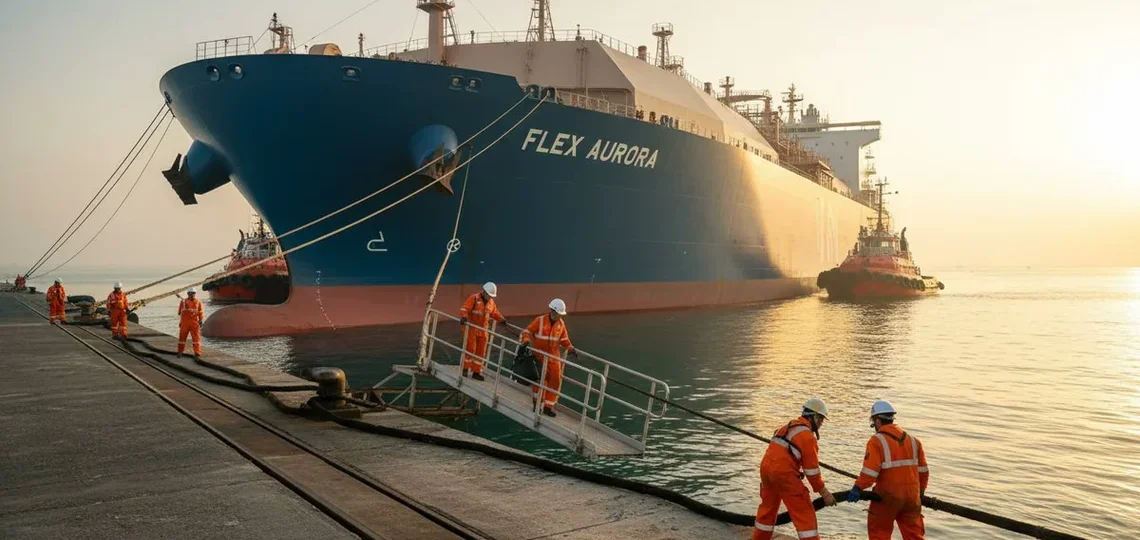
US authorities have reinforced their energy foothold in Southeast Europe by relying on Greece as a strategic entry point for liquefied natural gas (LNG) to Ukraine and the Balkans. A public statement by Ambassador Kimberly Guilfoyle in Athens marks a new political phase in an infrastructure process already well underway. The country now positions itself as a key platform for American LNG exports via the Alexandroupolis and Revithoussa terminals, connected to a network of interconnections called the Vertical Corridor.
A regional corridor structured for non-Russian gas
The Vertical Corridor is not a single infrastructure but a system of reversible flows between Greece, Bulgaria, Romania, Moldova, Ukraine and Slovakia. This configuration is designed to replace Russian volumes, as the European Union plans a full stop to Russian gas imports by autumn 2027. The expansion of capacities at transit points like Negru Voda–Kardam enables absorption of increasing American LNG volumes, redirected to Central European markets bypassing traditional routes.
The current energy strategy relies on regulatory lock-in, combining European sanctions, supply security goals and long-term contractual architecture with American and Greek operators. Several capacity sale projects have been submitted to European regulators, raising questions about their compliance with EU rules on transparency and non-discrimination.
Rising pressure on Greek ports
On the industrial front, Washington supports the transformation of Elefsis Port into a logistical alternative to Piraeus, controlled by Chinese group Cosco. A $125mn loan was granted by the US Development Finance Corporation (DFC) to Onex Elefsis Shipyards to modernise the infrastructure. This initiative complements the strategy to divert strategic flows away from Chinese-funded structures.
The Port of Piraeus, under concession to Cosco until 2052, remains a sensitive point. While no litigation has been initiated, the parallel development of Elefsis and Alexandroupolis reduces Piraeus’s importance in energy and military value chains without violating existing contractual commitments. The gap in treatment between the two ports is likely to grow as US-backed projects enter operational phases.
A structuring contractual anchor for US LNG
Commercially, contracts signed between DEPA Commercial and US suppliers such as Venture Global provide for deliveries through 2045. A recently established joint venture between DEPA and AKTOR foresees a minimum supply of 0.5 Mt/year from 2030 via Alexandroupolis. For winter 2025–2026, Ukraine has secured volumes via Greece worth approximately €2bn, supported by European financing.
This contractual structuring implies strong alignment with American commercial interests. Cumulative transport tariffs along the corridor remain higher than traditional Norwegian or Algerian routes, but the legal stability and non-Russian origin of the gas offset this disadvantage for several regional buyers.
A dual rivalry with Moscow and Beijing
Ukrainian authorities, facing partial destruction of their gas network, rely on the reliability of the Greek-Balkan corridor to ensure energy security during winter. Simultaneously, the United States reinforces its influence in the Eastern Mediterranean through regional alliances, particularly under the “3+1” format uniting Greece, Cyprus, Israel and the US.
In light of these developments, China sees its logistical leverage diminish without direct confrontation. Competition between Elefsis and Piraeus reflects a redefinition of control over strategic flows in the region. The balance of these investments will depend on the stability of transatlantic relations, European demand for LNG and geopolitical decisions in the Aegean Sea.