
Representatives of a divided and troubled world meet on Sunday in Sharm el-Sheikh for a two-week conference to address a planet buffeted by climate disasters and still on the path to catastrophic warming.
More than 120 heads of state and government are expected on Monday and Tuesday for the “leaders’ summit” of this twenty-seventh COP, according to the organizers, in a context of multiple and related crises: war in Ukraine, inflationary tensions and the spectre of global recession, energy, food and biodiversity crises…
This is enough to relegate to the background a climate crisis that is nevertheless “existential, primordial and omnipresent”, in the words of the Egyptian Minister of Foreign Affairs, Sameh Choukri, who will preside over the COP27.
Alarming reports have multiplied since COP26 in Glasgow, when nearly 200 countries solemnly pledged to “keep alive” the most ambitious goal of the Paris Agreement, a foundational treaty reached in 2015.
Namely, to limit warming to 1.5°C compared to the pre-industrial era, when humans began to burn fossil fuels (coal, oil or gas) on a large scale, which emit the greenhouse gases responsible for warming.
But since then, only 24 countries have raised their commitments and the UN sees “no credible way” to meet this target.
Even if all countries kept their promises, which never happened, the world would be on a 2.4°C warming trajectory by the end of the century. With the current policies, a catastrophic +2.8°C is looming. “Pitifully not up to the mark”, blasted the secretary general of
United Nations, Antonio Guterres.
Catastrophic impacts
However, it is not certain that the COP27 will lead to real progress in this area, even if the Egyptian presidency praises an “implementation conference”.
Calling for divisions to be set aside, the head of UN Climate, Simon Stiell, also urged on Friday during a press briefing to “move from words to deeds”. “Paris showed us what to do. Glasgow showed us how. In Sharm el-Sheikh, we will have to do it.
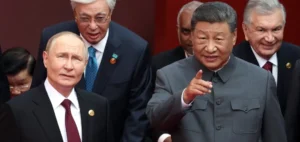
However, the renewed tensions between the world’s two main polluters, the United States and China, are weighing on the conference. Chinese President Xi Jinping will not be attending and American Joe Biden is expected to move on quickly after the November 8 mid-term elections.
However, the two could meet on the sidelines of the G20 in Bali, during the second week of the COP.
“If the two biggest emitters don’t talk to each other, we won’t be able to keep up with 1.5°C,” warns Li Shuo, of Greenpeace China.
However, at almost 1.2°C of warming, catastrophic impacts are already multiplying, as shown in 2022: terrible floods in Pakistan, with a third of the country under water, or in Nigeria, heat waves, mega-fires and droughts affecting crops.
Awareness has increased in developed countries, which are also increasingly affected, but action has not followed, particularly on financing, probably the most contentious issue on the COP27 agenda.
The rich countries have still not fulfilled the commitment they made in 2009 to increase their financing to $100 billion per year by 2020 to help the poorest countries reduce emissions and adapt to the effects of climate change. The amount capped at 83.3 billion in 2020, according to the latest, disputed OECD assessment. The target is now expected to be reached in 2023.
Too late, and above all too little, denounce the poorest, who are hardly responsible for global warming but are on the “front line” of its devastating effects.
“One hundred billion won’t even begin to meet a fraction of the needs,” warned Wael Aboulmagd, special representative of the Egyptian COP27 presidency, at a press briefing Friday. And to call for “reaching and surpassing” this objective, “important for the shaken confidence” of the countries of the South towards those of the North.
Mortician
The most exposed countries are now asking for dedicated funding for the “loss and damage” already suffered. But developed countries are very reluctant, and last year only agreed to the creation of a “dialogue” on the issue, planned until 2024. However, they should concede that the subject is officially on the agenda in Sharm el-Sheikh.
“Everyone agrees that there has to be a way to fix it. The devil is in the details,” says Ambassador Aboulmagd, while Simon Stiell calls for “an open and honest discussion.
“Are we going to respond to the more than three billion people who live in vulnerable countries?” says Harjeet Singh, head of strategy for the Climate Action Network, the main global coalition of more than 1,800 NGOs.
“The success or failure of COP27 will be judged by an agreement on this loss and damage financing facility,” said Munir Akram, Pakistan’s ambassador to the UN and chairman of the G77+China, the main group of emerging and poor countries in the climate negotiations.
This is all the more true given that funding for adaptation, which rich countries pledged last year to double, is also lagging behind.
“It would be better to pay for the doctor before (the damage) than for the mortician after,” says Avinash Persaud, representative of the Prime Minister of Barbados, Mia Motley, who is campaigning for a global reform of the global financial system, to redirect it towards climate action.