IAEA Experts Arrived in Zaporijjia

IAEA experts have arrived at the Zaporizhia nuclear power plant in Ukraine. It has been at the heart of the fighting for several weeks.

Share:

Comprehensive energy news coverage, updated nonstop

Annual subscription

8.25$/month*

*billed annually at 99$/year for the first year then 149,00$/year ​

Unlimited access • Archives included • Professional invoice

OTHER ACCESS OPTIONS

Monthly subscription

Unlimited access • Archives included

5.2$/month*
then 14.90$ per month thereafter

FREE ACCOUNT

3 articles offered per month

FREE

*Prices are excluding VAT, which may vary depending on your location or professional status

Since 2021: 35,000 articles • 150+ analyses per week

The IAEA expert mission arrived Thursday at the Ukrainian nuclear power plant of Zaporizhia occupied by the Russian army, a high-risk mission, Ukraine blaming the Russian army for bombing the area, while Moscow accuses Kiev of having sent a team of “saboteurs”.

“The IAEA mission has arrived” at the plant, a spokesman for the organization who is part of the team told AFP via WhatsApp.

The Russian news agency Ria-Novosti published a video showing the convoy of vehicles, some bearing the UN logo, arriving at the plant.

The head of the International Atomic Energy Agency, Rafael Grossi, who is leading the 14-person team, had earlier indicated that the experts would begin their work upon arrival.

“We will immediately begin the assessment of the security situation at the plant,” he had said.

The IAEA wants to establish a “permanent” presence in this plant in southern Ukraine to prevent a possible nuclear accident.

In Kiev, the head of the International Committee of the Red Cross called for a halt to all military operations around the plant, warning that an attack would be “catastrophic”.

“It is high time to stop playing with fire and instead take concrete steps to protect this site,” Robert Mardini told reporters. “The slightest miscalculation could cause havoc that we would regret for decades,” he warned.

A shutdown reactor

The two sides have been accusing each other for weeks of endangering the safety of this nuclear power plant, the largest in Europe.

One of the two reactors in operation was stopped because of Russian bombings, announced Thursday the Ukrainian operator of atomic power plants Energoatom according to which one of the six reactors continues to operate.

On Thursday, the Ukrainian authorities accused Russia of carrying out artillery strikes on Energodar, the town where the Zaporizhia power plant is located, and on the route that the IAEA mission was to take to get there.

For its part, the Russian army accused Ukrainian troops of having sent “two groups of saboteurs”.

The commandos reportedly “disembarked in seven boats (…) three kilometers northeast of the Zaporizhia nuclear power plant and attempted to take the plant,” the Russian Defense Ministry said in a statement.

He said that the Russian army had taken “measures to annihilate the enemy, including the use of aviation.

The plant is located along the Dnieper River, whose left bank is controlled in this area by Russian troops. These statements were unverifiable by independent sources.

The Russian Defense Ministry also accused the Ukrainian army of firing artillery at the “rendezvous point” of the IAEA mission near the nuclear plant.

An official of the Russian occupation administration in the Zaporizhia region, Vladimir Rogov, accused Ukraine of shelling Energodar, killing three civilians and wounding one.

Gas Warfare

On the ground, the Ukrainian army continues its counter-offensive in the south of the country, especially around Kherson, one of the few major Ukrainian cities conquered by Russia.

However, the Russian army assured on Wednesday that it had repelled the Ukrainian offensives over the last two days, inflicting heavy losses on the Ukrainians.

In a report released Thursday, the NGO Human Rights Watch said Russian forces have been forcibly transferring Ukrainian civilians, including those fleeing hostilities, to areas under their control since the Russian invasion began.

In Paris, Emmanuel Macron advocated the continuation of dialogue with Russia, believing that it was necessary “to assume that we can always continue to talk to everyone,” “especially those with whom we do not agree.

The French president was one of the few European leaders to meet with President Vladimir Putin after Russia invaded Ukraine on February 24, a strategy that has been criticized.

But Emmanuel Macron has at the same time estimated, during a speech to the French ambassadors at the Elysee Palace, that “the division of Europe is one of the goals of Russia’s war” in Ukraine.

In another war being waged in parallel, that of gas, the Russian giant Gazprom declared on Wednesday that it had “entirely” suspended its supply to Europe via the Nord Stream gas pipeline due to maintenance work that should last three days.

At a time when other European countries, notably Germany and France, are working to reduce their dependence on Russian gas, Hungary announced on Wednesday an agreement with Gazprom to receive additional deliveries.

On the diplomatic front, EU foreign ministers agreed on Wednesday to suspend a 2007 agreement with Russia to facilitate the issuance of short-stay visas on a reciprocal basis.

“This is a ridiculous decision in a series of absurdities,” the Kremlin reacted Thursday.
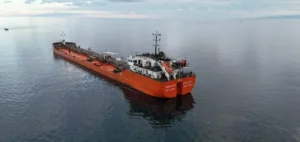
Three Russian tankers targeted off the Turkish coast have reignited Ankara’s concerns about oil and gas supply security in the Black Sea and the vulnerability of its subsea infrastructure.
Bucharest authorises an exceptional takeover of Lukoil’s local assets to avoid a supply shock while complying with international sanctions. Three buyers are already in advanced talks.
European governments want to add review and safeguard mechanisms to the trade deal with Washington to prevent a potential surge of US imports from disrupting their industrial base.
The Khor Mor gas field, operated by Pearl Petroleum, was hit by an armed drone, halting production and causing power outages affecting 80% of Kurdistan’s electricity capacity.
Global South Utilities is investing $1 billion in new solar, wind and storage projects to strengthen Yemen's energy capacity and expand its regional influence.
British International Investment and FirstRand partner to finance the decarbonisation of African companies through a facility focused on supporting high-emission sectors.
Budapest moves to secure Serbian oil supply, threatened by Croatia’s suspension of crude flows following US sanctions on the Russian-controlled NIS refinery.
Moscow says it wants to increase oil and liquefied natural gas exports to Beijing, while consolidating bilateral cooperation amid US sanctions targeting Russian producers.
The European Investment Bank is mobilising €2bn in financing backed by the European Commission for energy projects in Africa, with a strategic objective rooted in the European Union’s energy diplomacy.
Russia faces a structural decline in energy revenues as strengthened sanctions against Rosneft and Lukoil disrupt trade flows and deepen the federal budget deficit.
Washington imposes new sanctions targeting vessels, shipowners and intermediaries in Asia, increasing the regulatory risk of Iranian oil trade and redefining maritime compliance in the region.
OFAC’s licence for Paks II circumvents sanctions on Rosatom in exchange for US technological involvement, reshaping the balance of interests between Moscow, Budapest and Washington.
Finland, Estonia, Hungary and Czechia are multiplying bilateral initiatives in Africa to capture strategic energy and mining projects under the European Global Gateway programme.
The Brazilian president calls for a voluntary and non-binding energy transition during COP30 in Belém, avoiding direct confrontation with oil-producing countries.
The region attracted only a small share of global capital allocated to renewables in 2024, despite high energy needs and ambitious development goals, according to a report published in November.
The United States approves South Korea’s development of civilian uranium enrichment capabilities and supports a nuclear-powered submarine project, expanding a strategic partnership already linked to a major trade agreement.
The EU member states agree to prioritise a loan mechanism backed by immobilised Russian assets to finance aid to Ukraine, reducing national budgetary impact while ensuring enhanced funding capacity.
The Canadian government commits $56 billion to a new wave of infrastructure projects aimed at expanding energy corridors, accelerating critical mineral extraction and reinforcing strategic capacity.
Berlin strengthens its cooperation with Abuja through funding aimed at supporting Nigeria’s energy diversification and consolidating its renewable infrastructure.
COP30 begins in Belém under uncertainty, as countries fail to agree on key discussion topics, highlighting deep divisions over climate finance and the global energy transition.

All the latest energy news, all the time

Annual subscription

8.25$/month*

*billed annually at 99$/year for the first year then 149,00$/year ​

Unlimited access - Archives included - Pro invoice

Monthly subscription

Unlimited access • Archives included

5.2$/month*
then 14.90$ per month thereafter

*Prices shown are exclusive of VAT, which may vary according to your location or professional status.

Since 2021: 30,000 articles - +150 analyses/week.