India rejects Trump’s tariff threats over Russian oil purchases

New Delhi calls US sanctions unjustified and denounces double standard as Trump threatens to substantially increase tariffs.

Share:

Comprehensive energy news coverage, updated nonstop

Annual subscription

8.25$/month*

*billed annually at 99$/year for the first year then 149,00$/year ​

Unlimited access • Archives included • Professional invoice

OTHER ACCESS OPTIONS

Monthly subscription

Unlimited access • Archives included

5.2$/month*
then 14.90$ per month thereafter

FREE ACCOUNT

3 articles offered per month

FREE

*Prices are excluding VAT, which may vary depending on your location or professional status

Since 2021: 35,000 articles • 150+ analyses per week

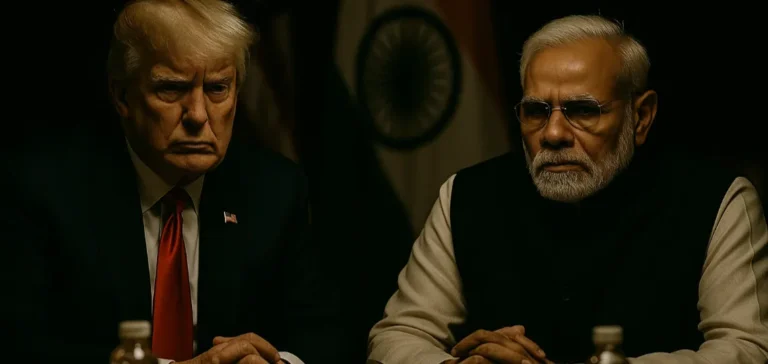
India has firmly rejected Donald Trump’s threats to impose “substantially” higher tariffs on Indian exports to the United States. The American president justified this measure by New Delhi’s “massive” purchases of Russian oil, stating on Truth Social that India “doesn’t care how many people are being killed in Ukraine by the Russian war machine.” The Indian Ministry of External Affairs called these criticisms “unjustified and unreasonable” on Monday, promising to take all necessary measures to protect the country’s national interests.

Tensions have intensified as Trump has set an August 8 deadline for Russia to reach a peace agreement with Ukraine, threatening to impose secondary sanctions on Russian oil buyers if no agreement is reached. India ranks among the top three Russian crude importers, receiving 1.6 million barrels per day in July according to S&P Global Commodities at Sea, alongside China and Turkey.

An energy market under diplomatic pressure

Indian ministry spokesperson Randhir Jaiswal emphasized that the United States had initially encouraged India to import Russian gas “to strengthen global energy market stability.” He specified that India had begun these imports because traditional supplies had been diverted to Europe after the outbreak of the Ukrainian conflict. This position reflects the complexity of commercial realignments that occurred since 2022, when several European countries reduced their trade with Moscow.

Market experts warn that any significant disruption to Indian purchases of Russian oil could have major consequences on global prices. David Goldwyn, president of Goldwyn Global Strategies, estimates that preventing China and India from buying Russian oil could remove 4 million barrels per day from the market and push crude prices above $100 per barrel. A measure targeting only India could still increase prices between $28 and $40 per barrel, which would contradict Trump’s stated goal of reducing energy costs for American consumers.

Accusations of commercial double standard

New Delhi has strongly criticized what it considers double-dealing by the United States and the European Union (EU). The Indian statement emphasizes that the United States maintains trade worth an estimated $3.5 billion with Russia despite severe sanctions. American imports include uranium hexafluoride for the nuclear industry, palladium for the electric vehicle industry, as well as fertilizers and chemicals.

India also pointed to European trade with Russia, which is not limited to energy but encompasses fertilizers, mining products, chemicals, iron and steel, as well as machinery and transport equipment. This situation complicates international trade relations as the United States remains India’s largest trading partner, with Indian exports to that country reaching $87.4 billion.

Potential impacts on Indian refineries

Indian refineries have begun to slow their Russian import deals and are attempting to diversify their supplies while awaiting clarification on potential tariffs and sanctions. Benjamin Tang, head of liquid bulk at S&P Global Commodities at Sea, notes that a rapid reduction in Russian crude shipments to India is unlikely given the scale of current imports. However, if such a change were to occur, it would likely lead to a resurgence of Middle Eastern suppliers such as Iraq, Saudi Arabia and the United Arab Emirates (UAE), as well as a potential increase in light crude imports from the United States.

Ajay Srivastava, former Indian trade official and head of the Global Trade Research Initiative (GTRI), stated that Trump’s claims about India’s oil trade with Russia are misleading. He emphasizes that this trade has been transparent and broadly understood by the United States, and that India increased its purchases to help stabilize global markets after Western sanctions disrupted supplies. Indian oil refineries, both public and private, make their purchasing decisions based on factors such as price, supply security and export rules, operating independently of the government without requiring its approval to buy from Russia or other countries.
Ghanaian company Cybele Energy has signed a $17mn exploration deal in Guyana’s shallow offshore waters, targeting a block estimated to contain 400 million barrels and located outside disputed territorial zones.
Oil prices moved little after a drop linked to the restart of a major Iraqi oilfield, while investors remained focused on Ukraine peace negotiations and an upcoming monetary policy decision in the United States.
TechnipFMC will design and install flexible pipes for Ithaca Energy as part of the development of the Captain oil field, strengthening its footprint in the UK offshore sector.
Vaalco Energy has started drilling the ET-15 well on the Etame platform, marking the beginning of phase three of its offshore development programme in Gabon, supported by a contract with Borr Drilling.
The attack on a key Caspian Pipeline Consortium offshore facility in the Black Sea halves Kazakhstan’s crude exports, exposing oil majors and reshaping regional energy dynamics.
Iraq is preparing a managed transition at the West Qurna-2 oil field, following US sanctions against Lukoil, by prioritising a transfer to players deemed reliable by Washington, including ExxonMobil.
The Rapid Support Forces have taken Heglig, Sudan’s largest oil site, halting production and increasing risks to regional crude export flows.
The rehabilitation cost of Sonara, Cameroon’s only refinery, has now reached XAF300bn (USD533mn), with several international banks showing growing interest in financing the project.
China imported 12.38 million barrels per day in November, the highest level since August 2023, driven by stronger refining margins and anticipation of 2026 quotas.
The United States reaffirmed its military commitment to Guyana, effectively securing access to its rapidly expanding oil production amid persistent border tensions with Venezuela.
Sanctioned tanker Kairos, abandoned after a Ukrainian drone attack, ran aground off Bulgaria’s coast, exposing growing legal and operational risks tied to Russia’s shadow fleet in the Black Sea.
The United States is temporarily licensing Lukoil’s operations outside Russia, blocking all financial flows to Moscow while facilitating the supervised sale of a portfolio valued at $22bn, without disrupting supply for allied countries.
Libya’s state oil firm NOC plans to launch a licensing round for 20 blocks in early 2026, amid mounting legal, political and financial uncertainties for international investors.
European sanctions on Russia and refinery outages in the Middle East have sharply reduced global diesel supply, driving up refining margins in key markets.
L’arrêt de la raffinerie de Pancevo, frappée par des sanctions américaines contre ses actionnaires russes, menace les recettes fiscales, l’emploi et la stabilité énergétique de la Serbie.
Oil prices climbed, driven by Ukrainian strikes on Russian infrastructure and the lack of diplomatic progress between Moscow and Washington over the Ukraine conflict.
Chevron has announced a capital expenditure range of $18 to $19 billion for 2026, focusing on upstream operations in the United States and high-potential international offshore projects.
ExxonMobil is shutting down its oldest ethylene steam cracker in Singapore, reducing local capacity to invest in its integrated Huizhou complex in China, amid regional overcapacity and rising operational costs.
Brazil, Guyana, Suriname and Argentina are expected to provide a growing share of non-OPEC+ oil supply, backed by massive offshore investments and continued exploration momentum.
The revocation of US licences limits European companies’ operations in Venezuela, triggering a collapse in crude oil imports and a reconfiguration of bilateral energy flows.

All the latest energy news, all the time

Annual subscription

8.25$/month*

*billed annually at 99$/year for the first year then 149,00$/year ​

Unlimited access - Archives included - Pro invoice

Monthly subscription

Unlimited access • Archives included

5.2$/month*
then 14.90$ per month thereafter

*Prices shown are exclusive of VAT, which may vary according to your location or professional status.

Since 2021: 30,000 articles - +150 analyses/week.