Wind blade composites: global market to reach USD 21.87 billion by 2030

The global market for composites used in wind blades is expected to reach USD 21.87 billion by 2030, driven by increasing demand for renewable energy and advances in production techniques, according to MarketsandMarkets.

Share:

Comprehensive energy news coverage, updated nonstop

Annual subscription

8.25€/month*

*billed annually at 99€/year for the first year then 149,00€/year ​

Unlimited access • Archives included • Professional invoice

OTHER ACCESS OPTIONS

Monthly subscription

Unlimited access • Archives included

5.2€/month*
then 14.90€ per month thereafter

FREE ACCOUNT

3 articles offered per month

FREE

*Prices are excluding VAT, which may vary depending on your location or professional status

Since 2021: 35,000 articles • 150+ analyses per week

The global wind blade composites industry is experiencing sustained growth, driven by increased energy demand and significant technological advances. According to a recent report by market research firm MarketsandMarkets, this sector is projected to rise from USD 13.28 billion in 2025 to USD 21.87 billion in 2030, representing a compound annual growth rate (CAGR) of 10.5%.

Dominance of glass fibres

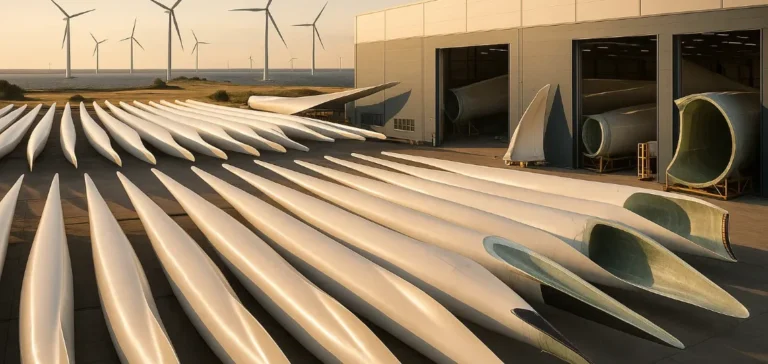
In terms of materials, glass fibre currently dominates this sector. It offers an excellent strength-to-weight ratio, enabling the manufacturing of wind blades that are both lightweight and durable. Glass fibre also provides significant economic advantages compared to other materials available in the market. Its mechanical qualities, including high fatigue resistance and chemical durability, ensure a long service life for blades, while minimising maintenance costs.

The epoxy resin segment holds a significant position due to its superior mechanical properties and efficiency as an adhesive material. Epoxy resins ensure excellent load transfer between fibres, thereby enhancing the structural integrity of wind blades. Furthermore, their resistance to UV radiation and temperature fluctuations makes epoxy particularly suited for the rigorous outdoor conditions to which wind blades are subjected.

Trend towards longer blades

The market is moving towards larger blades, often exceeding 50 metres in length. These extended blades enable turbines to sweep a larger area, significantly enhancing their energy yield. Increased incorporation of carbon fibres and specialised resins facilitates the production of these longer blades, maintaining both their strength and lightness.

The offshore segment is expected to experience the highest growth rate during the studied period. This development is driven by a planned significant increase in installations across various global regions, notably Northern Europe. Composites used in offshore applications must meet particularly stringent criteria regarding resistance to marine environments and severe weather conditions.

Asia-Pacific: the market’s main driver

Currently, the Asia-Pacific region holds the largest market share, driven notably by significant investments in countries such as China, India, and Japan. These countries are actively developing their wind energy infrastructure to address growing energy needs. Major local and international manufacturers are establishing production facilities in this region, benefiting from competitive costs, skilled labour, and supportive government policies.

Key global industry players include China Jushi Co., Ltd., DowAksa, Teijin Limited, SGL Carbon, Hexcel Corporation, Gurit Services AG, Toray Industries Inc., and Exel Composites. These companies position themselves throughout the value chain, from composite materials production to the final manufacturing of wind blades, illustrating strong competition in the sector.

This dynamic highlights the continuous evolutions to which the wind energy sector must adapt, especially through technological innovation and economic efficiency—key criteria for the future of the composites market dedicated to wind blades.
RWE has secured contracts for four renewable energy projects totalling 68 MW in Italy, with construction set to begin in 2026, reinforcing its expansion strategy in the market.
RWE and TotalEnergies will install 66 Reef cubes® around the foundations of 11 turbines at the OranjeWind wind farm, marking one of the largest applications of artificial reefs in the North Sea.
Swedish energy group Vattenfall introduces "Rewind", an interactive platform designed to commercially repurpose technical parts from dismantled wind turbines.
The rapid growth of onshore wind in Southeast Asia is at risk due to inflexible public policies and inadequate power transmission infrastructure.
Enefit Green has sold its only wind farm in Finland to Canadian fund TD Greystone Infrastructure Fund, refocusing operations on the Baltic states and Poland in a regional concentration strategy.
McDonald’s UK commits to purchasing all electricity from the Douglas West Extension Wind Farm, a 66 MW project developed by Capital Dynamics in Scotland, under a long-term agreement managed by ENGIE.
Swedish developer OX2 acquires three onshore wind projects totalling 235 MW in Romania, pushing its portfolio beyond 1.1 GW in a rapidly growing market.
Danish group Vestas is expanding its blade plant in Poland and creating more than 300 jobs to supply turbines to Germany, the leading onshore wind market in Europe.
The UK government has approved the development consent for the 480 MW Morecambe offshore wind farm, a project led by Copenhagen Infrastructure Partners and scheduled to enter construction in 2027.
Infinity Power has started work on its 200 MW wind project in Ras Ghareb, strengthening its position in the African market with technical support from China's POWERCHINA Huadong.
A partnership between the European Investment Bank and Crédit Agricole CIB aims to generate up to €8 billion in wind energy investments across the European Union through a bank guarantee mechanism.
With a €600mn ($652mn) contribution, the European Investment Bank becomes the main lender of the BC-Wind offshore wind project developed by Ocean Winds off the Polish coast.
Cadeler has taken delivery of its tenth wind turbine installation vessel, Wind Mover, delivered ahead of schedule and immediately deployed in Europe, strengthening its capabilities amid rising industrial demand.
Levanta Renewables partners with Triconti Windkraft Group to develop an onshore wind farm in Quezon province, scheduled to begin operations in 2028.
BW Ideol Projects Company acquires a minority stake in the Méditerranée Grand Large project, strengthening its partnership with EDF power solutions and Maple Power in the Mediterranean floating offshore wind sector.
Octopus Energy joins a global initiative to accelerate renewable energy deployment in Africa, committing $450mn through its Power Africa programme to supply electricity to more than one million people.
Australian energy provider Snowy Hydro has secured long-term agreements with Aula Energy and TagEnergy, adding 120 MW of wind power and 105 MW of battery storage to its national portfolio.
The He Dreiht offshore wind farm delivers its first MWh as the German auction model stalls, offering EnBW and its institutional investors a strategic showcase.
The Irish government has provisionally awarded development rights for the Tonn Nua offshore site to the Ørsted-ESB joint venture under a 20-year contract supporting a 900 MW project.
Nordex Group will supply six turbines to upgrade a 34.2 MW wind farm in Caparroso, financed by the European Union under the NextGenerationEU plan.

All the latest energy news, all the time

Annual subscription

8.25€/month*

*billed annually at 99€/year for the first year then 149,00€/year ​

Unlimited access - Archives included - Pro invoice

Monthly subscription

Unlimited access • Archives included

5.2€/month*
then 14.90€ per month thereafter

*Prices shown are exclusive of VAT, which may vary according to your location or professional status.

Since 2021: 30,000 articles - +150 analyses/week.