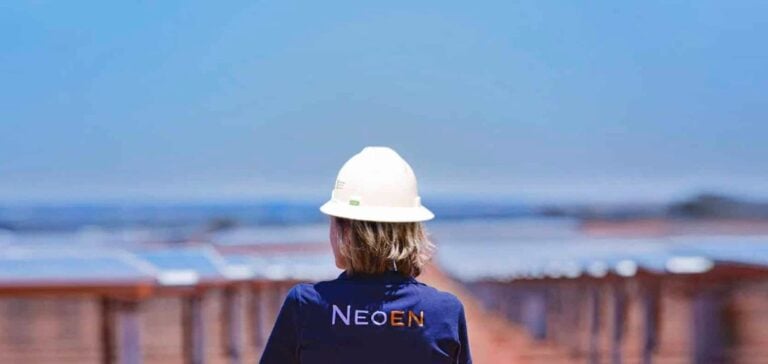
Neoen’s Sales Rebound, Driven by Electricity Storage

Neoen announced a 2% increase in its third-quarter revenue, reaching 123 million euros, primarily due to revenue from its electricity storage activity in Australia.

Share:

Comprehensive energy news coverage, updated nonstop

Annual subscription

8.25€/month*

*billed annually at 99€/year for the first year then 149,00€/year ​

Unlimited access • Archives included • Professional invoice

OTHER ACCESS OPTIONS

Monthly subscription

Unlimited access • Archives included

5.2€/month*
then 14.90€ per month thereafter

FREE ACCOUNT

3 articles offered per month

FREE

*Prices are excluding VAT, which may vary depending on your location or professional status

Since 2021: 35,000 articles • 150+ analyses per week

After several quarters of decline, the French renewable energy producer Neoen reported a slight 2% increase in its revenue in the third quarter of 2024, reaching 123 million euros. This recovery was driven by its electricity storage activity, which experienced significant growth, partially offsetting declines in the solar and wind segments.

At the core of this positive trend, Neoen’s batteries played a key role. Indeed, the company optimized its arbitrage revenues through these devices, storing electricity when prices are low to resell when prices rise. This strategy proved particularly profitable in Australia, where Neoen benefited from a favorable market context in August. As a result, revenue from the storage activity doubled compared to the previous year, reaching 25 million euros in the third quarter.

Mixed Results in Solar and Wind

Despite this success in the storage sector, Neoen experienced a decline in revenue in its solar and wind activities. Revenue from solar plants amounted to 51 million euros in the third quarter, recording a 9% decrease year-on-year. This reduction is explained by the sale of several solar installations at the end of last year, combined with less favorable sunlight conditions during this period.

The wind sector, meanwhile, saw a 6% decline in its revenue, amounting to 47 million euros. Neoen noted that this decrease is related to the expected evolution of certain contract terms regarding two of its wind farms. Although these declines weighed on the overall balance sheet, the company is relying on the strength of its storage segment to stabilize its performance.

A Pending Acquisition and Maintained Objectives

In addition to its financial results, Neoen is on the verge of finalizing its acquisition by the Canadian asset manager Brookfield. This acquisition is expected to be completed by the end of the year, with a public offer launch planned for the first quarter of 2025, pending the necessary regulatory approvals.

Despite uneven performances across segments, Neoen reaffirmed its adjusted EBITDA target for 2024, projected between 530 and 560 million euros. This forecast is based on the performance of its storage activity, which has become a strategic pillar for the group in response to the volatility of more traditional segments.
Brazil, Guyana, Suriname and Argentina are expected to provide a growing share of non-OPEC+ oil supply, backed by massive offshore investments and continued exploration momentum.
EDF commits to supply 33 MW of nuclear electricity to Verkor over 12 years, enabling the battery manufacturer to stabilise energy costs ahead of launching its first Gigafactory.
Donald Trump has scrapped the fuel consumption standards imposed under Joe Biden, citing lower vehicle prices, while carmakers welcome a move aligned with current market demand.
The revocation of US licences limits European companies’ operations in Venezuela, triggering a collapse in crude oil imports and a reconfiguration of bilateral energy flows.
ABB invests in UK-based start-up OctaiPipe to strengthen its smart energy-saving solutions for data centre infrastructure.
The cross-border hydrogen transport network HY4Link receives recognition from the European Commission as a project of common interest, unlocking access to funding and integration into Europe’s energy infrastructure.
Bourbon has signed an agreement with ExxonMobil for the charter of next-generation Crewboats on Angola’s Block 15, strengthening a strategic cooperation that began over 15 years ago.
Turkmenistan is leveraging the Global Gas Centre to build commercial links in Europe and South Asia, as it responds to its current dependence on China and a shifting post-Russian gas market.
Faced with tighter legal frameworks and reinforced sanctions, grey fleet operators are turning to 15-year-old VLCCs and scrapping older vessels to secure oil routes to Asia.
Reconnaissance Energy Africa completed drilling at the Kavango West 1X onshore well in Namibia, where 64 metres of net hydrocarbon pay were detected in the Otavi carbonate section.
National operator PSE partners with armed forces to protect transformer stations as critical infrastructure faces sabotage linked to foreign interference.
Budapest contests the European agreement to ban Russian natural gas imports by 2027, claiming the measure is incompatible with its economic interests and the European Union's founding treaties.
The withdrawal of Stellantis weakens Symbio, which is forced to drastically reduce its workforce at the Saint-Fons plant, despite significant industrial investment backed by both public and private stakeholders.
CNOOC Limited has started production at the Weizhou 11-4 oilfield adjustment project and its satellite fields, targeting 16,900 barrels per day by 2026.
Sustainable Holdings is developing a battery storage facility in Matsusaka, with operations scheduled to begin in June 2026 on Japan’s electricity market.
Toshiba’s subsidiary commits to acquiring non-fossil certificates from a floating solar power plant operated by OTS in Japan, under a virtual power purchase agreement coordinated by Digital Grid.
California-based Korbel Winery is now equipped with an integrated energy storage and intelligent control system, installed by Energy Toolbase and BPi, to optimise usage and address local grid constraints.
The Canadian start-up has secured financing to complete a C$13.6mn project aimed at converting captured CO₂ and natural gas into high-value carbon nanofibres.
The 200 MW Greenwater battery storage project enters execution phase following a $400mn bank financing, marking a strategic milestone in the Pacific Northwest’s energy infrastructure development.
The rapid growth of onshore wind in Southeast Asia is at risk due to inflexible public policies and inadequate power transmission infrastructure.

All the latest energy news, all the time

Annual subscription

8.25€/month*

*billed annually at 99€/year for the first year then 149,00€/year ​

Unlimited access - Archives included - Pro invoice

Monthly subscription

Unlimited access • Archives included

5.2€/month*
then 14.90€ per month thereafter

*Prices shown are exclusive of VAT, which may vary according to your location or professional status.

Since 2021: 30,000 articles - +150 analyses/week.