Algeria Banks on Hassi R’Mel to Maintain its Key Role in the Gas Market

Sonatrach is investing $2.3 billion to optimize the Hassi R'Mel gas field, aiming to sustain natural gas production and strengthen Algeria's energy position in Africa and Europe.

Share:

Comprehensive energy news coverage, updated nonstop

Annual subscription

8.25$/month*

*billed annually at 99$/year for the first year then 149,00$/year ​

Unlimited access • Archives included • Professional invoice

OTHER ACCESS OPTIONS

Monthly subscription

Unlimited access • Archives included

5.2$/month*
then 14.90$ per month thereafter

FREE ACCOUNT

3 articles offered per month

FREE

*Prices are excluding VAT, which may vary depending on your location or professional status

Since 2021: 35,000 articles • 150+ analyses per week

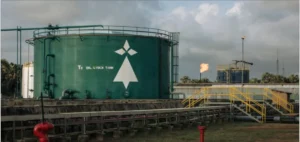
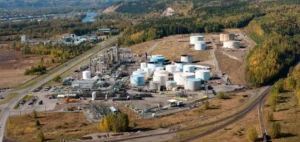
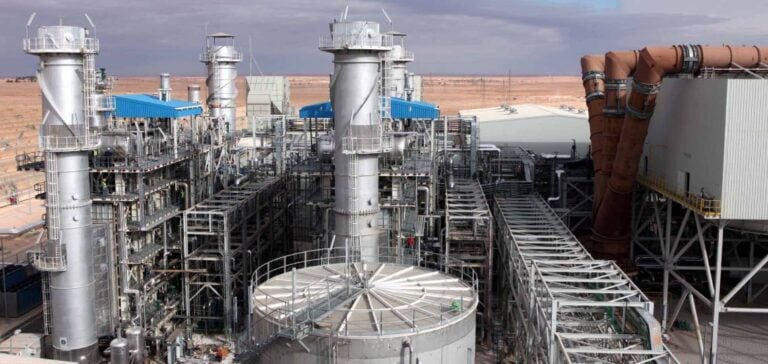
Algeria’s state-owned hydrocarbons company, Sonatrach, officially launched on December 1 a new strategic phase of operations at the Hassi R’Mel gas field, the country’s largest natural gas reserve and one of the most significant in Africa. This project, titled “Boosting Hassi R’Mel — Phase III — Step 2,” is a critical lever for ensuring the continuity of national production.

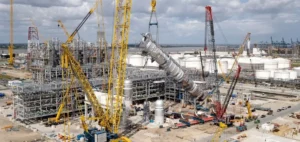
The Hassi R’Mel field, which provides approximately 26% of Algeria’s daily gas output, has already seen about 80% of its recoverable gas extracted through two prior projects completed in 2004 and 2009. In this latest phase, Sonatrach plans to install and operationalize three gas compression stations by 2027, aiming to extend the field’s viability and extract additional volumes.

Projections indicate that the project will enable the recovery of approximately 121 billion cubic meters of gas, in addition to 7 million tons of condensates and 3 million tons of liquefied petroleum gas (LPG). These results will support the current levels of gas production while meeting growing domestic and international market demands.

Strategic Partnerships and Investments

To execute this ambitious project, Sonatrach has partnered with leading companies in the oil and gas sector. Baker Hughes and Tecnimont have been selected to provide technical expertise. The total cost of this initiative is estimated at $2.3 billion.

Beyond this specific project, Algeria plans substantial investments in hydrocarbons over the next five years. In December 2023, Sonatrach announced a comprehensive investment program of $50 billion for the 2024-2028 period, including $36 billion dedicated solely to production and exploration. These investments aim to increase annual output to 200 billion cubic meters by 2028, up from the current 137 billion.

Strategic Objectives for Europe and Africa

Algeria has clear ambitions: to solidify its role as a key energy supplier not only on the domestic market but also regionally and internationally. In Europe, where demand for natural gas remains strong, particularly in the context of the energy transition, Algeria positions itself as an indispensable player.

Through the ongoing projects at Hassi R’Mel, Sonatrach aims to both honor its international commercial commitments and reinforce Algeria’s status as an energy leader in Africa. This strategic positioning is part of a long-term vision to diversify and sustain revenue from natural resources.
Budapest contests the European agreement to ban Russian natural gas imports by 2027, claiming the measure is incompatible with its economic interests and the European Union's founding treaties.
The European Union has enshrined in law a complete ban on Russian gas by 2027, forcing utilities, operators, traders and states to restructure contracts, physical flows and supply strategies under strict regulatory pressure.
The partial exploitation of associated gas from the Badila field by Perenco supplies electricity to Moundou, highlighting the logistical and financial challenges of gas development in Chad.
A new regulation requires gas companies to declare the origin, volume and duration of their contracts, as the EU prepares to end Russian imports.
Saudi Aramco has launched production at the unconventional Jafurah gas field, initiating an investment plan exceeding $100bn to substitute domestic crude and increase exportable flows under OPEC+ constraints.
By mobilising long-term contracts with BP and new infrastructure, PLN is driving Indonesia’s shift toward prioritising domestic LNG use, at the centre of a state-backed investment programme supported by international lenders.
TotalEnergies, TES and three Japanese companies will develop an industrial-scale e-gas facility in the United States, targeting 250 MW capacity and 75,000 tonnes of annual output by 2030.
Argentinian consortium Southern Energy will supply up to two million tonnes of LNG per year to Germany’s Sefe, marking the first South American alliance for the European importer.
The UK government has ended its financial support for TotalEnergies' liquefied natural gas project in Mozambique, citing increased risks and a lack of national interest in continuing its involvement.
Faced with a climate- and geopolitically-constrained winter, Beijing announces expected record demand for electricity and gas, placing coal, LNG and UHV grids at the centre of a national energy stress test.
The Iraqi government and Kurdish authorities have launched an investigation into the drone attack targeting the Khor Mor gas field, which halted production and caused widespread electricity outages.
PetroChina internalises three major gas storage sites through two joint ventures with PipeChina, representing 11 Gm³ of capacity, in a CNY40.02bn ($5.43bn) deal consolidating control over its domestic gas network.
The European Union is facilitating the use of force majeure to exit Russian gas contracts by 2028, a risky strategy for companies still bound by strict legal clauses.
Amid an expected LNG surplus from 2026, investors are reallocating positions toward the EU carbon market, betting on tighter supply and a bullish price trajectory.
Axiom Oil and Gas is suing Tidewater Midstream for $110mn over a gas handling dispute tied to a property for sale in the Brazeau region, with bids due this week.
Tokyo Gas has signed a 20-year agreement with US-based Venture Global to purchase one million tonnes per year of liquefied natural gas starting in 2030, reinforcing energy flows between Japan and the United States.
Venture Global accuses Shell of deliberately harming its operations over three years amid a conflict over spot market liquefied natural gas sales outside long-term contracts.
TotalEnergies ends operations of its Le Havre floating LNG terminal, installed after the 2022 energy crisis, due to its complete inactivity since August 2024.
Golar LNG has completed a $1.2bn refinancing for its floating LNG unit Gimi, securing extended financing terms and releasing net liquidity to strengthen its position in the liquefied natural gas market.
Woodside Energy and East Timor have reached an agreement to assess the commercial viability of a 5 million-tonne liquefied natural gas project from the Greater Sunrise field, with first exports targeted between 2032 and 2035.

All the latest energy news, all the time

Annual subscription

8.25$/month*

*billed annually at 99$/year for the first year then 149,00$/year ​

Unlimited access - Archives included - Pro invoice

Monthly subscription

Unlimited access • Archives included

5.2$/month*
then 14.90$ per month thereafter

*Prices shown are exclusive of VAT, which may vary according to your location or professional status.

Since 2021: 30,000 articles - +150 analyses/week.