Kyowakiden Industry inaugurates the world's second osmotic energy plant in Fukuoka
Japanese company Kyowakiden Industry has commissioned the world's second osmotic energy plant in Fukuoka, capable of generating up to 880,000 kWh per year at a cost of 3.8 million euros.
| Sectors | Marine & Hydraulic Energy, Osmotic Energy |
|---|---|
| Themes | Innovation & Transformation, Sector Innovation |
| Companies | Kyowakiden Industry |
| Countries | Japan, Norway, Saudi Arabia |
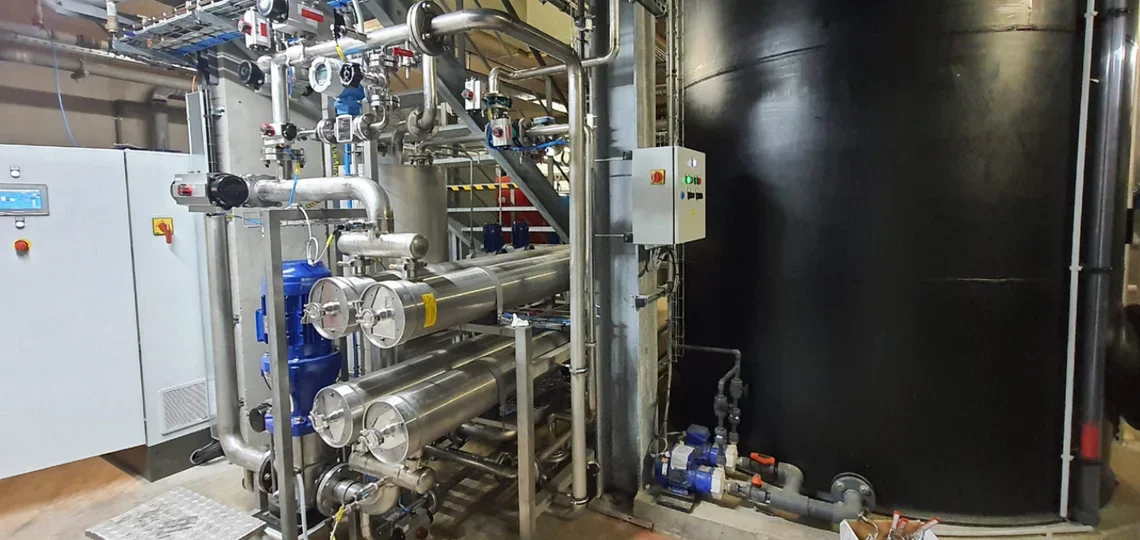
In Fukuoka, southwestern Japan, Kyowakiden Industry commissioned the world's second osmotic energy plant in August 2025, following a first installation in Norway. The facility, which cost 700 million yen (3.8 million euros), harnesses the natural phenomenon of osmosis to generate electricity from the flow of water molecules between treated wastewater and concentrated seawater. At full capacity, it is expected to produce up to 880,000 kilowatt-hours per year, equivalent to the consumption of approximately 300 households.
A site shaped by Fukuoka's hydrological constraints
Fukuoka city and its surrounding region, home to 2.6 million people, have relied since 2005 on a major desalination plant for drinking water, given the absence of large rivers. Kyowakiden Industry, headquartered in Nagasaki, selected this site to exploit the brine produced by the desalination facility — a locally abundant resource. The osmosis process relies on water molecules passing from a low-salinity solution to a higher-salinity one through a permeable membrane, a movement powerful enough at scale to drive a turbine and generate electricity.
For now, the installation only powers the plant site itself, covering just a fraction of its energy needs. It will undergo a five-year testing period to assess performance, including costs, membrane maintenance, and the durability of salt-exposed components. Plant managers acknowledge that the cost of electricity produced remains "much higher" than fossil fuels or other renewable energy sources.
A weather-independent advantage over other renewables
No osmotic facility has yet been deployed at grid scale, and the water pumping process itself consumes energy. Yet officials and experts point to a key differentiator: unlike solar or wind, osmotic energy does not depend on weather conditions. The high costs are partly explained by the unique nature of the installation, according to Tetsuro Ueyama, head of research and development (R&D) at Kyowakiden Industry.
Ueyama anticipates a scale-up: if the technology proves itself, his company plans to build facilities "approximately five to ten times larger than this one." He also sees export potential, particularly in Saudi Arabia and other Middle Eastern countries with large desalination plants. "If osmotic energy production technology advances to the point where it can be practically used with ordinary seawater, it would represent a major contribution in the fight against climate change," Kenji Hirokawa, an official at the desalination plant, told AFP.
A technology seeking to move beyond estuary settings
Osmotic energy has until now been envisaged mainly in estuarine zones, where freshwater rivers meet the sea. The technique used in Fukuoka broadens this scope by exploiting desalination brine, opening possibilities in arid regions with large desalination plants but limited hydrological resources. Kyowakiden Industry ultimately aims to use ordinary seawater for osmotic energy production — an ambition its executives describe as realistic.