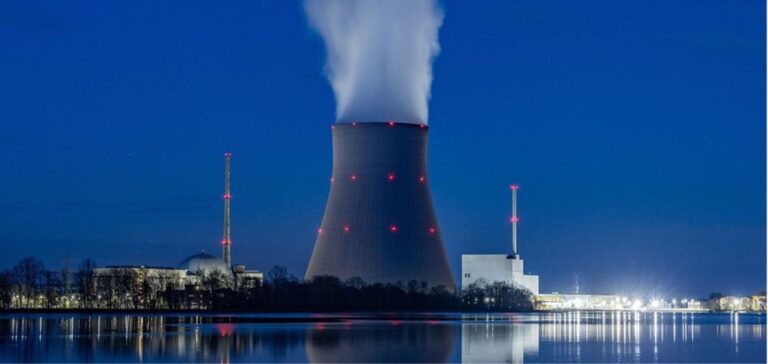
The Lubmin power plant has been in the process of being dismantled for 30 years

The dismantling of nuclear power plants in Germany is a long and complex process, as demonstrated by the Lubmin plant, which will take decades to dismantle. Radioactive materials are cut and purified with special tools, but storage and recycling remain challenges.

Share:

Comprehensive energy news coverage, updated nonstop

Annual subscription

8.25€/month*

*billed annually at 99€/year for the first year then 149,00€/year ​

Unlimited access • Archives included • Professional invoice

OTHER ACCESS OPTIONS

Monthly subscription

Unlimited access • Archives included

5.2€/month*
then 14.90€ per month thereafter

FREE ACCOUNT

3 articles offered per month

FREE

*Prices are excluding VAT, which may vary depending on your location or professional status

Since 2021: 35,000 articles • 150+ analyses per week

After German reunification, Hartmut Schindel did not bet much on his future at the nuclear power plant in Lubmin on the Baltic Sea, which had just been closed.

But 33 years later, Hartmut is still there and so is the power plant, or at least what remains of it after the various phases of its dismantling, which is still only halfway through. “We were sure we were going to be gotten rid of,” recalls this employee who started out as an apprentice at what was once the largest nuclear facility in East Germany.

Five reactors to dismantle, 1.8 million tons of potentially radioactive material to decontaminate… The titanic construction site, launched in 1995, still employs some 900 people. “We are very careful, and of course it takes time,” says Hartmut Schindel, who has moved from nuclear waste management to communications functions. This is the long road ahead for Germany’s last three active nuclear power plants, which will cease operation for good on Saturday.

Giant saws

In the site’s central workshop, a constant din envelops the workers, dressed in overalls and helmets. They cut, compress and purify steel blocks or cable bundles with a whole arsenal: a 1,200-degree flashlight, an XXL metal saw or an ultra-high pressure water jet.

The materials are then stored in standardized pallets of 120 by 80 centimeters. The radioactive residues are stored in another hall, where huge red, yellow and blue containers stand. Entire sections of the plant are slowly being eroded at a rate of 600 tons per year.

In the 5 reactors, active between 1973 and 1990, some components continue to emit high dose radiation. “In order to dismantle them safely, a special building had to be constructed, which will be ready by 2025,” explains Kurt Radloff, spokesman for the EWN Group in charge of the construction. The most radioactive components will be immersed in water and dismantled remotely, “a flagship technique” that could inspire the dismantling of other plants, he said.

The question of disposal is more difficult, as Germany does not yet have a disposal facility for high-level radioactive waste. Not to mention the challenge of recycling, as 98% of the materials, once decontaminated, can be recycled after meticulous checks. The oldest nuclear decommissioning site in Germany, the Lubmin plant -also known as the Greifswald plant- in northern Germany is also a special case.

The costs of dismantling were skyrocketing, the delays were accumulating. It will take another 30 years to complete the work. “At first we thought it would be over by 2030,” says Christian von Hirschhausen, an expert at the DIW economic institute. “You also learn as you go, by undoing the plant,” concedes Kurt Radloff.

“Thank you. No contamination.”

In addition to the size of this site, the East German type of power plants are “more complex” to deconstruct, according to the economist, particularly because of data lost at the time of reunification. “The plant was built for eternity,” recalls Hartmut Schindel, who will soon retire.

Security reasons were given for closing Lubmin after the fall of the Wall. About twenty other reactors, closed in recent years, are being dismantled in Germany for periods that should be shorter. Every day, most of the employees mechanically follow a heavy procedure, between airlocks, successive undressing and scanning in narrow capsules. Inside these, one complies with the orders of a robotic voice straight from the 1980’s, until it resounds: “thank you. No contamination”.

The radioactivity tests also apply to each pallet that leaves the site. If the light is red, it’s back to decontamination. Even the journalists’ cameras, batteries, etc. are not spared from this examination, which can last up to 40 minutes.

An unusual image in this drastically secured environment: a local tennis club trains on a court nestled at the very top of the old Block 6, a reactor that was never put into service and has long since been converted.

The full-scope simulator for the Lianjiang nuclear project has successfully passed factory acceptance testing, paving the way for its installation at the construction site in China's Guangdong province.
A coalition of Danish industry groups, unions and investors launches a platform in support of modular nuclear power, aiming to develop firm low-carbon capacity to sustain industrial competitiveness.
The United Kingdom and TAE Technologies create a joint venture in Culham to produce neutral beams, a key component of fusion, with strategic backing from Google.
Texas-based developer Natura Resources receives new federal funding to test key components of its 100-megawatt modular reactor in partnership with Oak Ridge National Laboratory.
The Niigata regional assembly is deliberating on restarting unit 6 of the world’s largest nuclear plant, thirteen years after operations ceased following the Fukushima disaster.
Reactor Doel 2 was taken offline, becoming the fifth Belgian reactor to cease operations under the country’s gradual nuclear phase-out policy.
Rolls-Royce SMR has expanded its partnership with ÚJV Řež to accelerate the deployment of small modular reactors, targeting the construction of several units in the Czech Republic and abroad.
The Indian government aims to amend legislation to allow private companies to participate in civil nuclear development, a move positioned as critical to achieving the country’s long-term energy targets.
The VVER-1200 nuclear reactor at Xudabao 4 in China has completed installation of its final passive water tank, marking the end of modular construction for the second phase of the project.
Ottawa and Edmonton commit to a nuclear production roadmap by 2050, through a memorandum of understanding also covering carbon capture and an Indigenous-led pipeline project.
Niamey asserts control over its uranium resources by authorising open market sales of Somaïr’s production, formerly operated by France’s Orano, amid ongoing legal disputes.
Equinix has signed a strategic agreement with French start-up Stellaria to reserve 500 MWe of advanced nuclear capacity to power its future European AI data centres starting in 2035.
Bishkek plans to host a RITM-200N small modular reactor supplied by Rosatom to address electricity shortages and deepen energy ties with Moscow, despite the risks posed by Western sanctions.
The Niigata prefectural assembly will vote on the restart of Unit 6, potentially marking TEPCO’s first reactor relaunch since the 2011 Fukushima disaster.
The Norwegian government has initiated a consultation with neighbouring countries on its modular nuclear power plant project in Aure and Heim, in accordance with the Espoo Convention.
Türkiye and South Korea have signed a memorandum of understanding to jointly explore nuclear power plant projects, marking a strategic step in the long-term development of Türkiye's energy infrastructure.
Asian Development Bank has amended its energy policy to enable funding for civil nuclear projects in developing member countries across the Asia-Pacific region.
First Hydrogen begins research with the University of Alberta to identify molten-salt mixtures simulating nuclear fuels for SMR prototypes.
Framatome has completed the manufacturing of the first nuclear fuel assemblies for the Barakah power plant, marking a key milestone in the supply agreement signed with Emirates Nuclear Energy Company in July.
A government-commissioned report proposes 47 measures to simplify nuclear regulation, reduce decommissioning costs and accelerate delivery of civilian and military projects.

All the latest energy news, all the time

Annual subscription

8.25€/month*

*billed annually at 99€/year for the first year then 149,00€/year ​

Unlimited access - Archives included - Pro invoice

Monthly subscription

Unlimited access • Archives included

5.2€/month*
then 14.90€ per month thereafter

*Prices shown are exclusive of VAT, which may vary according to your location or professional status.

Since 2021: 30,000 articles - +150 analyses/week.