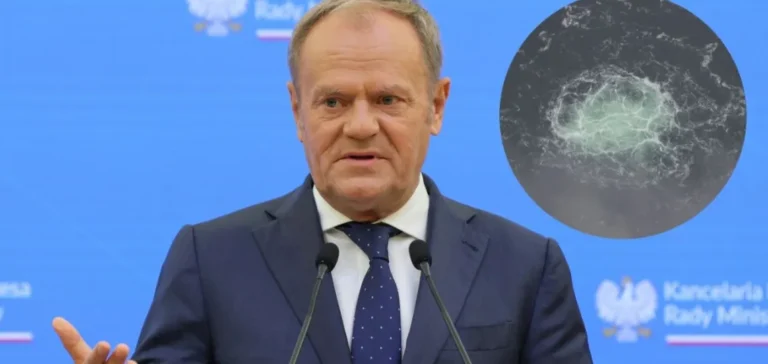
Tusk refuses to hand over Ukrainian suspect to Germany over Nord Stream sabotage

Polish Prime Minister Donald Tusk said it was not in Poland’s interest to extradite to Germany a Ukrainian citizen suspected of taking part in the explosions that damaged the Nord Stream gas pipelines in 2022.

Share:

Comprehensive energy news coverage, updated nonstop

Annual subscription

8.25$/month*

*billed annually at 99$/year for the first year then 149,00$/year ​

Unlimited access • Archives included • Professional invoice

OTHER ACCESS OPTIONS

Monthly subscription

Unlimited access • Archives included

5.2$/month*
then 14.90$ per month thereafter

FREE ACCOUNT

3 articles offered per month

FREE

*Prices are excluding VAT, which may vary depending on your location or professional status

Since 2021: 35,000 articles • 150+ analyses per week

Polish Prime Minister Donald Tusk stated that it would not be in the national interest to hand over to Germany a Ukrainian national wanted for his alleged role in the explosions that hit the Nord Stream gas pipelines. The man, identified as Volodymyr Z., was arrested in late September near Warsaw under a European arrest warrant issued by Berlin.

A decision left to the Polish judiciary

Donald Tusk said the final decision would rest with the Polish court, while reiterating Warsaw’s long-standing opposition to the pipelines linking Russia to Germany. According to him, the Nord Stream 1 and Nord Stream 2 projects deepened Europe’s energy dependence on Moscow. “The problem of Europe, Ukraine, Lithuania and Poland is not that Nord Stream 2 was destroyed, but that it was built,” the Polish leader said.

Investigation into sabotage and regional tensions

German authorities have not yet responded to Warsaw’s comments. A Polish court extended Volodymyr Z.’s provisional detention for forty days while examining the extradition request submitted by Berlin. The case is part of the investigation into the September 2022 explosions near Denmark’s Bornholm Island, which severely damaged the underwater pipelines connecting Russia to Europe.

German federal prosecutors accuse the suspect of taking part in an operation by a group that allegedly rented a sailing yacht to place explosives on the pipelines. He faces charges of conspiracy to commit an explosives attack and anti-constitutional sabotage. Another Ukrainian national arrested in Italy in August is also suspected of coordinating the attacks and is contesting his extradition.

A case linking energy and national interests

The Nord Stream explosions marked a turning point in the Ukraine conflict and triggered a major energy crisis in Europe. Neither Russia, nor Ukraine, nor Western countries have claimed responsibility for the sabotage, fuelling speculation and diplomatic tension. For Poland, the case highlights the fragility of the balance between European alliances, energy interests and national judicial decisions, at a time when gas dependency remains a major strategic issue.
European governments want to add review and safeguard mechanisms to the trade deal with Washington to prevent a potential surge of US imports from disrupting their industrial base.
The Khor Mor gas field, operated by Pearl Petroleum, was hit by an armed drone, halting production and causing power outages affecting 80% of Kurdistan’s electricity capacity.
Global South Utilities is investing $1 billion in new solar, wind and storage projects to strengthen Yemen's energy capacity and expand its regional influence.
British International Investment and FirstRand partner to finance the decarbonisation of African companies through a facility focused on supporting high-emission sectors.
Budapest moves to secure Serbian oil supply, threatened by Croatia’s suspension of crude flows following US sanctions on the Russian-controlled NIS refinery.
Moscow says it wants to increase oil and liquefied natural gas exports to Beijing, while consolidating bilateral cooperation amid US sanctions targeting Russian producers.
The European Investment Bank is mobilising €2bn in financing backed by the European Commission for energy projects in Africa, with a strategic objective rooted in the European Union’s energy diplomacy.
Russia faces a structural decline in energy revenues as strengthened sanctions against Rosneft and Lukoil disrupt trade flows and deepen the federal budget deficit.
Washington imposes new sanctions targeting vessels, shipowners and intermediaries in Asia, increasing the regulatory risk of Iranian oil trade and redefining maritime compliance in the region.
OFAC’s licence for Paks II circumvents sanctions on Rosatom in exchange for US technological involvement, reshaping the balance of interests between Moscow, Budapest and Washington.
Finland, Estonia, Hungary and Czechia are multiplying bilateral initiatives in Africa to capture strategic energy and mining projects under the European Global Gateway programme.
The Brazilian president calls for a voluntary and non-binding energy transition during COP30 in Belém, avoiding direct confrontation with oil-producing countries.
The region attracted only a small share of global capital allocated to renewables in 2024, despite high energy needs and ambitious development goals, according to a report published in November.
The United States approves South Korea’s development of civilian uranium enrichment capabilities and supports a nuclear-powered submarine project, expanding a strategic partnership already linked to a major trade agreement.
The EU member states agree to prioritise a loan mechanism backed by immobilised Russian assets to finance aid to Ukraine, reducing national budgetary impact while ensuring enhanced funding capacity.
The Canadian government commits $56 billion to a new wave of infrastructure projects aimed at expanding energy corridors, accelerating critical mineral extraction and reinforcing strategic capacity.
Berlin strengthens its cooperation with Abuja through funding aimed at supporting Nigeria’s energy diversification and consolidating its renewable infrastructure.
COP30 begins in Belém under uncertainty, as countries fail to agree on key discussion topics, highlighting deep divisions over climate finance and the global energy transition.
The United States secures a tungsten joint venture in Kazakhstan and mining protocols in Uzbekistan, with financing envisaged from the Export-Import Bank of the United States and shipment routed via the Trans-Caspian corridor.
The United States grants Hungary a one-year waiver on sanctions targeting Russian oil, in return for a commitment to purchase US liquefied natural gas worth $600mn.

All the latest energy news, all the time

Annual subscription

8.25$/month*

*billed annually at 99$/year for the first year then 149,00$/year ​

Unlimited access - Archives included - Pro invoice

Monthly subscription

Unlimited access • Archives included

5.2$/month*
then 14.90$ per month thereafter

*Prices shown are exclusive of VAT, which may vary according to your location or professional status.

Since 2021: 30,000 articles - +150 analyses/week.