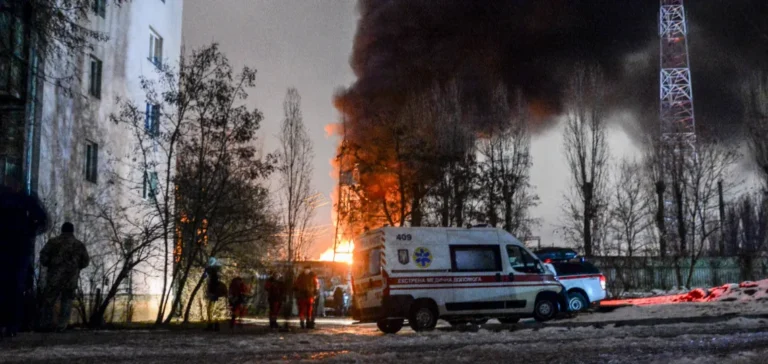
Russia strikes 95 targets and severely damages Ukrainian gas sites

An unprecedented overnight offensive targeted gas infrastructure in Ukraine, damaging several key facilities in the Kharkiv and Poltava regions, according to Ukrainian authorities.

Share:

Comprehensive energy news coverage, updated nonstop

Annual subscription

8.25€/month*

*billed annually at 99€/year for the first year then 149,00€/year ​

Unlimited access • Archives included • Professional invoice

OTHER ACCESS OPTIONS

Monthly subscription

Unlimited access • Archives included

5.2€/month*
then 14.90€ per month thereafter

FREE ACCOUNT

3 articles offered per month

FREE

*Prices are excluding VAT, which may vary depending on your location or professional status

Since 2021: 35,000 articles • 150+ analyses per week

Russia launched a combined attack of 35 missiles and 60 drones against Ukrainian energy infrastructure, in what Naftogaz described as the largest offensive against the gas sector since the war began in 2022. The Ukrainian Air Force reported that 18 missiles and 78 drones reached their targets, while the others were intercepted. The strikes mainly targeted gas extraction facilities.

Critical facilities hit in two strategic regions

The regions of Kharkiv in the northeast and Poltava in the centre of the country were heavily affected. State-owned company Naftogaz confirmed that several sites had sustained significant damage, with some classified as critical. Naftogaz Chief Executive Officer Sergiy Koretsky denounced a deliberate campaign against civilian infrastructure, stating that the goal was to compromise winter energy supply.

Private operator DTEK also reported substantial damage to its facilities, without providing details on the extent of the disruption. At this stage, no estimates have been released regarding the direct impact on national gas production or domestic distribution.

A recurring strategy ahead of winter

Ukrainian Prime Minister Yuliia Svyrydenko accused Moscow of attempting to disrupt the heating season. According to government data, strikes during the previous winter had already halved national gas production. The first targeted strikes against the Ukrainian gas network were observed last winter, following two years of widespread bombardment of electrical infrastructure.

The Russian Ministry of Defence acknowledged carrying out “massive strikes with high-precision weapons” on infrastructure it claimed supported Ukraine’s military-industrial capabilities. Russian authorities did not specify the exact nature of the targets nor release an assessment of the damage inflicted.

Ukrainian retaliation on Russian oil facilities

In response to these strikes, Ukraine has continued attacks on oil infrastructure within Russian territory. A source within the Security Service of Ukraine (SBU) claimed a Ukrainian drone had struck a refinery in the Orenburg region, approximately 1,400 kilometres from the border. Footage shared on social media shows an impact followed by a column of smoke, though the authenticity of the videos has not been confirmed.

The regional Russian governor acknowledged a drone strike on an industrial facility without providing further information. No official data has been released on the potential economic or operational impact on the affected refinery.

International judicial pressure on Russian military leadership

In 2024, the International Criminal Court issued arrest warrants for the former Russian Minister of Defence and the Chief of General Staff for their involvement in the strikes on Ukraine’s energy infrastructure. These attacks are considered war crimes under international humanitarian law. The systematic strikes on gas production sites reflect a shift in Russian military strategy, now targeting primary energy resources ahead of winter.

Falling rig counts and surging natural gas demand are reshaping the Lower 48 energy landscape, fuelling a rebound in gas-focused mergers and acquisitions.
Riley Exploration Permian has finalised the sale of its Dovetail Midstream entity to Targa Northern Delaware for $111 million, with an additional conditional payment of up to $60 million. The deal also includes a future transfer of equipment for $10 million.
Stanwell has secured an exclusive agreement with Quinbrook for the development of the Gladstone SDA Energy Hub, combining gas turbines and long-duration battery storage to support Queensland’s electricity grid stability.
The growth of US liquefied natural gas exports could slow if rising domestic costs continue to squeeze margins, as new volumes hit an already saturated global market.
Turkmenistan is leveraging the Global Gas Centre to build commercial links in Europe and South Asia, as it responds to its current dependence on China and a shifting post-Russian gas market.
The Marmara Ereğlisi liquefied natural gas (LNG) terminal operated by BOTAŞ is increasing its regasification capacity, consolidating Türkiye’s role as a regional player in gas redistribution toward the Balkans and Southeast Europe.
Budapest contests the European agreement to ban Russian natural gas imports by 2027, claiming the measure is incompatible with its economic interests and the European Union's founding treaties.
The European Union has enshrined in law a complete ban on Russian gas by 2027, forcing utilities, operators, traders and states to restructure contracts, physical flows and supply strategies under strict regulatory pressure.
The partial exploitation of associated gas from the Badila field by Perenco supplies electricity to Moundou, highlighting the logistical and financial challenges of gas development in Chad.
A new regulation requires gas companies to declare the origin, volume and duration of their contracts, as the EU prepares to end Russian imports.
Saudi Aramco has launched production at the unconventional Jafurah gas field, initiating an investment plan exceeding $100bn to substitute domestic crude and increase exportable flows under OPEC+ constraints.
By mobilising long-term contracts with BP and new infrastructure, PLN is driving Indonesia’s shift toward prioritising domestic LNG use, at the centre of a state-backed investment programme supported by international lenders.
TotalEnergies, TES and three Japanese companies will develop an industrial-scale e-gas facility in the United States, targeting 250 MW capacity and 75,000 tonnes of annual output by 2030.
Argentinian consortium Southern Energy will supply up to two million tonnes of LNG per year to Germany’s Sefe, marking the first South American alliance for the European importer.
The UK government has ended its financial support for TotalEnergies' liquefied natural gas project in Mozambique, citing increased risks and a lack of national interest in continuing its involvement.
Faced with a climate- and geopolitically-constrained winter, Beijing announces expected record demand for electricity and gas, placing coal, LNG and UHV grids at the centre of a national energy stress test.
The Iraqi government and Kurdish authorities have launched an investigation into the drone attack targeting the Khor Mor gas field, which halted production and caused widespread electricity outages.
PetroChina internalises three major gas storage sites through two joint ventures with PipeChina, representing 11 Gm³ of capacity, in a CNY40.02bn ($5.43bn) deal consolidating control over its domestic gas network.
The European Union is facilitating the use of force majeure to exit Russian gas contracts by 2028, a risky strategy for companies still bound by strict legal clauses.
Amid an expected LNG surplus from 2026, investors are reallocating positions toward the EU carbon market, betting on tighter supply and a bullish price trajectory.

All the latest energy news, all the time

Annual subscription

8.25€/month*

*billed annually at 99€/year for the first year then 149,00€/year ​

Unlimited access - Archives included - Pro invoice

Monthly subscription

Unlimited access • Archives included

5.2€/month*
then 14.90€ per month thereafter

*Prices shown are exclusive of VAT, which may vary according to your location or professional status.

Since 2021: 30,000 articles - +150 analyses/week.