Fortum: Nuclear investments deemed unprofitable at current prices

Fortum, a major energy player in Finland, believes that electricity prices on the Nordic market are not sufficient to make new nuclear projects profitable, despite ambitions in Sweden and Finland.

Share:

Comprehensive energy news coverage, updated nonstop

Annual subscription

8.25$/month*

*billed annually at 99$/year for the first year then 149,00$/year ​

Unlimited access • Archives included • Professional invoice

OTHER ACCESS OPTIONS

Monthly subscription

Unlimited access • Archives included

5.2$/month*
then 14.90$ per month thereafter

FREE ACCOUNT

3 articles offered per month

FREE

*Prices are excluding VAT, which may vary depending on your location or professional status

Since 2021: 35,000 articles • 150+ analyses per week

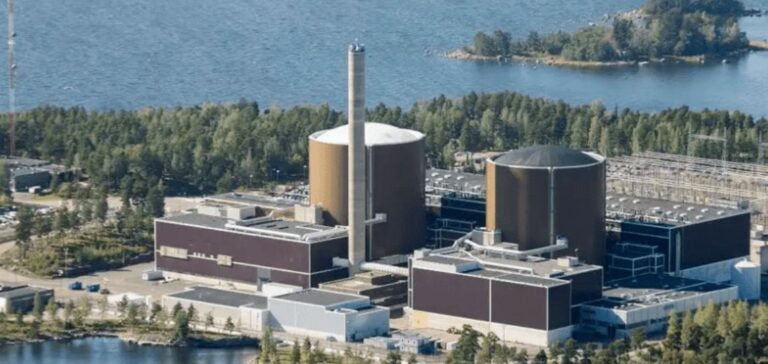
Fortum Oyj, a pillar of Finland’s energy industry, has clearly stated its position on new nuclear investments.
According to Fortum CEO Markus Rauramo, current electricity prices in the Nordic region do not make it economically justifiable to develop new nuclear infrastructure.
The fall in electricity prices from 135.86 euros/MWh in 2022 to an average of 42.01 euros/MWh in 2024 is a key factor in this assessment.
Sweden’s ambitions to build 2,500 MW of new nuclear capacity by 2035 thus appear compromised without stronger economic support.
Sweden has estimated the cost of these new reactors at SEK 400 billion ($38 billion), but Fortum insists that current market conditions are not conducive to such investments.

Optimization strategies and financial adjustments

Despite this unfavorable environment for nuclear power, Fortum continues to adapt its strategy to improve its financial performance.
The company recently announced an operating profit of 233 million euros for the second quarter of 2024, beating forecasts, albeit down on the previous year.
This performance is due in particular to optimized management of its hydro assets and the strategic sale of its solar portfolio in India. At the same time, Fortum is pursuing its plan to reduce fixed costs by 100 million euros by 2025.
The company expects to achieve savings of €50 million by the end of this year.
These adjustments are essential to maintain Fortum’s competitiveness in a market where energy prices are constantly changing.

Impact of the energy transition on the sector

The boom in renewable energies, particularly wind and solar power, has profoundly altered the dynamics of the Nordic energy market. The abundance of this intermittent generation has contributed to falling electricity prices, posing a challenge to the profitability of stable generation projects such as nuclear power.
This situation is forcing players like Fortum to reassess their investment priorities.
Against this backdrop, nuclear projects in Sweden and Finland, while crucial to grid stability, are being held back by economic considerations.
Future decisions will depend heavily on developments in the energy market and government policies aimed at supporting this sector.
The VVER-1200 nuclear reactor at Xudabao 4 in China has completed installation of its final passive water tank, marking the end of modular construction for the second phase of the project.
Ottawa and Edmonton commit to a nuclear production roadmap by 2050, through a memorandum of understanding also covering carbon capture and an Indigenous-led pipeline project.
Niamey asserts control over its uranium resources by authorising open market sales of Somaïr’s production, formerly operated by France’s Orano, amid ongoing legal disputes.
Equinix has signed a strategic agreement with French start-up Stellaria to reserve 500 MWe of advanced nuclear capacity to power its future European AI data centres starting in 2035.
Bishkek plans to host a RITM-200N small modular reactor supplied by Rosatom to address electricity shortages and deepen energy ties with Moscow, despite the risks posed by Western sanctions.
The Niigata prefectural assembly will vote on the restart of Unit 6, potentially marking TEPCO’s first reactor relaunch since the 2011 Fukushima disaster.
The Norwegian government has initiated a consultation with neighbouring countries on its modular nuclear power plant project in Aure and Heim, in accordance with the Espoo Convention.
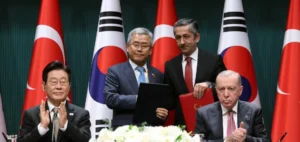
Türkiye and South Korea have signed a memorandum of understanding to jointly explore nuclear power plant projects, marking a strategic step in the long-term development of Türkiye's energy infrastructure.
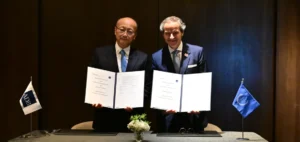
Asian Development Bank has amended its energy policy to enable funding for civil nuclear projects in developing member countries across the Asia-Pacific region.
First Hydrogen begins research with the University of Alberta to identify molten-salt mixtures simulating nuclear fuels for SMR prototypes.
Framatome has completed the manufacturing of the first nuclear fuel assemblies for the Barakah power plant, marking a key milestone in the supply agreement signed with Emirates Nuclear Energy Company in July.
A government-commissioned report proposes 47 measures to simplify nuclear regulation, reduce decommissioning costs and accelerate delivery of civilian and military projects.
The Hualong One reactor at Zhangzhou nuclear power plant has been connected to the grid, marking a major milestone in the expansion of China’s civilian nuclear programme.
Russian state nuclear group Rosatom has validated the additive manufacturing of parts for its small modular reactors, marking an industrial first for RITM-200 SMR plant equipment.
California-based Maritime Fusion, backed by Y Combinator and Trucks VC, is betting on a decentralised approach to fusion to target maritime and off-grid applications.
Bayridge Resources secures a majority stake in an advanced uranium project in Canada, strengthening its strategic presence in a geologically promising region.
A significant volume of concrete from the dismantling of the Sizewell A nuclear power plant is being transferred to support the foundations of the Sizewell C project, under a partnership between UK nuclear sector stakeholders.
Korean group KEPCO and UAE-based ENEC have signed two memorandums of understanding to expand their cooperation in civil nuclear energy, artificial intelligence, and digital technologies targeting new international markets.
The Janus programme will deploy micro nuclear power plants across nine military bases to reinforce energy autonomy for critical U.S. Army installations.
The Idaho National Laboratory has started irradiation testing on uranium-zirconium fuel samples from Lightbridge in its experimental reactor, marking a key step toward the industrial validation of advanced nuclear fuel.

All the latest energy news, all the time

Annual subscription

8.25$/month*

*billed annually at 99$/year for the first year then 149,00$/year ​

Unlimited access - Archives included - Pro invoice

Monthly subscription

Unlimited access • Archives included

5.2$/month*
then 14.90$ per month thereafter

*Prices shown are exclusive of VAT, which may vary according to your location or professional status.

Since 2021: 30,000 articles - +150 analyses/week.