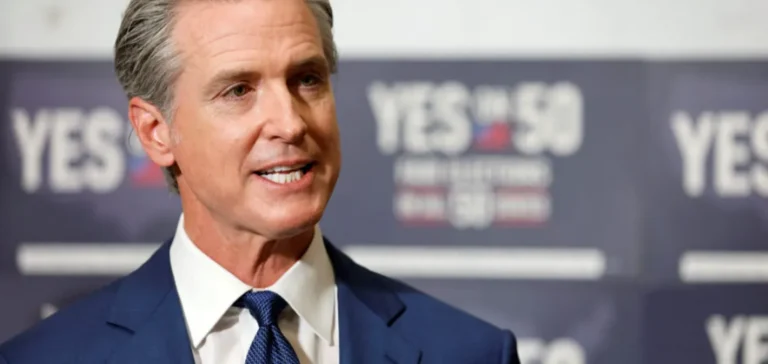
Gavin Newsom seeks to reposition California as an autonomous player amid US withdrawal

Governor Gavin Newsom attended the COP30 summit in Belém to present California as a strategic partner, distancing himself from federal policy and leveraging the state's economic weight.

Share:

Comprehensive energy news coverage, updated nonstop

Annual subscription

8.25$/month*

*billed annually at 99$/year for the first year then 149,00$/year ​

Unlimited access • Archives included • Professional invoice

OTHER ACCESS OPTIONS

Monthly subscription

Unlimited access • Archives included

5.2$/month*
then 14.90$ per month thereafter

FREE ACCOUNT

3 articles offered per month

FREE

*Prices are excluding VAT, which may vary depending on your location or professional status

Since 2021: 35,000 articles • 150+ analyses per week

California Governor Gavin Newsom used his appearance at the United Nations Climate Change Conference (COP30) in Belém, Brazil, to declare that his state remains a reliable partner for public and private stakeholders, despite the federal government’s withdrawal from multilateral discussions.

Speaking at an investor forum in São Paulo, Newsom explained that his presence was motivated by what he described as a “leadership vacuum” in Washington, stating that the lack of national engagement compels states like California to strengthen their own international influence channels. He reminded the audience that California’s economy ranks fourth globally, providing significant leverage in shaping energy policy.

California’s economic weight in contrast to federal isolation

Newsom’s trip is part of a broader subnational strategy, including meetings with several governors and international delegations. He held talks with the governor of Brazil’s Pará state, where the summit is hosted. The goal is to reinforce bilateral cooperation on technology and energy, independently from US federal frameworks.

The governor emphasised that California employs seven times more workers in renewable technologies than in fossil fuels. He also highlighted the state’s role in the development of electric vehicle manufacturer Tesla, noting that the company was founded in California, which continues to lead in green supply chain industries.

Competition with China and criticism of federal direction

During his remarks, Gavin Newsom also warned investors of the United States’ declining competitiveness in the face of China’s dominance. He cited China’s control over electric vehicle supply chains, batteries and industrial software as evidence of a strategic gap. According to him, manufacturers such as General Motors are slowing their investment in electric vehicles, weakening their market position.

Newsom criticised former President Donald Trump’s energy policies, asserting that they are turning the US into a “petro state” aligned with a state-led capitalism model similar to China’s. He denounced America’s protectionist tariff approach as counterproductive for industrial investment and collaboration.

A potential national bid?

The South American tour comes as Newsom is increasingly seen as a potential candidate for the 2028 US presidential election. His communication style is shifting, adopting some of the direct and provocative language popularised by Donald Trump, while aiming to project himself as a strategic opponent on energy and economic matters.

While the federal administration chose not to participate in COP30, several diplomats expressed concern that the US could attempt to slow the negotiations from a distance. Newsom, in contrast, is seeking to present an alternative vision, relying on state-level autonomy in a context of growing fragmentation in US energy governance.

The gradual exit from CfD contracts is turning stable assets into infrastructures exposed to higher volatility, challenging expected returns and traditional financing models for the renewable sector.
The Canadian government introduces major legislative changes to the Energy Efficiency Act to support its national strategy and adapt to the realities of digital commerce.
Quebec becomes the only Canadian province where a carbon price still applies directly to fuels, as Ottawa eliminated the public-facing carbon tax in April 2025.
New Delhi launches a 72.8 bn INR incentive plan to build a 6,000-tonne domestic capacity for permanent magnets, amid rising Chinese export restrictions on critical components.
The rise of CfDs, PPAs and capacity mechanisms signals a structural shift: markets alone no longer cover 10–30-year financing needs, while spot prices have surged 400% in Europe since 2019.
Germany plans to finalise the €5.8bn ($6.34bn) purchase of a 25.1% stake in TenneT Germany to strengthen its control over critical national power grid infrastructure.
The Ghanaian government is implementing a reform of its energy system focused on increasing the use of local natural gas, aiming to reduce electricity production costs and limit the sector's financial imbalance.
On the 50th anniversary of its independence, Suriname announced a national roadmap including major public investment to develop its offshore oil reserves.
China's power generation capacity recorded strong growth in October, driven by continued expansion of solar and wind, according to official data from the National Energy Administration.
The 2026–2031 offshore programme proposes opening over one billion acres to oil exploration, triggering a regulatory clash between Washington, coastal states and legal advocacy groups.
The government of Mozambique is consolidating its gas transport and regasification assets under a public vehicle, anchoring the strategic Beira–Rompco corridor to support Rovuma projects and respond to South Africa’s gas dependency.
The British system operator NESO initiates a consultation process to define the methodology of eleven upcoming regional strategic plans aimed at coordinating energy needs across England, Scotland and Wales.
The Belém summit ends with a technical compromise prioritising forest investment and adaptation, while avoiding fossil fuel discussions and opening a climate–trade dialogue likely to trigger new regulatory disputes.
The Asian Development Bank and the Kyrgyz Republic have signed a financing agreement to strengthen energy infrastructure, climate resilience and regional connectivity, with over $700mn committed through 2027.
A study from the Oxford Institute for Energy Studies finds that energy-from-waste with carbon capture delivers nearly twice the climate benefit of converting waste into aviation fuel.
Signed for 25 years, the new concession contract between Sipperec, EDF and Enedis covers 87 municipalities in the Île-de-France region and commits the parties to managing and developing the public electricity distribution network until 2051.
The French Energy Regulatory Commission publishes its 2023–2024 report, detailing the crisis impact on gas and electricity markets and the measures deployed to support competition and rebuild consumer trust.
Gathered in Belém, states from Africa, Asia, Latin America and Europe support the adoption of a timeline for the gradual withdrawal from fossil fuels, despite expected resistance from several producer countries.
The E3 and the United States submit a resolution to the IAEA to formalise Iran's non-cooperation following the June strikes, consolidating the legal basis for tougher energy and financial sanctions.
The United Kingdom launches a taskforce led by the Energy Minister to strengthen the security of the national power grid after a full shutdown at Heathrow Airport caused by a substation fire.

All the latest energy news, all the time

Annual subscription

8.25$/month*

*billed annually at 99$/year for the first year then 149,00$/year ​

Unlimited access - Archives included - Pro invoice

Monthly subscription

Unlimited access • Archives included

5.2$/month*
then 14.90$ per month thereafter

*Prices shown are exclusive of VAT, which may vary according to your location or professional status.

Since 2021: 30,000 articles - +150 analyses/week.