The Water Plan: scarcity of the resource

The figures published by the Service des données et études statistiques (SDES) of the Ministry of Ecological Transition on the water consumption of French nuclear power plants have been reassessed downwards.

Share:

Comprehensive energy news coverage, updated nonstop

Annual subscription

8.25$/month*

*billed annually at 99$/year for the first year then 149,00$/year ​

Unlimited access • Archives included • Professional invoice

OTHER ACCESS OPTIONS

Monthly subscription

Unlimited access • Archives included

5.2$/month*
then 14.90$ per month thereafter

FREE ACCOUNT

3 articles offered per month

FREE

*Prices are excluding VAT, which may vary depending on your location or professional status

Since 2021: 35,000 articles • 150+ analyses per week

This Thursday, the French executive presented its water plan in order to face the rarefaction of the resource.

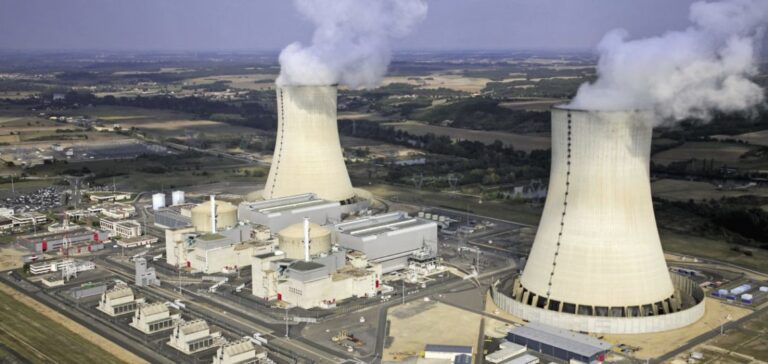
French nuclear power plants consume three times less fresh water than initially estimated by the statisticians of the Ministry of Ecological Transition, according to their new figures published Wednesday on the eve of the presentation of the Water Plan. The consumption of water, to cool the reactors, is now estimated at about 0.5 billion cubic meters per year against some 1.7 billion in the previous assessment, reducing the share of nuclear power from 31% to 12% of total French consumption, according to figures published by the Service des données et études statistiques (SDES) of the Ministry of Ecological Transition.

In metropolitan France, the total volume of water consumed – which corresponds to the share of water withdrawn but not returned to the aquatic environment – is estimated at 4.1 billion m3 on average for the years 2010-2019, according to the SDES. “Agriculture is the first water-consuming activity with 58% of the total, ahead of drinking water (26%), the cooling of power plants (12%), and industrial uses (4%),” says the new assessment, unchanged in volume for the other sectors.

“We have had the opportunity in recent weeks to work more finely with energy companies to come and specify the reality of withdrawals and consumption of the park in a context where significant efforts have been made to contribute to the sobriety of water use,” justified a representative of the ministry during a presentation of the trip of President Emmanuel Macron Thursday to present the “Water Plan”.

The document of the administration put online Wednesday evening explicitly cites the contribution to this new calculation of EDF, which has provided the ministry with its figures since 2010. However, this reassessment is taking place in a context of increasing water scarcity due to global warming and the revival of nuclear power in France. In terms of gross withdrawals, the cooling of power plants consumes some 15.3 billion m3, i.e. almost half of the total annual withdrawals in France. All of these volumes are considered to be returned to the rivers for some plants. Only those with cooling towers, which spew out the emblematic plumes of steam, see a portion of the water fly away (about 22% according to the ministry).

“At the beginning of the year, we questioned the rather fragile assumptions” on which the previous estimates were based, explained to AFP Béatrice Sédillot, head of the SDES. General percentages had been applied to the colossal volumes withdrawn by all the power plants from the riverbanks in order to estimate the part consumed and not returned.


Several scenarios are under review to regain control of CEZ, a key electricity provider in Czechia, through a transaction estimated at over CZK200bn ($9.6bn), according to the Minister of Industry.
The government has postponed the release of the new Multiannual Energy Programme to early 2026, delayed by political tensions over the balance between nuclear and renewables.
Indonesia plans $31bn in investments by 2030 to decarbonise captive power, but remains constrained by coal dependence and uncertainty over international financing.
A drone attack on the Al-Muqrin station paralysed part of Sudan's electricity network, affecting several states and killing two rescuers during a second strike on the burning site.
The Bolivian government eliminates subsidies on petrol and diesel, ending a system in place for twenty years amid budgetary pressure and dwindling foreign currency reserves.
Poland’s financial watchdog has launched legal proceedings over suspicious transactions involving Energa shares, carried out just before Orlen revealed plans to acquire full ownership.
The Paris Council awards a €15bn, 25-year contract to Dalkia, a subsidiary of EDF, to operate the capital’s heating network, replacing long-time operator Engie amid political tensions ahead of municipal elections.
Norway’s energy regulator plans a rule change mandating grid operators to prepare for simultaneous sabotage scenarios, with an annual cost increase estimated between NOK100 and NOK300 per household.
The State of São Paulo has requested the termination of Enel Distribuição São Paulo’s concession, escalating tensions between local authorities and the federal regulator amid major political and energy concerns three years before the contractual expiry.
Mauritania secures Saudi financing to build a key section of the “Hope Line” as part of its national plan to expand electricity transmission infrastructure inland.
RESourceEU introduces direct European Union intervention on critical raw materials via stockpiling, joint purchasing and export restrictions to reduce external dependency and secure strategic industrial chains.
The third National Low-Carbon Strategy enters its final consultation phase before its 2026 adoption, defining France’s emissions reduction trajectory through 2050 with sector-specific and industrial targets.
Germany will allow a minimum 1.4% increase in grid operator revenues from 2029, while tightening efficiency requirements in a compromise designed to unlock investment without significantly increasing consumer tariffs.
Facing a structural electricity surplus, the government commits to releasing a new Multiannual Energy Programme by Christmas, as aligning supply, demand and investments becomes a key industrial and budgetary issue.
A key scientific report by the United Nations Environment Programme failed to gain state approval due to deep divisions over fossil fuels and other sensitive issues.
RTE warns of France’s delay in electrifying energy uses, a key step to limiting fossil fuel imports and supporting its reindustrialisation strategy.
India’s central authority has cancelled 6.3 GW of grid connections for renewable projects since 2022, marking a tightening of regulations and a shift in responsibility back to developers.
The Brazilian government has been instructed to define within two months a plan for the gradual reduction of fossil fuels, supported by a national energy transition fund financed by oil revenues.
The German government may miss the January 2026 deadline to transpose the RED III directive, creating uncertainty over biofuel mandates and disrupting markets.
Italy allocated 82% of the proposed solar and wind capacities in the Fer-X auction, totalling 8.6GW, with competitive purchase prices and a strong concentration of projects in the southern part of the country.

All the latest energy news, all the time

Annual subscription

8.25$/month*

*billed annually at 99$/year for the first year then 149,00$/year ​

Unlimited access - Archives included - Pro invoice

Monthly subscription

Unlimited access • Archives included

5.2$/month*
then 14.90$ per month thereafter

*Prices shown are exclusive of VAT, which may vary according to your location or professional status.

Since 2021: 30,000 articles - +150 analyses/week.