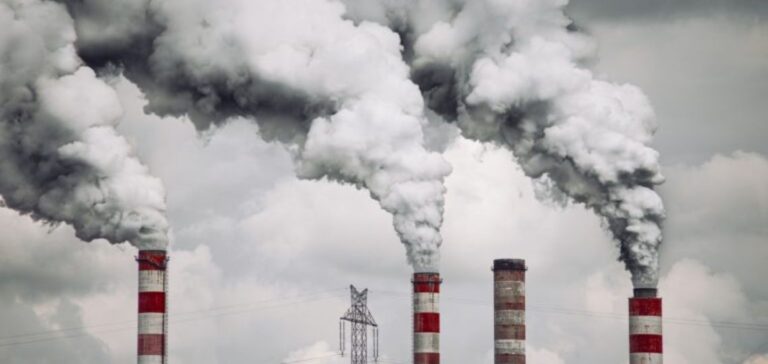
Carbon emissions peak in 2019

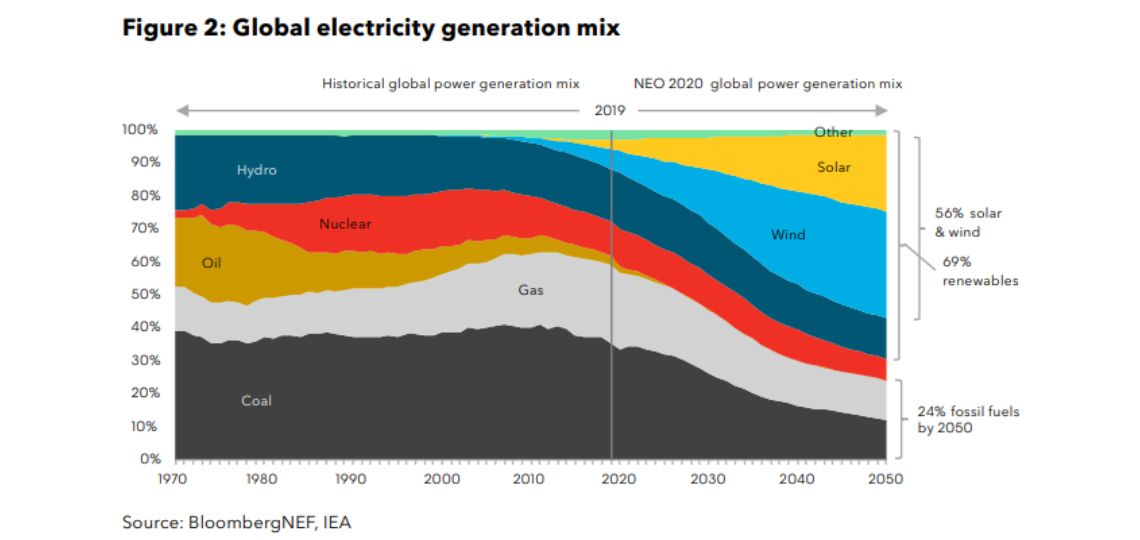
Global carbon emissions in the energy sector are set to fall by 10% by 2020. By 2050, wind and solar power are expected to provide 56% of the world's electricity, but an annual 10% reduction in carbon emissions will be needed to meet the Paris Agreement target of limiting global warming to 1.5 degrees Celsius.

Share:

Comprehensive energy news coverage, updated nonstop

Annual subscription

8.25$/month*

*billed annually at 99$/year for the first year then 149,00$/year ​

Unlimited access • Archives included • Professional invoice

OTHER ACCESS OPTIONS

Monthly subscription

Unlimited access • Archives included

5.2$/month*
then 14.90$ per month thereafter

FREE ACCOUNT

3 articles offered per month

FREE

*Prices are excluding VAT, which may vary depending on your location or professional status

Since 2021: 35,000 articles • 150+ analyses per week

According to BloombergNEF, global carbon emissions from the energy sector should fall by 10% by 2020. Wind and solar power will provide 56% of the world’s electricity by 2050.

Carbon emissions to decline year-on-year after 2027

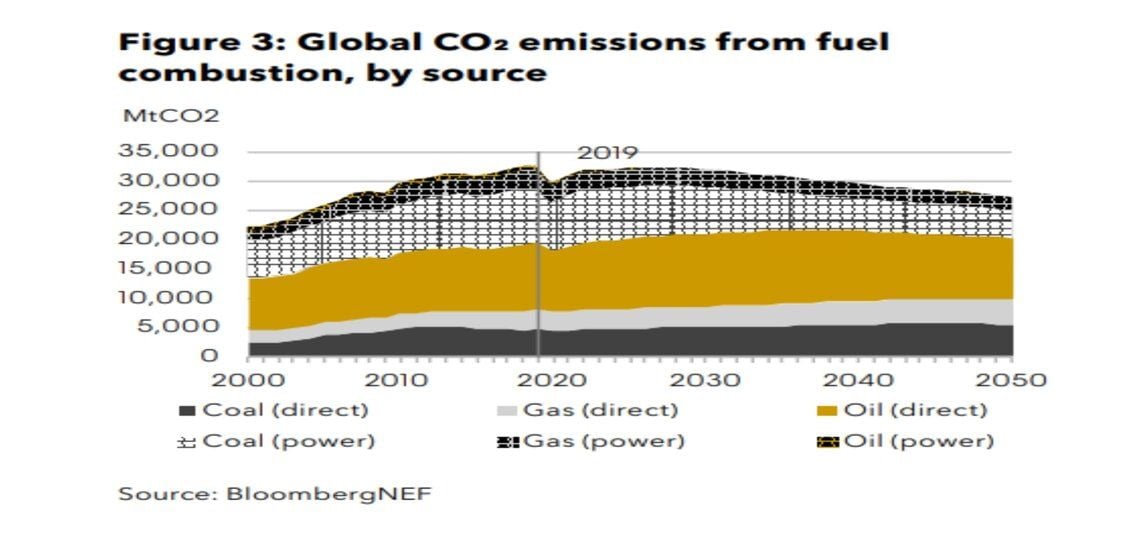
According to projections by BloombergNEF (BNEF), the global drop in energy demand caused by the coronavirus will reduce sector-wide emissions by 10% this year and eliminate 2.5 years of global emissions by 2050.

Earlier this year, the International Energy Agency (IEA) revealed that global carbon emissions stabilized in 2019. This announcement follows two consecutive years of growth, to around 33 gigatons.
Carbon emissions

While economic recovery from the pandemic will see energy-related emissions rise by 2027, they will not return to the level reached in 2019. And from 2027 onwards, there will be an annual drop of 0.7% until mid-century.

However, this won’t even come close to the 1.5 degree Celsius limit for global warming. This was the objective of the Paris Agreement on climate change. BNEF’s research estimates that the rate of reduction in carbon emissions from the energy sector needed to meet this target is 10% each year between now and 2050.

Wind and solar power are key to reducing carbon emissions from the energy sector
 

electricity mix

Increasingly competitive wind and solar power will stimulate the ongoing decarbonization of energy consumption. The accelerated adoption of electric vehicles and advances in energy efficiency across all industries will also be important.

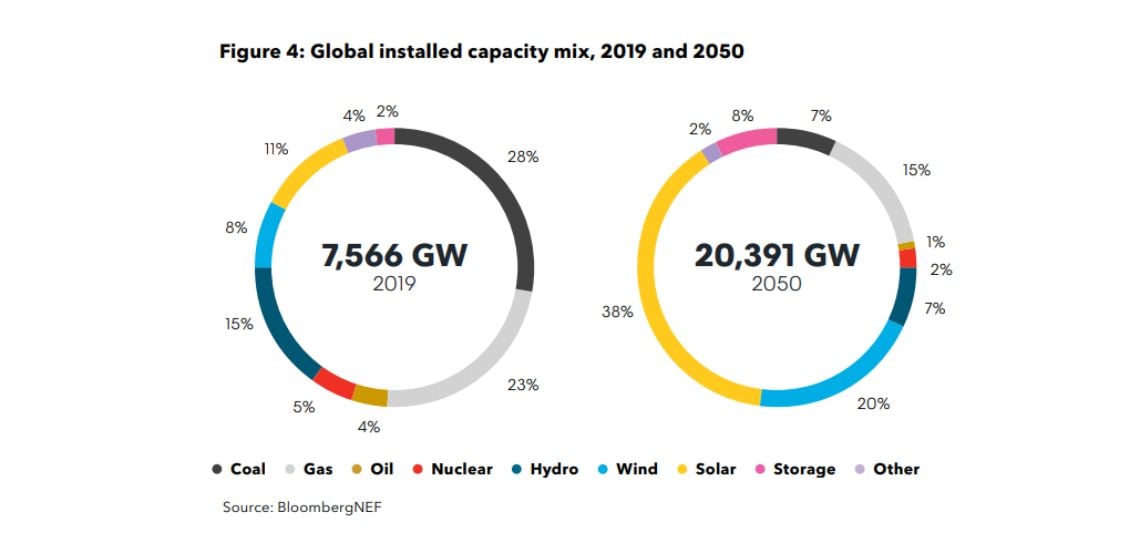
It is estimated that 13 billion euros will be invested in new capacity over the next three decades. Wind power, solar power and batteries are expected to account for 80%. Just under half of all new capital will be injected in the Asia-Pacific region.
 

energy mix

Fueled by this investment, wind and solar power should account for 58% of the world’s electricity production by 2050. According to current estimates, these energy sources currently account for 10% of the global electricity market.

A further 11 billion euros will have to be invested in modernizing and expanding electricity networks. This is to take account of the growing electrification of energy systems and the ensuing changes in supply and demand.


“The next ten years will be crucial for the energy transition,” said Jon Moore, CEO of BNEF. “There are three key elements we will need to see: accelerated deployment of wind power and photovoltaics; faster adoption of electric vehicles, small-scale renewables and low-carbon heating technologies such as heat pumps; and large-scale development and deployment.”

The outlook for fossil fuels

Natural gas will be the only fossil fuel not to experience a peak in demand before 2050. It is expected to grow at an annual rate of 0.5% over the period. Buildings and industry will account for 33% and 23% of its growth respectively, as sectors where there are “few low-carbon economic substitutes”.

BNEF’s New Energy Outlook 2020 predicts that coal-fired power generation in China will peak in 2027. China is by far the world’s biggest coal consumer. However, the country is committed to achieving net zero emissions by 2060.

In India, where coal is still an important part of the national energy mix, fossil fuel-fired power generation is set to reach its peak in 2030.

Overall, coal is expected to account for 12% of the world’s electricity supply by 2050, compared with around 33% today.

BNEF’s analysis suggests that oil demand will peak in 2035. This is later than some forecasts, including those of BP and the IEA.
Oil demand


Scaling up green hydrogen to reduce carbon emissions

Hydrogen fuel – particularly “green” hydrogen – has been widely tipped to emerge as a low-carbon alternative energy carrier. But for it to have a significant impact, there are several cost and scale challenges to overcome.

Under BNEF’s “climate scenario” – which forecasts ways to keep global warming well below two degrees Celsius by 2050 – around 100,000 terawatt-hours (TWh) of global electricity generation will be needed by 2050 to meet growing demand.

“This power grid is six to eight times larger than today’s. It has twice the peak demand and produces five times as much electricity,” according to the report. “Two-thirds of this electricity is used for the direct supply of electricity in transport, industry, etc. The rest is used to manufacture green hydrogen.
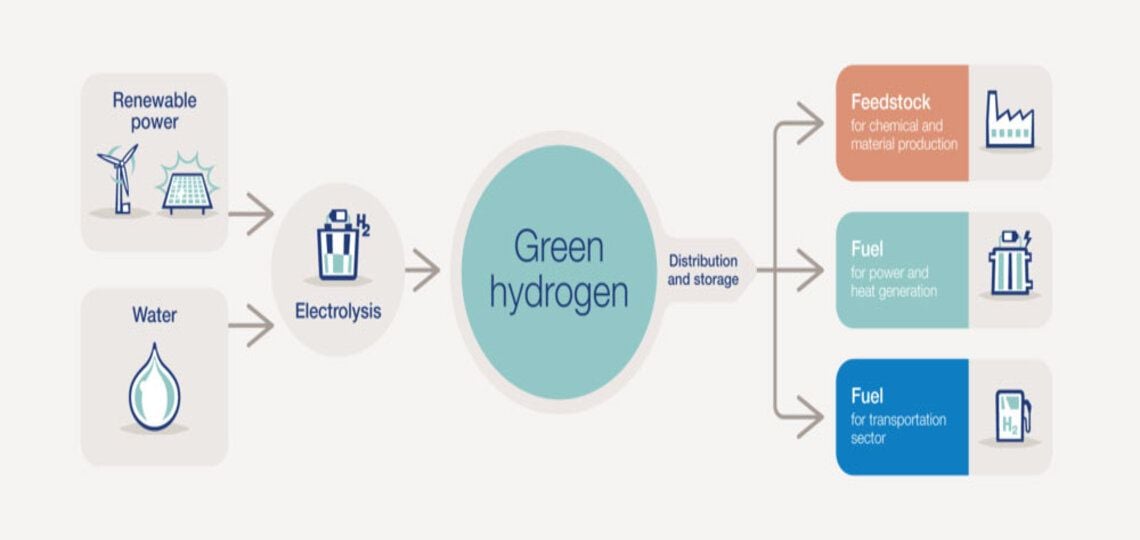
Green hydrogen
Green hydrogen value chain (source: Alfa Laval)


In the scenario, green hydrogen supplies just under a quarter of final energy consumption by mid-century.

This would require 800 million tonnes of fuel and 36,000 TWh of electricity. In other words 38% more than is produced in the world today. What’s more, this will require up to $130 billion in new investment over the next 30 years.

This would represent around 60 billion euros spent on electricity generation and the electricity grid for direct electricity supply. But also between 11 and 63 billion euros devoted to the manufacture, transport and storage of hydrogen.

The government has postponed the release of the new Multiannual Energy Programme to early 2026, delayed by political tensions over the balance between nuclear and renewables.
Indonesia plans $31bn in investments by 2030 to decarbonise captive power, but remains constrained by coal dependence and uncertainty over international financing.
A drone attack on the Al-Muqrin station paralysed part of Sudan's electricity network, affecting several states and killing two rescuers during a second strike on the burning site.
The Bolivian government eliminates subsidies on petrol and diesel, ending a system in place for twenty years amid budgetary pressure and dwindling foreign currency reserves.
Poland’s financial watchdog has launched legal proceedings over suspicious transactions involving Energa shares, carried out just before Orlen revealed plans to acquire full ownership.
The Paris Council awards a €15bn, 25-year contract to Dalkia, a subsidiary of EDF, to operate the capital’s heating network, replacing long-time operator Engie amid political tensions ahead of municipal elections.
Norway’s energy regulator plans a rule change mandating grid operators to prepare for simultaneous sabotage scenarios, with an annual cost increase estimated between NOK100 and NOK300 per household.
The State of São Paulo has requested the termination of Enel Distribuição São Paulo’s concession, escalating tensions between local authorities and the federal regulator amid major political and energy concerns three years before the contractual expiry.
Mauritania secures Saudi financing to build a key section of the “Hope Line” as part of its national plan to expand electricity transmission infrastructure inland.
RESourceEU introduces direct European Union intervention on critical raw materials via stockpiling, joint purchasing and export restrictions to reduce external dependency and secure strategic industrial chains.
The third National Low-Carbon Strategy enters its final consultation phase before its 2026 adoption, defining France’s emissions reduction trajectory through 2050 with sector-specific and industrial targets.
Germany will allow a minimum 1.4% increase in grid operator revenues from 2029, while tightening efficiency requirements in a compromise designed to unlock investment without significantly increasing consumer tariffs.
Facing a structural electricity surplus, the government commits to releasing a new Multiannual Energy Programme by Christmas, as aligning supply, demand and investments becomes a key industrial and budgetary issue.
A key scientific report by the United Nations Environment Programme failed to gain state approval due to deep divisions over fossil fuels and other sensitive issues.
RTE warns of France’s delay in electrifying energy uses, a key step to limiting fossil fuel imports and supporting its reindustrialisation strategy.
India’s central authority has cancelled 6.3 GW of grid connections for renewable projects since 2022, marking a tightening of regulations and a shift in responsibility back to developers.
The Brazilian government has been instructed to define within two months a plan for the gradual reduction of fossil fuels, supported by a national energy transition fund financed by oil revenues.
The German government may miss the January 2026 deadline to transpose the RED III directive, creating uncertainty over biofuel mandates and disrupting markets.
Italy allocated 82% of the proposed solar and wind capacities in the Fer-X auction, totalling 8.6GW, with competitive purchase prices and a strong concentration of projects in the southern part of the country.
Amid rising public spending, the French government has tasked two experts with reassessing the support scheme for renewable electricity and storage, with proposals expected within three months.

All the latest energy news, all the time

Annual subscription

8.25$/month*

*billed annually at 99$/year for the first year then 149,00$/year ​

Unlimited access - Archives included - Pro invoice

Monthly subscription

Unlimited access • Archives included

5.2$/month*
then 14.90$ per month thereafter

*Prices shown are exclusive of VAT, which may vary according to your location or professional status.

Since 2021: 30,000 articles - +150 analyses/week.