Tariffs threaten US energy and digital strategy

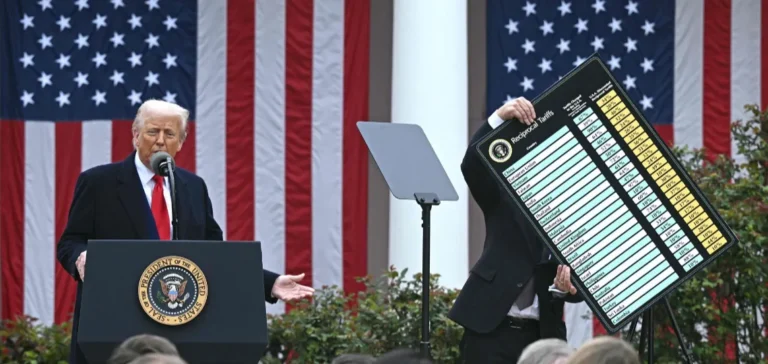
Liberty Energy warns about the impact of import duties on drilling and power equipment, pointing to a potential obstacle to federal goals related to artificial intelligence and energy independence.

Share:

Comprehensive energy news coverage, updated nonstop

Annual subscription

8.25$/month*

*billed annually at 99$/year for the first year then 149,00$/year ​

Unlimited access • Archives included • Professional invoice

OTHER ACCESS OPTIONS

Monthly subscription

Unlimited access • Archives included

5.2$/month*
then 14.90$ per month thereafter

FREE ACCOUNT

3 articles offered per month

FREE

*Prices are excluding VAT, which may vary depending on your location or professional status

Since 2021: 35,000 articles • 150+ analyses per week

US-based Liberty Energy, a company specialised in oilfield services and decentralised power generation, reported mounting pressure on its operations due to the current trade policy. During its third-quarter earnings presentation, the company highlighted that import tariffs on industrial materials are undermining the deployment of strategic energy infrastructure.

Tariff increases misaligned with federal priorities

Liberty Energy President and Chief Executive Officer Ron Gusek stated that taxes on imported components are restricting access to the equipment required for power generation installations and drilling operations. He referred to the government’s ambitions in artificial intelligence, which depend on expanded energy capacity, particularly for data centres.

“Many of these components are made abroad and are now subject to tariffs,” Gusek said, citing Liberty Energy’s former executive Chris Wright, now leading the United States Department of Energy. He questioned the coherence between the administration’s strategic objectives and its trade restrictions on industrial imports.

Weakened oilfield activity

Oilfield activity remains below 2024 levels despite a modest recovery in the second half of the year. As of early October, 589 drilling rigs were active, a decline of 9% year-on-year. The number of hydraulic fracturing crews dropped by over 25% during the same period.

Operators across the oil sector are showing caution in the face of volatile pricing and an uncertain regulatory environment. According to Liberty Energy, oil market trends have more than offset the rise in natural gas-related activity, which continues to benefit from expanding liquefied natural gas exports and increasing electricity demand.

Investment shift toward power production

In response to these constraints, Liberty Energy is accelerating its Power Innovations business, which focuses on gas-powered on-site generation projects for industrial, commercial and high-performance computing infrastructure.

The company expects to reach 500 megawatts of installed capacity by the end of 2026, with a cumulative target of 1 gigawatt by the end of 2027. Gusek noted that the share of capacity serving data centre customers now exceeds initial projections made when the programme was launched in 2023.


Several scenarios are under review to regain control of CEZ, a key electricity provider in Czechia, through a transaction estimated at over CZK200bn ($9.6bn), according to the Minister of Industry.
The government has postponed the release of the new Multiannual Energy Programme to early 2026, delayed by political tensions over the balance between nuclear and renewables.
Indonesia plans $31bn in investments by 2030 to decarbonise captive power, but remains constrained by coal dependence and uncertainty over international financing.
A drone attack on the Al-Muqrin station paralysed part of Sudan's electricity network, affecting several states and killing two rescuers during a second strike on the burning site.
The Bolivian government eliminates subsidies on petrol and diesel, ending a system in place for twenty years amid budgetary pressure and dwindling foreign currency reserves.
Poland’s financial watchdog has launched legal proceedings over suspicious transactions involving Energa shares, carried out just before Orlen revealed plans to acquire full ownership.
The Paris Council awards a €15bn, 25-year contract to Dalkia, a subsidiary of EDF, to operate the capital’s heating network, replacing long-time operator Engie amid political tensions ahead of municipal elections.
Norway’s energy regulator plans a rule change mandating grid operators to prepare for simultaneous sabotage scenarios, with an annual cost increase estimated between NOK100 and NOK300 per household.
The State of São Paulo has requested the termination of Enel Distribuição São Paulo’s concession, escalating tensions between local authorities and the federal regulator amid major political and energy concerns three years before the contractual expiry.
Mauritania secures Saudi financing to build a key section of the “Hope Line” as part of its national plan to expand electricity transmission infrastructure inland.
RESourceEU introduces direct European Union intervention on critical raw materials via stockpiling, joint purchasing and export restrictions to reduce external dependency and secure strategic industrial chains.
The third National Low-Carbon Strategy enters its final consultation phase before its 2026 adoption, defining France’s emissions reduction trajectory through 2050 with sector-specific and industrial targets.
Germany will allow a minimum 1.4% increase in grid operator revenues from 2029, while tightening efficiency requirements in a compromise designed to unlock investment without significantly increasing consumer tariffs.
Facing a structural electricity surplus, the government commits to releasing a new Multiannual Energy Programme by Christmas, as aligning supply, demand and investments becomes a key industrial and budgetary issue.
A key scientific report by the United Nations Environment Programme failed to gain state approval due to deep divisions over fossil fuels and other sensitive issues.
RTE warns of France’s delay in electrifying energy uses, a key step to limiting fossil fuel imports and supporting its reindustrialisation strategy.
India’s central authority has cancelled 6.3 GW of grid connections for renewable projects since 2022, marking a tightening of regulations and a shift in responsibility back to developers.
The Brazilian government has been instructed to define within two months a plan for the gradual reduction of fossil fuels, supported by a national energy transition fund financed by oil revenues.
The German government may miss the January 2026 deadline to transpose the RED III directive, creating uncertainty over biofuel mandates and disrupting markets.
Italy allocated 82% of the proposed solar and wind capacities in the Fer-X auction, totalling 8.6GW, with competitive purchase prices and a strong concentration of projects in the southern part of the country.

All the latest energy news, all the time

Annual subscription

8.25$/month*

*billed annually at 99$/year for the first year then 149,00$/year ​

Unlimited access - Archives included - Pro invoice

Monthly subscription

Unlimited access • Archives included

5.2$/month*
then 14.90$ per month thereafter

*Prices shown are exclusive of VAT, which may vary according to your location or professional status.

Since 2021: 30,000 articles - +150 analyses/week.