Kaycee uranium project: Drilling reveals large mineralized extension

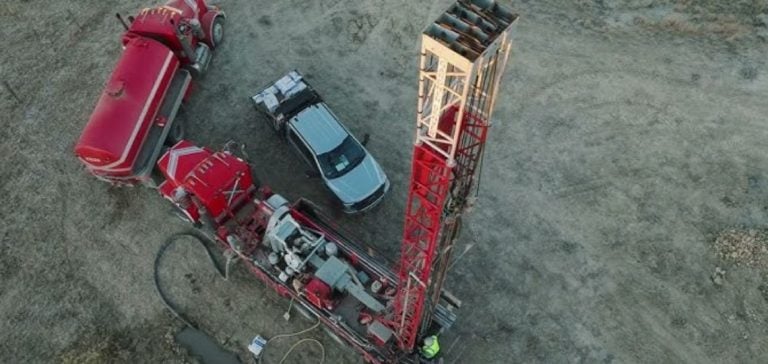
Kaycee project in Wyoming reveals promising uranium mineralization. Drilling by Nuclear Fuels Inc. s drilling marks a significant advance, with results indicating a possible connection between the Spur and Saddle zones.

Share:

Comprehensive energy news coverage, updated nonstop

Annual subscription

8.25$/month*

*billed annually at 99$/year for the first year then 149,00$/year ​

Unlimited access • Archives included • Professional invoice

OTHER ACCESS OPTIONS

Monthly subscription

Unlimited access • Archives included

5.2$/month*
then 14.90$ per month thereafter

FREE ACCOUNT

3 articles offered per month

FREE

*Prices are excluding VAT, which may vary depending on your location or professional status

Since 2021: 35,000 articles • 150+ analyses per week

The Kaycee uranium project in Wyoming’s Powder River Basin (PRB) continues to attract attention with promising drilling results.
Nuclear Fuels Inc.
recently announced an extension of mineralization in the Spur Zone, reinforcing the region’s potential for uranium mining via in situ recovery (ISR) technology. The latest results show that mineralization extends over more than 300 meters, with grades reaching 0.117% eU3O8 over a thickness of 1.5 meters, and a grade-thickness (GT) product of 0.585.
Results like these are crucial for assessing the economic viability of a large-scale ISR operation.
The Spur Zone, located to the north of the Saddle Zone, has revealed drilling with notable uranium enrichment, and the technical team is focusing on analyzing this potential connection between the two zones.
This extension could enable the company to consolidate its resources, while continuing exploration towards historically identified regional targets.

Drilling in the Saddle Zone: solid results

Drilling results in the Saddle Zone are also promising.
The latest intercepts show maximum grades of 0.233% eU3O8 over a thickness of 2.1 metres, with a GT of 1.631.
These results reinforce the hypothesis of ongoing mineralization, with prospects for expansion.
The Saddle Zone represents a strategic interest for the Kaycee project due to its deeper deposits and key geographic location, close to Wyoming’s energy infrastructure.
The next phase of drilling will focus on expanding the Saddle Zone and investigating new regional targets identified in previous campaigns.
The aim is to confirm the continuity of resources along a north-south axis, which could ultimately enable the development of an optimized ISR field, minimizing operating costs while maximizing uranium extraction.

The strategic context of the Kaycee project

The Kaycee project is distinguished by its location in the Powder River Basin, a region historically productive in uranium.
With over 42 square miles of mineral rights, covering a mineralized trend of 36 miles, the project spans three geological formations: Wasatch, Fort Union and Lance.
These formations have historically produced uranium, accessible via ISR technology, which represents a cost-effective and less invasive extraction method than traditional mining.
Wyoming, where the project is located, plays a key role in uranium production in the United States.
It benefits from a favorable regulatory framework, thanks to its status as an Agreement State with the Nuclear Regulatory Commission (NRC), which enables a smoother permitting process.
With historic production of over 250 million pounds of uranium, the region remains a strategic area for uranium mining companies, who are looking to capitalize on increasing global demand for the mineral, particularly to support the decarbonization of energy sectors.

Uranium market outlook

The global uranium market is experiencing growing momentum, driven by demand for low-carbon energy.
Nuclear power remains one of the most effective solutions for reducing greenhouse gas emissions, and projects like Kaycee are attracting particular attention from investors.
SRI strategies developed in regions like Wyoming enable efficient extraction, while limiting the environmental footprint and operating costs.
The outlook for the Kaycee project is promising, with an ongoing drilling program continuing to reveal high-quality mineralized resources.
Geological analyses and drilling results confirm the potential of ISR operations, which could ultimately feed the growing demand from energy industries seeking to integrate low-carbon solutions into their energy mix.

The full-scope simulator for the Lianjiang nuclear project has successfully passed factory acceptance testing, paving the way for its installation at the construction site in China's Guangdong province.
A coalition of Danish industry groups, unions and investors launches a platform in support of modular nuclear power, aiming to develop firm low-carbon capacity to sustain industrial competitiveness.
The United Kingdom and TAE Technologies create a joint venture in Culham to produce neutral beams, a key component of fusion, with strategic backing from Google.
Texas-based developer Natura Resources receives new federal funding to test key components of its 100-megawatt modular reactor in partnership with Oak Ridge National Laboratory.
Reactor Doel 2 was taken offline, becoming the fifth Belgian reactor to cease operations under the country’s gradual nuclear phase-out policy.
Rolls-Royce SMR has expanded its partnership with ÚJV Řež to accelerate the deployment of small modular reactors, targeting the construction of several units in the Czech Republic and abroad.
The Indian government aims to amend legislation to allow private companies to participate in civil nuclear development, a move positioned as critical to achieving the country’s long-term energy targets.
The VVER-1200 nuclear reactor at Xudabao 4 in China has completed installation of its final passive water tank, marking the end of modular construction for the second phase of the project.
Ottawa and Edmonton commit to a nuclear production roadmap by 2050, through a memorandum of understanding also covering carbon capture and an Indigenous-led pipeline project.
Niamey asserts control over its uranium resources by authorising open market sales of Somaïr’s production, formerly operated by France’s Orano, amid ongoing legal disputes.
Equinix has signed a strategic agreement with French start-up Stellaria to reserve 500 MWe of advanced nuclear capacity to power its future European AI data centres starting in 2035.
Bishkek plans to host a RITM-200N small modular reactor supplied by Rosatom to address electricity shortages and deepen energy ties with Moscow, despite the risks posed by Western sanctions.
The Niigata prefectural assembly will vote on the restart of Unit 6, potentially marking TEPCO’s first reactor relaunch since the 2011 Fukushima disaster.
The Norwegian government has initiated a consultation with neighbouring countries on its modular nuclear power plant project in Aure and Heim, in accordance with the Espoo Convention.
Türkiye and South Korea have signed a memorandum of understanding to jointly explore nuclear power plant projects, marking a strategic step in the long-term development of Türkiye's energy infrastructure.
Asian Development Bank has amended its energy policy to enable funding for civil nuclear projects in developing member countries across the Asia-Pacific region.
First Hydrogen begins research with the University of Alberta to identify molten-salt mixtures simulating nuclear fuels for SMR prototypes.
Framatome has completed the manufacturing of the first nuclear fuel assemblies for the Barakah power plant, marking a key milestone in the supply agreement signed with Emirates Nuclear Energy Company in July.
A government-commissioned report proposes 47 measures to simplify nuclear regulation, reduce decommissioning costs and accelerate delivery of civilian and military projects.
The Hualong One reactor at Zhangzhou nuclear power plant has been connected to the grid, marking a major milestone in the expansion of China’s civilian nuclear programme.

All the latest energy news, all the time

Annual subscription

8.25$/month*

*billed annually at 99$/year for the first year then 149,00$/year ​

Unlimited access - Archives included - Pro invoice

Monthly subscription

Unlimited access • Archives included

5.2$/month*
then 14.90$ per month thereafter

*Prices shown are exclusive of VAT, which may vary according to your location or professional status.

Since 2021: 30,000 articles - +150 analyses/week.