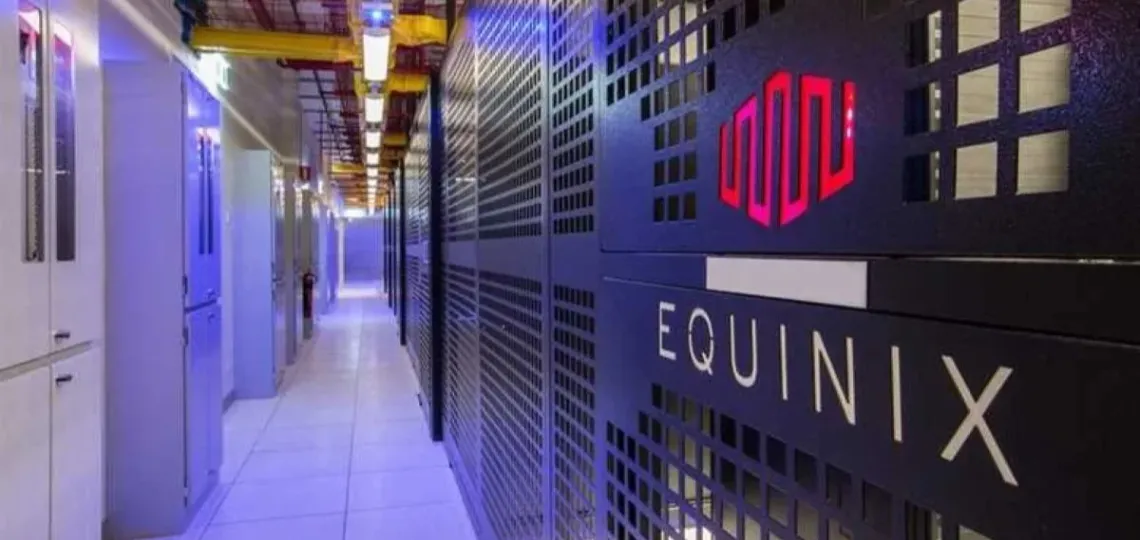
Equinix secures 500 MWe nuclear supply from Stellaria for AI data centres

Equinix has signed a strategic agreement with French start-up Stellaria to reserve 500 MWe of advanced nuclear capacity to power its future European AI data centres starting in 2035.
Share:

Comprehensive energy news coverage, updated nonstop

Annual subscription

8.25$/month*

*billed annually at 99$/year for the first year then 149,00$/year ​

Unlimited access • Archives included • Professional invoice

OTHER ACCESS OPTIONS

Monthly subscription

Unlimited access • Archives included

5.2$/month*
then 14.90$ per month thereafter

FREE ACCOUNT

3 articles offered per month

FREE

*Prices are excluding VAT, which may vary depending on your location or professional status

Since 2021: 35,000 articles • 150+ analyses per week

Equinix, one of the world’s leading data centre operators, has entered into a capacity reservation agreement with Stellaria, a French start-up specialising in molten salt reactors. The contract covers approximately 500 MWe of dedicated electrical capacity, expected to be available by 2035, to power high-intensity computing clusters used in artificial intelligence applications.

A new generation of nuclear energy for digital infrastructure

Stellaria is developing the Stellarium reactor, a fast-spectrum molten salt reactor (AMR – Advanced Modular Reactor), designed to produce around 110 MWe per module. The project is the result of a collaboration between the French Alternative Energies and Atomic Energy Commission (CEA), Schneider Electric, and supported by Technip Energies and Orano, under the France 2030 investment programme. The agreement with Equinix marks Stellaria’s first public commercial engagement with a non-energy client.

The Stellarium reactor is intended to provide low-carbon, dispatchable energy to power-intensive industrial facilities such as data centres, chemical plants, and metallurgical sites. Stellaria promotes a compact, underground design suitable for urban and land-constrained environments.

Equinix: building an internal energy layer

Operating more than 270 data centres globally, Equinix is strengthening its energy independence strategy through multiple partnerships in advanced nuclear. In addition to Stellaria in Europe, the company has signed similar agreements with Oklo, Radiant and ULC-Energy in the United States and the United Kingdom. The objective is to build a portfolio exceeding 1 GW of firm, low-carbon capacity dedicated to its digital infrastructure.

Equinix has stated that renewable energy alone cannot guarantee the continuous availability required for AI workloads, which demand uninterrupted, round-the-clock power. Modular reactors located close to or on-site at critical facilities could address current power grid limitations.

Regulatory framework and industrial risks

The first Stellarium reactor is expected to be commercially operational between 2033 and 2035, subject to approval from the French Nuclear Safety Authority (ASN). The MSR (Molten Salt Reactor) concept is not yet licensed in Europe and will require demonstration phases, material validation and long-term testing to ensure regulatory compliance.

Technical challenges include managing high-temperature corrosion, chemical stability of the salts, and liquid fuel processing. Legally, the responsibilities concerning reactor operation, waste treatment, and fuel ownership must be clearly defined.

Growing integration between digital and energy sectors

The Equinix-Stellaria contract reflects a growing trend of direct contractual arrangements between major digital users and advanced nuclear producers. These agreements bypass traditional wholesale markets, enabling hyperscalers to secure long-term energy supply while addressing increasing regulatory pressure on data centre environmental performance.

Through the France 2030 plan, France aims to position itself as a European hub for the convergence of AI and nuclear innovation. By supporting Stellaria, the government seeks to anchor high-capital, high-tech projects within its borders and strengthen its industrial value chains.

Molten salt reactor developer Natura Resources has acquired Shepherd Power and partnered with NOV to scale up modular reactor manufacturing by the next decade.
China National Nuclear Corporation expects commercial operation in 2026 for its ACP100 reactor, following successful cold testing and completion of critical structures in 2025.
Start-up SEATOM has been selected to join NATO's DIANA programme with its micro nuclear reactor designed for extreme environments, reinforcing its position in dual-use marine and military energy technologies.
The Estonian Ministry of Economic Affairs has opened a tender to select a site and conduct initial environmental studies for a 600 MW nuclear power plant, marking a decisive step for the country’s energy future.
The European Commission has approved Poland's financial support plan for its first nuclear power plant, a €42bn project backed by public funding, state guarantees, and a contract for difference mechanism.
Six European nuclear authorities have completed the second phase of a joint review of the Nuward modular reactor, a key step toward aligning regulatory frameworks for small nuclear reactors across Europe.
Driven by off-grid industrial heat demand and decarbonisation mandates, the global small modular reactor market is set to grow 24% annually through 2030, with installed capacity expected to triple within five years.
US fusion energy leaders have called on the federal government to redirect public funding towards their projects, arguing that large-scale investment is needed to stay competitive with China.
Santee Cooper has approved a memorandum of understanding with Brookfield Asset Management to assess the feasibility of restarting two unfinished nuclear reactors, with a potential $2.7 billion payment and 550 MW capacity stake.
Helical Fusion has signed a landmark agreement with Aoki Super to supply electricity from fusion, marking a first in Japan’s energy sector and a commercial step forward for the helical stellarator technology.
India’s nuclear capacity is expected to grow by more than 13,000 MW by 2032, driven by ongoing heavy water reactor construction, new regional projects and small modular reactor development by the Bhabha Atomic Research Centre.
NextEra Energy has lifted its earnings estimates for 2025 and 2026, supported by power demand linked to long‑term contracts previously signed with Google and Meta to supply their artificial intelligence data centres with low‑carbon electricity.
London launches a complete regulatory overhaul of its nuclear industry to shorten authorisation timelines, expand eligible sites, and lower construction and financing costs.
Finland's Ministry of Economic Affairs extends the deadline to June 2026 for the regulator to complete its review of the operating licence for the Olkiluoto spent nuclear fuel repository.
The conditional green light from the nuclear regulator moves Cigéo into its final regulatory stage, while shifting the risks towards financing, territorial negotiations and industrial execution.
The drone strike confirmed by the IAEA on the Chernobyl site vault exposes Ukraine to a nuclear risk under armed conflict, forcing the EBRD to finance partial restoration while industry standards must now account for drone threats.
Deep Fission is installing a 15 MWe pressurised reactor 1.6 km underground at Great Plains Industrial Park, under the Department of Energy’s accelerated pilot programme, targeting criticality by July 4, 2026.
EDF commits to supply 33 MW of nuclear electricity to Verkor over 12 years, enabling the battery manufacturer to stabilise energy costs ahead of launching its first Gigafactory.
The full-scope simulator for the Lianjiang nuclear project has successfully passed factory acceptance testing, paving the way for its installation at the construction site in China's Guangdong province.
A coalition of Danish industry groups, unions and investors launches a platform in support of modular nuclear power, aiming to develop firm low-carbon capacity to sustain industrial competitiveness.

All the latest energy news, all the time

Annual subscription

8.25$/month*

*billed annually at 99$/year for the first year then 149,00$/year ​

Unlimited access - Archives included - Pro invoice

Monthly subscription

Unlimited access • Archives included

5.2$/month*
then 14.90$ per month thereafter

*Prices shown are exclusive of VAT, which may vary according to your location or professional status.

Since 2021: 30,000 articles - +150 analyses/week.