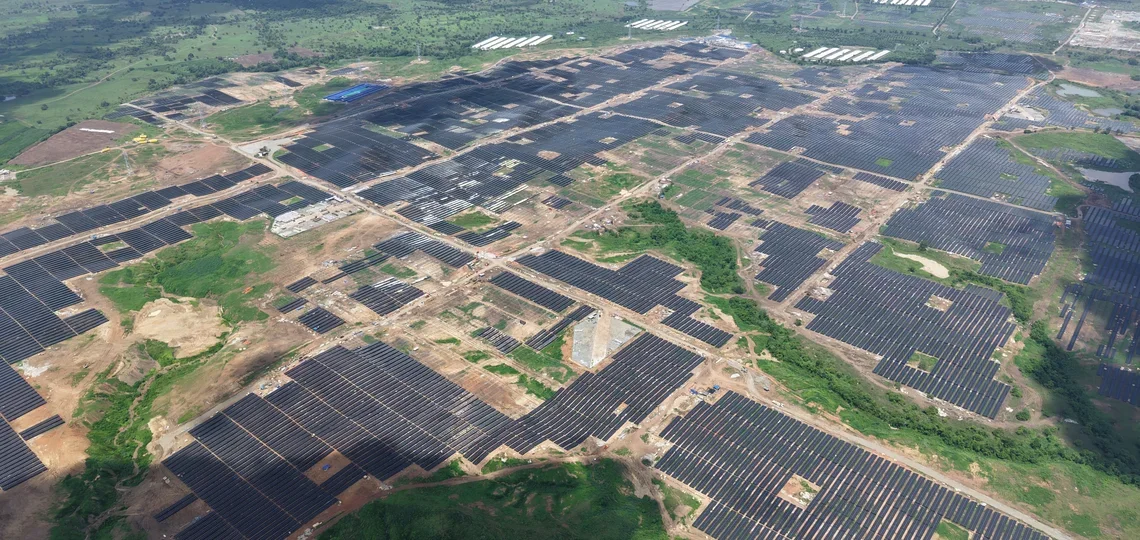
The global solar inverter market is expected to contract by 2% in 2025, reaching 577 Gigawatts AC (GWac), followed by a further 9% decline in 2026 to 523 GWac. This downturn, unprecedented after several years of uninterrupted growth, follows exceptional shipments in 2024. The sector is entering a strategic adjustment phase, shaped by evolving regulations and demand drivers.
First downturn in China since 2019
China’s inverter market will decline by 5% in 2025 to 304 GWac, marking its first contraction since 2019. The drop comes amid a transition between the country’s 14th and 15th five-year plans, generating temporary uncertainty in deployment targets. Nevertheless, China is expected to maintain its leading position with more than 2.9 Terawatts AC (TWac) in cumulative demand by 2034.
Excluding China, the Asia-Pacific region (APeC) is projected to grow, reaching 89 GWac in 2025. The growth is supported by investments in local manufacturing and the expansion of residential photovoltaic (PV) markets in India and Southeast Asia.
Europe in decline, United States under political pressure
In Europe, inverter shipments will drop from 88 GWac to 83 GWac in 2025 and are expected to stabilise below 75 GWac per year by 2032. Persistent inventory issues and declining utility-scale capture prices, particularly in Spain, are slowing new deployment.
In the United States, the market will reach 47 GWac in 2025 before declining by 22% in 2026. The drop is linked to the gradual phase-out of tax credits under the Inflation Reduction Act. The politically uncertain environment adds risks for manufacturers who must adapt to short-term regulatory adjustments.
Price pressure and technological diversification
Inverter prices continue to fall across all categories, driven by increased competition from Chinese manufacturers and ongoing technological developments. Module-level power electronics (MLPE) still show significant pricing disparities by region. In the United States, MLPE prices remain over 50% above the global average.
Hybrid inverters, compatible with DC-coupled battery systems, saw prices fall by 13% in 2024. These systems are becoming standard offerings from major manufacturers like Huawei, SolarEdge and Tesla. In the utility-scale segment, domestic Chinese three-phase string inverters are expected to drop below $0.02/Wac, while standalone central units could approach $0.01/Wac by 2034.
Cybersecurity and regulation: new competitive pressures
US and European authorities are increasing scrutiny of inverter cybersecurity, particularly regarding remote access capabilities. New requirements are expected by 2026, potentially impacting industrial strategies. In Europe, measures extending the Cyber Resilience Act could introduce additional software and traceability obligations, complicating market access for certain foreign players.
In the United States, lawmakers are calling for restrictions on Chinese inverter imports, which could shift the competitive balance. Despite these tensions, forecasts point to a market rebound in the early 2030s, driven by electrification, the rise of artificial intelligence and asset repowering cycles.