Washington will oversee the sale of Lukoil stations until April 2026

The United States is temporarily licensing Lukoil’s operations outside Russia, blocking all financial flows to Moscow while facilitating the supervised sale of a portfolio valued at $22bn, without disrupting supply for allied countries.

Share:

Comprehensive energy news coverage, updated nonstop

Annual subscription

8.25$/month*

*billed annually at 99$/year for the first year then 149,00$/year ​

Unlimited access • Archives included • Professional invoice

OTHER ACCESS OPTIONS

Monthly subscription

Unlimited access • Archives included

5.2$/month*
then 14.90$ per month thereafter

FREE ACCOUNT

3 articles offered per month

FREE

*Prices are excluding VAT, which may vary depending on your location or professional status

Since 2021: 35,000 articles • 150+ analyses per week

The United States Department of the Treasury has issued a general license authorising the continuation of Lukoil’s service station operations outside Russia until 29 April 2026. The decision allows operations in several strategic regions to continue, while blocking financial flows to the Russian Federation.

A legal framework for financial neutralisation

Lukoil and Rosneft were listed as Specially Designated Nationals (SDNs) in October under Executive Order 14024. This measure prohibits any transaction with US persons and exposes third-party entities to secondary sanctions. However, General License No. 128B introduces an exception: it authorises transactions necessary for the operation of service stations and the purchase of products, as long as no funds are transferred to Russia.

The relevant bank accounts may be used for these operations but remain blocked outside this authorised scope. A key clause of the licence specifies that “funds generated may not be transferred to any person or account located in the Russian Federation”, requiring operators to strictly separate financial flows.

Protection of strategic assets and orchestration of sales

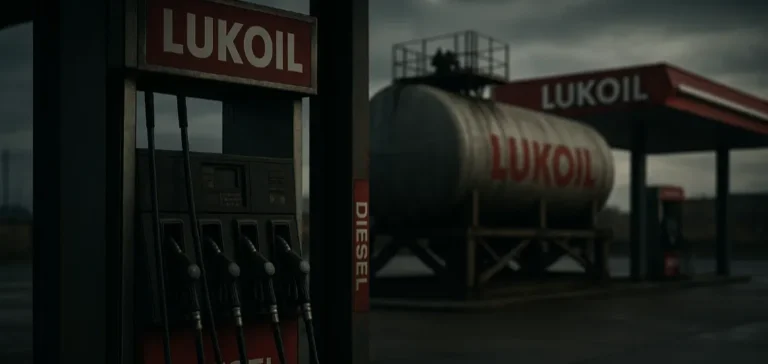
Lukoil operates around 2,000 service stations in more than ten countries, notably in Eastern Europe, the Middle East, and the United States. Critical infrastructure such as the Burgas refinery in Bulgaria is also covered. A separate licence ensures the continuation of Bulgarian operations until April 2026.

Several potential buyers, including ExxonMobil, Chevron, Carlyle, and Gulf sovereign funds, have expressed interest in the entire international portfolio, valued at $22bn. The US Treasury retains veto power over transactions. A proposal from Gunvor has already been rejected for political reasons.

Energy continuity without benefit to Moscow

US authorities aim to prevent fuel supply disruptions in allied countries while reducing Russian revenue. Stations remain operational but are considered “financially orphaned” assets from Moscow’s perspective. This approach limits inflationary risk for allies and restricts Lukoil’s ability to repatriate funds to its parent company.

Revenue generated is used exclusively for operations, maintenance, and asset sale preparation. Lukoil cannot use these funds to finance activities in Russia or distribute dividends. As such, the assets are financially neutralised.

Gradual disengagement under regulatory supervision

Lukoil’s international portfolio is now structured as a divestment backlog under supervision. Each transaction requires US government approval. This structure may lead to valuation discounts and prolonged timelines due to compliance requirements.

Lukoil may refocus on Russia and a few non-Western jurisdictions. The exit of shareholders such as Leonid Fedun has increased the influence of figures closely tied to Russian authorities within the company’s governance.

Role of local governments and market implications

Several countries, including Romania and Bulgaria, have adopted or are considering temporary control mechanisms to avoid service disruptions. These measures enable governments to manage transitions in case asset sales fail or if the US licence is not renewed.

Oil markets thus benefit from temporary stability in affected regions. For investors, the current period offers consolidation opportunities but requires heightened compliance to ensure no financial benefit accrues to Russia.

European sanctions on Russia and refinery outages in the Middle East have sharply reduced global diesel supply, driving up refining margins in key markets.
L’arrêt de la raffinerie de Pancevo, frappée par des sanctions américaines contre ses actionnaires russes, menace les recettes fiscales, l’emploi et la stabilité énergétique de la Serbie.
Oil prices climbed, driven by Ukrainian strikes on Russian infrastructure and the lack of diplomatic progress between Moscow and Washington over the Ukraine conflict.
Chevron has announced a capital expenditure range of $18 to $19 billion for 2026, focusing on upstream operations in the United States and high-potential international offshore projects.
Brazil, Guyana, Suriname and Argentina are expected to provide a growing share of non-OPEC+ oil supply, backed by massive offshore investments and continued exploration momentum.
The revocation of US licences limits European companies’ operations in Venezuela, triggering a collapse in crude oil imports and a reconfiguration of bilateral energy flows.
Bourbon has signed an agreement with ExxonMobil for the charter of next-generation Crewboats on Angola’s Block 15, strengthening a strategic cooperation that began over 15 years ago.
Faced with tighter legal frameworks and reinforced sanctions, grey fleet operators are turning to 15-year-old VLCCs and scrapping older vessels to secure oil routes to Asia.
Reconnaissance Energy Africa completed drilling at the Kavango West 1X onshore well in Namibia, where 64 metres of net hydrocarbon pay were detected in the Otavi carbonate section.
CNOOC Limited has started production at the Weizhou 11-4 oilfield adjustment project and its satellite fields, targeting 16,900 barrels per day by 2026.
The Adura joint venture merges Shell and Equinor’s UK offshore assets, becoming the leading independent oil and gas producer in the mature North Sea basin.
A new $100mn fund has been launched to support Nigerian oil and gas service companies, as part of a national target to reach 70% local content by 2027.
Western measures targeting Rosneft and Lukoil deeply reorganise oil trade, triggering a discreet yet massive shift of Russian export routes to Asia without causing global supply disruption.
The Nigerian Upstream Petroleum Regulatory Commission opens bidding for 50 exploration blocks across strategic zones to revitalise upstream investment.
La Nigerian Upstream Petroleum Regulatory Commission ouvre la compétition pour 50 blocs d’exploration, répartis sur plusieurs zones stratégiques, afin de relancer les investissements dans l’amont pétrolier.
Serbia's only refinery, operated by NIS, has suspended production due to a shortage of crude oil, a direct consequence of US sanctions imposed on its majority Russian shareholder.
Crude prices increased, driven by rising tensions between the United States and Venezuela and drone attacks targeting Russian oil infrastructure in the Black Sea.
Amid persistent financial losses, Tullow Oil restructures its governance and accelerates efforts to reduce over $1.8 billion in debt while refocusing operations on Ghana.
The Iraqi government is inviting US oil companies to bid for control of the giant West Qurna 2 field, previously operated by Russian group Lukoil, now under US sanctions.
Two tankers under the Gambian flag were attacked in the Black Sea near Turkish shores, prompting a firm response from President Recep Tayyip Erdogan on growing risks to regional energy transport.

All the latest energy news, all the time

Annual subscription

8.25$/month*

*billed annually at 99$/year for the first year then 149,00$/year ​

Unlimited access - Archives included - Pro invoice

Monthly subscription

Unlimited access • Archives included

5.2$/month*
then 14.90$ per month thereafter

*Prices shown are exclusive of VAT, which may vary according to your location or professional status.

Since 2021: 30,000 articles - +150 analyses/week.