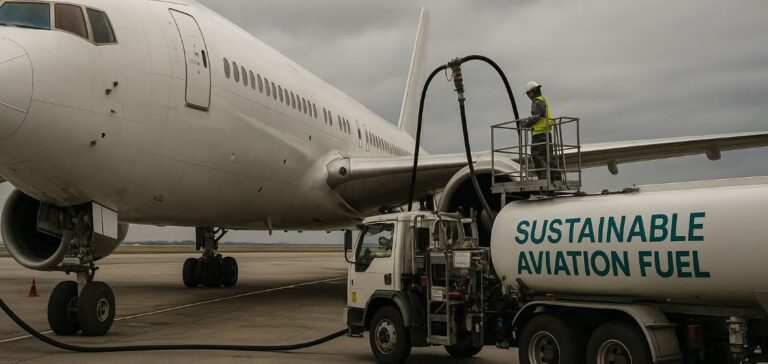
Verso Energy receives support for its sustainable aviation fuel project in Normandy

Verso Energy has secured funding under the France 2030 programme for its "DEZiR" project, aimed at producing sustainable aviation fuel from biogenic COâ‚‚, with an annual production capacity of 81,000 tonnes.

Share:

Subscribe for unlimited access to all the latest energy sector news.

Over 150 multisector articles and analyses every week.

For less than €3/week*

*For an annual commitment

*Engagement annuel à seulement 99 € (au lieu de 149 €), offre valable jusqu'au 30/07/2025 minuit.

The “DEZiR” project by Verso Energy has been selected under the “CARB AERO (FEED)” call for projects, part of the France 2030 initiative. This project, aimed at producing sustainable aviation fuel (e-SAF), marks an important step in the decarbonisation of the aviation sector. It is part of a broader effort to reduce the carbon footprint of air transport in Europe.

Production of sustainable aviation fuel in Normandy

Located in Normandy, in Petit-Couronne (Seine-Maritime) and Alizay (Eure), Verso Energy’s project plans to produce 81,000 tonnes of e-SAF annually, replacing fossil-based kerosene. This initiative is expected to prevent the emission of over 5 million tonnes of COâ‚‚ over a 25-year period. The project will also generate significant economic benefits, including the creation of 250 direct and indirect jobs in the region.

An initiative supported by France 2030

The funding provided by the state will finance an engineering study (“FEED”), a key step in the project’s development. This study will also serve as the technical foundation for three other e-SAF projects in France, located in the Landes, Haute-Vienne/Charente, and Vosges regions. The “DEZiR” project is therefore part of a broader vision to develop an industrial sector in France for the production of synthetic fuels.

A replicable industrial model for France

Verso Energy has formed a strategic partnership with Technip Energies, through its subsidiary Rely, to develop a standardised platform for producing synthetic fuel from methanol. This platform, based on the Methanol-to-Jet technology, will be used to replicate this industrial model in the company’s other projects, contributing to the structuring of this new energy sector in France.

Verso Energy’s integrated model relies on the use of electricity produced by its own renewable energy generation facilities, aiming for long-term industrial competitiveness. The company aims to meet the needs of airlines by 2030, in line with the requirements of the European ReFuelEU Aviation regulation.

“France has unparalleled assets to become a global leader in the production of synthetic fuels and to meet not only domestic demand but also the needs of many other markets. We are very pleased with the support from France 2030, which reflects our country’s ambition to seize this opportunity,” said Antoine Huard, CEO and co-founder of Verso Energy.

Airbus Singapore and Bogor Agricultural University in Indonesia are developing aviation fuel from biomass, aiming for an annual capacity of 100 million tonnes.
Fusion Fuel Green PLC will invest €480,000 in a South African joint venture to deploy proprietary boiler technology at an industrial site, with cash flows expected from the first year.
The national strategy grants limited space to biofuels and biocombustibles, despite their immediate potential to reduce emissions, putting the sector in difficulty as it calls for a clear regulatory framework and stronger institutional support.
Three locations in British Columbia, Ontario and Quebec will host facilities aiming to convert wood waste into renewable diesel using a process validated by a recent feasibility study.
Phillips 66 has been ordered to pay $820mn to Propel Fuels for using trade secrets to accelerate its activities in renewable fuels.
INA has completed its first industrial production of sustainable aviation fuel at the Rijeka refinery, demonstrating the feasibility of commercial-scale co-processing of biogenic feedstocks with the technology developed by Chevron Lummus Global.
Seventeen UK companies secure £63mn ($81.5mn) to develop sustainable aviation fuels, supporting nearly 1,400 jobs and boosting the national sector.
Singapore announces fixed airline ticket levy dedicated to Sustainable Aviation Fuel (SAF) procurement, maintaining unchanged amounts from 2026 to 2028, regardless of significant fluctuations in global fuel prices.
Curve Energy Corp. has formalized a non-disclosure agreement with Saudi Aramco Technologies, allowing confidential exchanges of information as part of potential technological collaborations in the global market for low-sulfur marine fuels.
The French government formalizes its industrial strategy to develop a competitive national sector for sustainable aviation fuels, aiming to meet domestic demand and strengthen France's export position by 2030.
Three French ministers and major industrial groups sign an agreement to accelerate national production of sustainable aviation fuels, aiming to position France as a European leader in this emerging sector.
Global biodiesel and bio-LNG supply struggles to keep pace with rising maritime demand, posing an immediate risk to the sector’s emissions reduction targets.
While corporate demand for sustainable aviation fuel increases, European regulatory rigidity limits short-term investment prospects. SAFc Connect seeks to streamline transactions.
Raven SR takes a crucial step towards renewable hydrogen production by obtaining a permit for its bioenergy project in Richmond, California. This approval marks a significant step forward in the conversion of organic waste into clean fuels and contributes to the reduction of CO2 emissions.
Nigerian president inaugurates Dangote's mega-refinery, offering the prospect of solving shortages and creating revenue. However, analysts doubt the actual start-up date of the refinery, which could be delayed until the end of 2024.
Denmark takes a major step forward in the management of captured CO2 with the construction of its first large-scale facility in Aalborg. The Port of Aalborg and Fidelis New Energy unveil ambitious plans to process up to four million tons of CO2 per year, contributing to the country's emission reduction.
Floating wind resources are poised to become a crucial part of the U.S. energy transition. A look back at the industry's rapid growth prospects, the U.S. Department of Energy's ambitious goals, and development opportunities in California, Oregon and the Gulf of Maine.
The right-wing majority Senate has largely approved the nuclear revival bill to speed up the construction of new reactors, despite the opposition of the ecologist group, before the final adoption expected on May 16 in the National Assembly.
TotalEnergies, the French oil major, is preparing for a climate debate with some of its shareholders at its general meeting on May 26. An advisory resolution on the group's indirect CO2 emissions, proposed by the activist shareholder organization Follow This, was included in the agenda of the AGM.
In the first quarter of the year, EDF recorded a 34.6% increase in revenues compared to the same period last year, despite a drop in its nuclear production. High energy market prices and the acquisition of new residential customers in France contributed to this growth.
Consent Preferences