Uniper demolishes 116-metre cooling tower at Scholven site
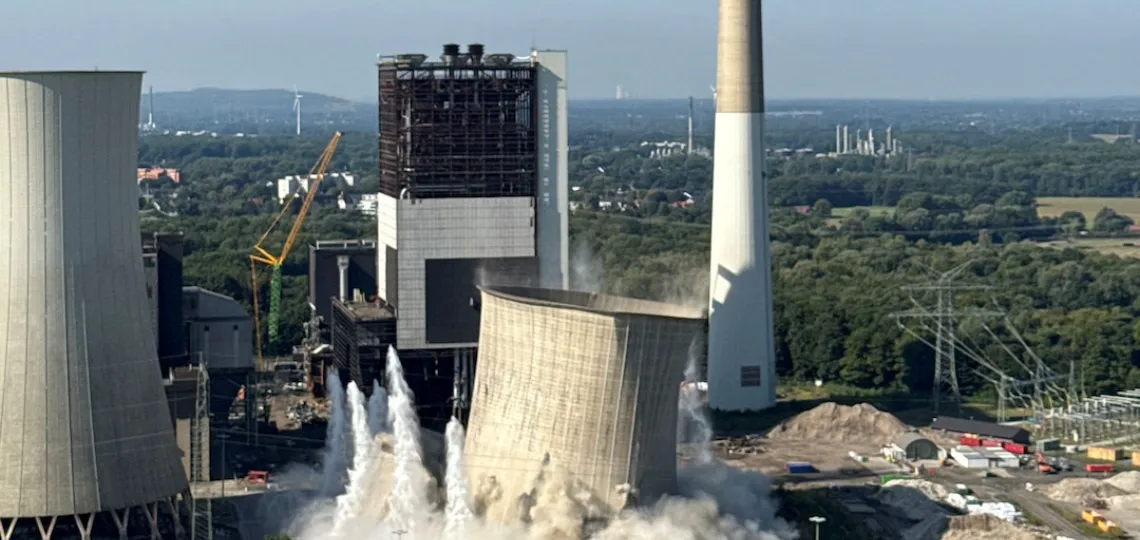
Uniper has demolished cooling tower F at its Scholven power plant, marking a new stage in the dismantling of the Gelsenkirchen coal site, where the energy company plans to build a hydrogen-ready gas-fired plant.
| Sectors | Hydrogen Energy, Gas, Coal, Low-Carbon Hydrogen, Carbon, Natural Gas |
|---|---|
| Themes | Risks & Events, Cost Overruns |
| Companies | Amprion, Uniper |
| Countries | Germany |
German energy company Uniper has carried out the planned demolition of the 116-metre-high cooling tower F at its Scholven site in Gelsenkirchen. The operation was executed precisely at 11:00 under the supervision of blasting specialist Thüringer Sprenggesellschaft, in the presence of selected guests. The process is part of the decommissioning of unit F, which began in April 2024.
A controlled demolition with extensive safety measures
A total of 60 kilograms of explosives was used to bring down the concrete structure, which weighs an estimated 11,000 tonnes. The fall direction had been precisely calculated by engineers, with 400 drill holes and specially designed guiding slots installed. The resulting rubble will be processed on site into high-quality recycled material to fill excavation pits.
Buerelterstraße and Feldhauser Straße were temporarily closed, and a 300-metre safety perimeter was established around the site. Although residents were not evacuated, they were informed in advance of safety procedures. The safety concept was developed in collaboration with local authorities, electricity grid operator Amprion and several neighbouring companies.
Repurposing the site for low-carbon energy generation
The Scholven plant has been undergoing progressive dismantling for several years. Towers G and H were already demolished in 2008 using a similar blasting strategy. In addition to cooling tower F, Uniper plans to demolish boiler house F and the flue gas desulphurisation (FGD) facility later this year. Further demolitions are scheduled for 2026.
As part of the site’s transformation, Uniper is planning to build a new H2-ready gas-fired power plant, meaning it will be capable of operating on hydrogen in future. Other low-emission energy production projects are also in the planning stage. The company has not disclosed a specific timeline or investment volume for these new installations.
A milestone for the industrial conversion of the site
The company’s management described the demolition as a “symbolic” step in the site’s coal phase-out. The event marks a major technical and logistical step in freeing up construction-ready space for future projects. These efforts form part of a broader strategy to reallocate former energy infrastructure for purposes aligned with energy transition goals, particularly in the industrial regions of northern Ruhr.