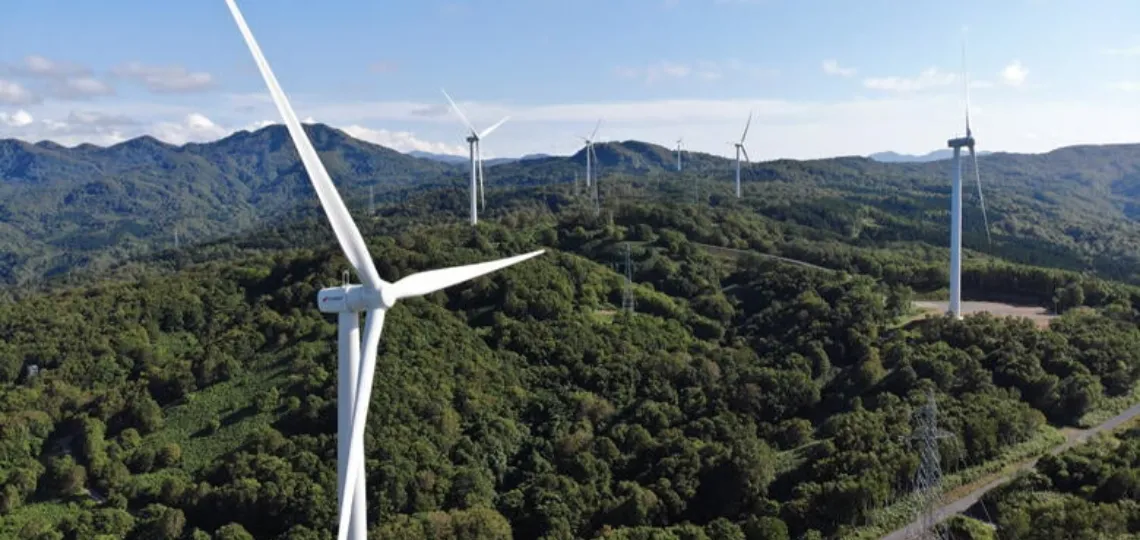
TerraWind Renewables announced the acquisition of five onshore wind projects totalling 255MW in the Tohoku region of northern Japan, consolidating its portfolio to 327MW of capacity under development. These asset transfers come amid a gradual reshaping of the local market, marked by delays in large offshore wind projects.
Acquisitions concentrated in three key prefectures
The new assets include two sites in Akita Prefecture (25MW and 8MW), a 12MW project in Aomori, and two large-scale developments in Iwate (120MW and 90MW). The sellers have not been disclosed. TerraWind has not specified the transaction amount or financing details but confirmed that the projects complement those already transferred by its Japanese shareholder Shizen Energy at launch.
The initial portfolio included projects in Ishikawa (9MW) and Kumamoto (21MW), along with a 42MW site in Hokkaido developed in-house. With the new acquisitions, total capacity now stands at 327MW across seven prefectures.
Construction targets starting in 2026
The company plans to begin construction on several projects from 2026, with the first commercial operation scheduled for 2028. TerraWind’s Chief Executive Officer Oliver Senter stated that the current environment presents a “window of opportunity” for onshore developers, citing strong buyer demand, offshore wind delays, and declining public support for greenfield solar developments.
Founded in 2024, TerraWind is a joint venture 80% owned by US-based investor Stonepeak and 20% by Shizen Energy. The company targets a portfolio of 500MW in operation or under construction by 2030, without disclosing any signed power purchase agreements at this stage.
Strategic focus on shovel-ready assets
This large-scale asset transfer reflects TerraWind’s growth strategy built around fast-track integration of advanced-stage projects. By establishing a presence in the Tohoku region, the company reinforces its position in a segment seen as more accessible than offshore wind in Japan. No further acquisition plans have been announced for the near term.
“We believe the fundamentals are in place for onshore wind to fill part of Japan’s energy target gap,” Senter wrote in an online post, without specifying commissioning timelines for individual sites.