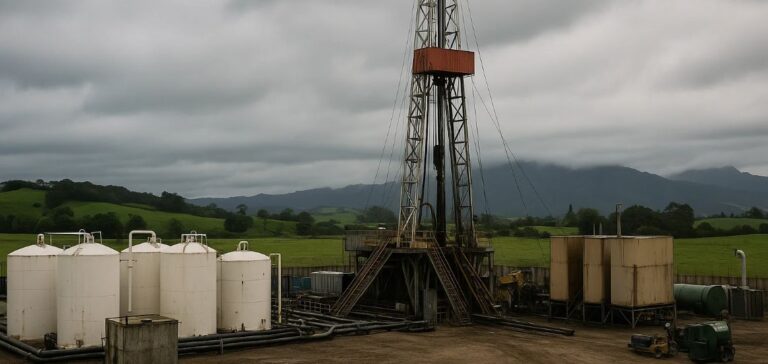
TAG Oil sells New Zealand oil royalty interests for USD 2.5 mn

Canadian company TAG Oil has completed the sale of its interests in five production permits in New Zealand to Kiwi Royalty Limited, for a total consideration of up to USD 2.5 mn.

Share:

Comprehensive energy news coverage, updated nonstop

Annual subscription

8.25$/month*

*billed annually at 99$/year for the first year then 149,00$/year ​

Unlimited access • Archives included • Professional invoice

OTHER ACCESS OPTIONS

Monthly subscription

Unlimited access • Archives included

5.2$/month*
then 14.90$ per month thereafter

FREE ACCOUNT

3 articles offered per month

FREE

*Prices are excluding VAT, which may vary depending on your location or professional status

Since 2021: 35,000 articles • 150+ analyses per week

TAG Oil Ltd., a Canadian oil and gas producer, has announced the completion of the sale of its 2.5% gross overriding royalty interests in five New Zealand oil permits. The transaction, executed with Kiwi Royalty Limited, was finalised on April 22 following its initial announcement on April 8. The agreement includes an upfront payment of USD 2.2 mn, which comprises a non-refundable deposit of USD 50,000, and additional conditional payments of up to USD 300,000 by the end of 2027.

Contractual details and performance conditions

The affected permits are PMP 38156 (Cheal and Cardiff), PMP 53803 (Sidewinder), PMP 60454 (Supplejack), PEP 51153 (Puka), and PMP 60291 (Cheal East). The remaining balance of up to USD 300,000 will be paid based on cumulative production performance. A further USD 150,000 will be paid if production exceeds 1 million barrels of oil equivalent (BOE) between April 1, 2025, and December 31, 2026. An additional USD 150,000 will be triggered if cumulative production surpasses 2 million BOE before the end of 2027.

Financial impact and capital reallocation strategy

No finder’s fee was paid in this arm’s length transaction. The sale aligns with TAG Oil’s strategic shift to focus on core assets, notably its operations in Egypt. According to Executive Chairman and Chief Executive Officer Abby Badwi, the deal will allow the company to redirect capital toward its priority projects while improving financial flexibility.

The New Zealand portfolio was considered non-core for TAG Oil, which continues to prioritise cash flow optimisation and support for higher value development opportunities. The sale comes as mid-sized oil companies re-evaluate international holdings to concentrate on more profitable production zones or assets with immediate development potential.


Iranian authorities intercepted a vessel carrying 350,000 litres of fuel in the Persian Gulf, tightening control over strategic maritime routes in the Strait of Hormuz.
North Atlantic France finalizes the acquisition of Esso S.A.F. at the agreed per-share price and formalizes the new name, North Atlantic Energies, marking a key step in the reorganization of its operations in France.
Greek shipowner Imperial Petroleum has secured $60mn via a private placement with institutional investors to strengthen liquidity for general corporate purposes.
Ecopetrol plans between $5.57bn and $6.84bn in investments for 2026, aiming to maintain production, optimise infrastructure and ensure profitability despite a moderate crude oil market.
Faced with oversupply risks and Russian sanctions, OPEC+ stabilises volumes while preparing a structural redistribution of quotas by 2027, intensifying tensions between producers with unequal capacities.
The United Kingdom is replacing its exceptional tax with a permanent price mechanism, maintaining one of the world’s highest fiscal pressures and reshaping the North Sea’s investment attractiveness for oil and gas operators.
Pakistan confirms its exit from domestic fuel oil with over 1.4 Mt exported in 2025, transforming its refineries into export platforms as Asia faces a structural surplus of high- and low-sulphur fuel oil.
Turkish company Aksa Enerji has signed a 20-year contract with Sonabel for the commissioning of a thermal power plant in Ouagadougou, aiming to strengthen Burkina Faso’s energy supply by the end of 2026.
The Caspian Pipeline Consortium resumed loadings in Novorossiisk after a Ukrainian attack, but geopolitical tensions persist over Kazakh oil flows through this strategic Black Sea corridor.
Hungary increases oil product exports to Serbia to offset the imminent shutdown of the NIS refinery, threatened by US sanctions over its Russian majority ownership.
Faced with falling oil production, Pemex is expanding local refining through Olmeca, aiming to reduce fuel imports and optimise its industrial capacity under fiscal pressure.
Brazil’s state oil company will reduce its capital spending by 2%, hit by falling crude prices, marking a strategic shift under Lula’s presidency.
TotalEnergies has finalised the sale of its 12.5% stake in Nigeria’s offshore Bonga oilfield for $510mn, boosting Shell and Eni’s positions in the strategic deepwater production site.
Serbia is preparing a budget law amendment to enable the takeover of NIS, a refinery under US sanctions and owned by Russian groups, to avoid an imminent energy shutdown.
Nigeria’s Dangote refinery selects US-based Honeywell to supply technology that will double its crude processing capacity and expand its petrochemical output.
Iraq secures production by bypassing US sanctions through local payments, energy-for-energy swaps, and targeted suspension of financial flows to Lukoil to protect West Qurna-2 exports.
Restarting Olympic Pipeline’s 16-inch line does not restore full supply to Oregon and Seattle-Tacoma airport, both still exposed to logistical risks and regional price tensions.
Faced with tightened sanctions from the United States and European Union, Indian refiners are drastically reducing their purchases of Russian crude from December, according to industry sources.
Serbia’s only refinery, operated by NIS, may be forced to halt production this week, weakened by US sanctions targeting its Russian shareholders.
Glencore's attributable production in Cameroon dropped by 31% over nine months, adding pressure on public revenues as Yaoundé revises its oil and budget forecasts amid field maturity and targeted investment shifts.

All the latest energy news, all the time

Annual subscription

8.25$/month*

*billed annually at 99$/year for the first year then 149,00$/year ​

Unlimited access - Archives included - Pro invoice

Monthly subscription

Unlimited access • Archives included

5.2$/month*
then 14.90$ per month thereafter

*Prices shown are exclusive of VAT, which may vary according to your location or professional status.

Since 2021: 30,000 articles - +150 analyses/week.