Successful launch for Nucera, steelmaker Thyssenkrupp’s green project
Thyssenkrupp Nucera, a multi-billion euro “unicorn” specializing in the production of green hydrogen plants, successfully floated on the Frankfurt Stock Exchange on Friday, illustrating the potential of this alternative energy source to fossil fuels. Thyssenkrupp Nucera strengthens its leading position in the green hydrogen industry Thyssenkrupp Nucera shares closed up 18.85% at 24.34 euros a […]
| Sector | Énergie Hydrogène, Hydrogène vert |
|---|---|
| Theme | Développement de projets, Annonce |
Thyssenkrupp Nucera, a multi-billion euro “unicorn” specializing in the production of green hydrogen plants, successfully floated on the Frankfurt Stock Exchange on Friday, illustrating the potential of this alternative energy source to fossil fuels.
Thyssenkrupp Nucera strengthens its leading position in the green hydrogen industry
Thyssenkrupp Nucera shares closed up 18.85% at 24.34 euros a share, having benefited from an entry price of 20 euros. This would value the listed entity at around 3.0 billion euros. Nucera is the “green” nugget of German steel giant Thyssenkrupp, a conglomerate with a history stretching back more than a hundred years, engaged in a profound transformation to meet the challenges of decarbonization.
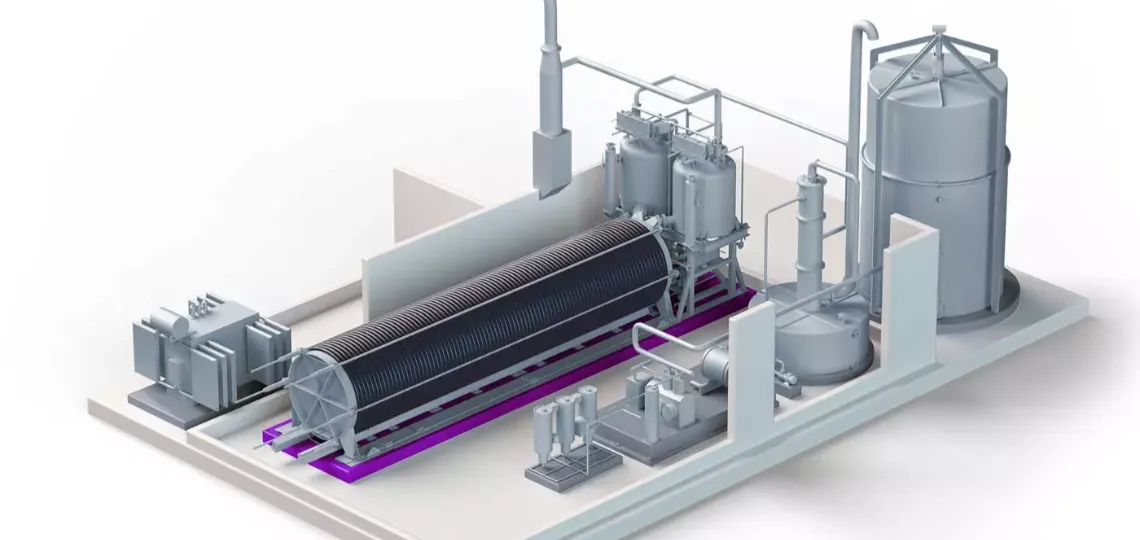
This IPO “broadens Thyssenkrupp Nucera’s financial flexibility”, and strengthens its profile “as a leading player in the fields of the green hydrogen industry”, said Miguel Angel Lopez Borrego, Chairman of the Management Board of Thyssenkrupp AG, moments before ringing the bell on the Frankfurt trading floor – Energy Joker – Nucera manufactures plants that generate hydrogen and can store it on a large scale from renewable energy sources such as solar and wind power, heralding a host of industrial opportunities.
Hydrogen is set to play the role of “energy joker” in a Germany that closed its last nuclear reactor in April and will turn its back on coal over the next decade, setting its sights on renewable energy sources (solar and wind), notes Konstantin Oldenburger at CMC Markets. For Thyssenkrupp Nucera, the IPO is the latest episode in a “success story” to develop the green hydrogen production units that companies rely on to achieve “climate neutrality”, explained CEO Werner Ponikwar.
Planned IPO postponed, remains a major unicorn with ThyssenKrupp and De Nora as shareholders
Parent company ThyssenKrupp is setting an example here, as hydrogen will eventually replace coal in the blast furnaces of its historic Duisburg ironworks. A project into which the North Rhine-Westphalia region wants to inject billions, but which is awaiting the green light from the European Union in terms of state aid. – “Princess turned Unicorn” – Nucera, which employs around 600 people, was planning to go public last year, but had to postpone its plans due to conditions made difficult by rising interest rates and increasing market volatility.
This is the second largest IPO of the year in Europe, following that of Italian gambling company Lottomatica on Euronext Milan in May. After listing, Nucera will retain Thyssenkrupp as majority shareholder, while Italian partner De Nora, a specialist in electrodes and water filtration systems, will retain a minority stake.
Hydrogen unicorn Nucera raises funds to support its promising technologies
The funds raised will support the development of this global supplier of alkaline water electrolysis (AWE) and chlor-alkali (CA) technologies. Nucera and its parent company have invested in two technologies that are still in their infancy, turning them into “a company (now valued) in the billions of euros”, said a delighted Mr. Lopez Borrego.
“The enchanted princess has become a unicorn”, the name of these “tech” companies valued at over a billion dollars, he continued. The company remains loss-making in terms of net income, and its growth “should only really accelerate in the coming years”, according to analyst Konstantin Oldenburger.
According to the International Energy Agency (IEA), the global hydrogen market is set to grow sevenfold by 2050, from 94 million tonnes in 2021 to 660 million tonnes in 2050. Nucera is also a “ray of hope” for Thyssenkrupp, says Mr. Oldenburger, as the industrial conglomerate, which produces sheet steel of all kinds as well as submarines, has gone through several years of financial turbulence. The group, which has already sold its lucrative elevator division in 2020, is still looking for a future for its core steel division.