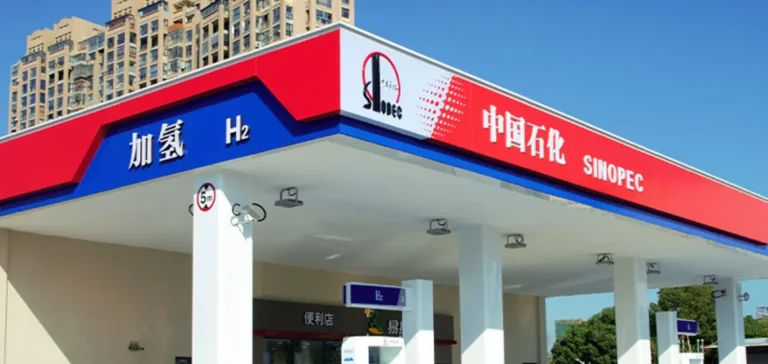
Sinopec signs $40.9bn in deals during 2025 China International Import Expo

Sinopec finalised supply agreements worth $40.9bn with 34 foreign companies at the 2025 China International Import Expo, reinforcing its position in the global petroleum and chemical trade.

Share:

Comprehensive energy news coverage, updated nonstop

Annual subscription

8.25$/month*

*billed annually at 99$/year for the first year then 149,00$/year ​

Unlimited access • Archives included • Professional invoice

OTHER ACCESS OPTIONS

Monthly subscription

Unlimited access • Archives included

5.2$/month*
then 14.90$ per month thereafter

FREE ACCOUNT

3 articles offered per month

FREE

*Prices are excluding VAT, which may vary depending on your location or professional status

Since 2021: 35,000 articles • 150+ analyses per week

China Petroleum & Chemical Corporation (Sinopec) announced the signing of contracts totalling $40.9bn with 34 international partners from 17 countries and regions during the eighth edition of the China International Import Expo (CIIE), held in Shanghai. These agreements cover 24 products across 10 major categories, including crude oil, chemicals, industrial equipment, and consumer goods.

Commitments spread across multiple segments of the energy chain

The variety of products involved in the deals reflects Sinopec’s intention to secure a broader supply base. The company is strengthening its position in the international trade of strategic raw materials while consolidating its role within the petrochemical value chain.

Sinopec stated that the deals are part of a long-term strategy. Since the first CIIE in 2018, the group has signed over $325bn in cumulative orders. This approach is driven by expanding international commercial ties and a technology investment policy aimed at modernising its operations.

Technology, artificial intelligence, and industrial resilience

During the forum held alongside the signing ceremony, Zhao Dong, Vice Chairman of the Board and President of Sinopec, emphasised the role of technological innovation in the group’s strategy. He noted that Sinopec seeks to “activate new engines of value creation” by combining industrial capabilities with digital solutions.

According to his remarks, the group plans to accelerate the integration of next-generation information technologies within the energy and chemical industries to enhance competitiveness. He also mentioned the need to adapt production models to evolving market demands amid global structural transformation.

Global industry players in attendance

In addition to Sinopec executives, several leaders from major international firms participated in the event. Datuk Sazali Hamzah, Executive Vice President of Petronas Chemicals Group, Axel Lorenz, CEO of Process Automation at Siemens, Aravind Yarlagadda, Senior Vice President at Baker Hughes, and Audun M. Martinsen, Partner at Rystad Energy, delivered speeches highlighting supply chain evolution and the role of digitalisation in energy industries.

Washington has crossed a historic threshold by capturing Nicolas Maduro after years of sanctions and embargo. A look back at two decades of tensions and their implications for the global oil market.
Chinese company CNOOC has started production at the Buzios6 project, raising the total capacity of the pre-salt oilfield to 1.15 million barrels per day.
Tema refinery has resumed operations at reduced capacity following a prolonged shutdown and targeted maintenance work on critical infrastructure.
Caspian Pipeline Consortium suspended loading and intake operations due to a storm and full storage capacity.
Frontera Energy has signed a crude supply deal worth up to $120mn with Chevron Products Company, including an initial $80mn prepayment and an option for additional funding.
Amplify Energy has completed the sale of its Oklahoma assets for $92.5mn, as part of its strategy to streamline its portfolio and optimise its financial structure.
State-owned Nigerian company NNPC has opened a bidding process to sell stakes in oil and gas assets as part of a portfolio restructuring strategy.
As offshore projects expand, Caribbean nations are investing in shore bases and specialised ports to support oil and gas operations at sea.
Turkish, Hungarian and Polish national companies confirm participation in Tripoli's summit as Libya revives upstream investments and broadens licensing opportunities.
Oil workers’ union FUP announced its intention to approve Petrobras’ latest proposal, paving the way to end a week-long national strike with no impact on production.
Subsea7 has secured a subsea installation contract from LLOG for the Buckskin South project, scheduled for execution between 2026 and 2027, strengthening its position in the Gulf of Mexico and boosting its order book visibility.
Global crude oil production is expected to rise by 0.8 million barrels per day in 2026, with Brazil, Guyana and Argentina contributing 50% of the projected increase.
Woodbridge Ventures II Inc. signs definitive agreement with Greenflame Resources for a transformative merger, alongside a concurrent financing of up to $10mn.
Interceptions of ships linked to Venezuelan oil are increasing, pushing shipowners to suspend operations as PDVSA struggles to recover from a cyberattack that disrupted its logistical systems.
Harbour Energy acquires US offshore operator LLOG for $3.2bn, adding 271 million barrels in reserves and establishing a fifth operational hub in the Gulf of Mexico.
The agreement signed with Afreximbank marks a strategic shift for Heirs Energies, aiming to scale up its exploration and production operations on Nigeria's OML 17 oil block.
Oritsemeyiwa Eyesan’s appointment as head of Nigeria’s oil regulator marks a strategic shift as the country targets $10bn in upstream investment through regulatory reform and transparent licensing.
Baghdad states that all international companies operating in Kurdistan’s oil fields must transfer their production to state marketer SOMO, under the agreement signed with Erbil in September.
Chinese oil group CNOOC continues its expansion strategy with a new production start-up in the Pearl River Basin, marking its ninth offshore launch in 2025.
A train carrying over 1,200 tonnes of gasoline produced in Azerbaijan entered Armenia on December 19, marking the first commercial operation since recent conflicts, with concrete implications for regional transit.

All the latest energy news, all the time

Annual subscription

8.25$/month*

*billed annually at 99$/year for the first year then 149,00$/year ​

Unlimited access - Archives included - Pro invoice

Monthly subscription

Unlimited access • Archives included

5.2$/month*
then 14.90$ per month thereafter

*Prices shown are exclusive of VAT, which may vary according to your location or professional status.

Since 2021: 30,000 articles - +150 analyses/week.