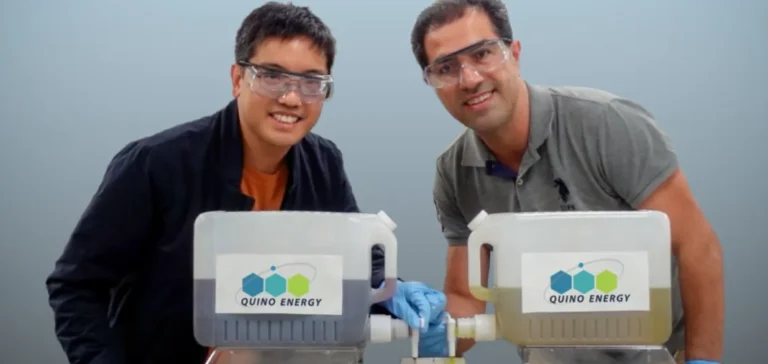
Quino Energy raises $16mn to industrialise organic electrolytes for flow batteries

Quino Energy secures $16mn in funding to scale global production of its organic electrolytes, with strategic support from investor Atri Energy Transition.

Share:

Comprehensive energy news coverage, updated nonstop

Annual subscription

8.25£/month*

*billed annually at 99£/year for the first year then 149,00£/year ​

Unlimited access • Archives included • Professional invoice

OTHER ACCESS OPTIONS

Monthly subscription

Unlimited access • Archives included

5.2£/month*
then 14.90£ per month thereafter

FREE ACCOUNT

3 articles offered per month

FREE

*Prices are excluding VAT, which may vary depending on your location or professional status

Since 2021: 35,000 articles • 150+ analyses per week

US-based company Quino Energy, specialised in long-duration energy storage via flow batteries, has raised $10mn in equity during a Series A funding round led by Atri Energy Transition. The agreement also includes access to an additional $6mn in equity funding, bringing the total potential investment to $16mn.

New factory and pilot projects at the heart of deployment

The funding will enable Quino Energy to establish a production line for its proprietary organic electrolyte and carry out pilot projects in several regions worldwide. The electrolyte, manufactured through a waste-free continuous flow process, is based on low-cost feedstocks derived from coal tar. Its compatibility with standard vanadium flow battery hardware allows for rapid and cost-effective industrial scaling.

Quino Energy plans to build a new factory capable of producing at a cost lower than vanadium, currently the industry benchmark. At gigawatt-hour scale, the company estimates cost reductions of up to 75%. The product is also compatible with carbon steel tanks, widely used in the oil sector, offering potential repurposing of existing infrastructure.

Targeting leadership in long-duration storage markets

Hyderabad-based Atri Energy Transition aims to support economically viable and impactful Long Duration Energy Storage (LDES) solutions. Quino Energy recently received a $10mn grant from the California Energy Commission and $5mn from the US Department of Energy under the Critical Facility Energy Resilience (CiFER) programme for a 5 MWh battery project in Southern California.

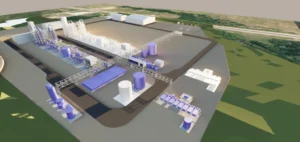
In June, a strategic agreement was signed with TerraFlow Energy to co-develop organic electrolytes for large-scale flow batteries. Additional funding was provided by the Department of Energy’s Advanced Materials and Manufacturing Technologies Office (AMMTO) to support the development of a pilot electrolyte production site in Buffalo, New York.

Potential for accelerated global deployment

With its backward-compatible organic electrolyte and partnership-based strategy, Quino Energy targets significant cost reductions for grid operators, utilities, and industrial developers. The flexibility of integrating the technology into existing equipment could accelerate the adoption of flow batteries in fast-growing markets, especially in regions facing grid reliability and resilience challenges.
The Australian government opens Tender 8 to secure 16 GWh of storage, for the first time including aggregated portfolios of 5 to 30 MW within the National Electricity Market.
With a strategic investment in a 200 MWh facility, European Energy strengthens its industrial position in Denmark and energises the Nordic battery storage market.
The Spanish renewable energy producer significantly increased its investments and revenue while achieving more than half of its asset rotation target for the 2025–2027 period.
Chinese manufacturer EVE Energy has signed a three-year memorandum of understanding with Sweden’s Vimab BESS AB to supply batteries and energy storage solutions in Northern Europe.
Huawei's full-lifecycle battery safety rating system has been officially validated by a national technical committee, marking a key milestone for large-scale energy storage deployment.
AMPYR Australia and InCommodities have signed a 15-year partnership for the Bulabul BESS project, marking the Danish trader’s first long-term commitment in the Australian energy storage market.
Tokyo Gas and Okaya & Co. will begin construction in December 2025 of a 25 MW/75 MWh battery energy storage system in Hokkaido, with commercial operations expected in 2028 or later.
US-based CETY has been awarded a $10mn contract to build a battery energy storage system in New York State, marking the first in a series of planned installations across the region.
French energy group Engie wins its second-largest global battery storage project with a capacity of 280 MW, awarded by a state-owned company in Gujarat, India.
Nostromo’s IceBrick system becomes the first behind-the-meter thermal storage device to participate in California’s wholesale energy market, in partnership with Olivine, marking a milestone for commercial buildings.
Pacific Green has received approval from the Victorian government for its second energy storage park in Australia, a 1GW project to be developed over 36 months in Portland’s industrial zone.
TagEnergy launches a 150 MW storage project at the Golden Plains wind farm site, strengthening its investment strategy in Australia's energy infrastructure.
CATL, Sun Village and Marubeni Power Retail have signed an agreement to develop 2.4GWh of grid-scale storage capacity in Japan, without a defined schedule, leveraging investment, construction and commercial management synergies.
Northland Power has acquired two energy storage projects in Poland from Greenvolt Power Group, consolidating a strategic partnership in a transitioning market.
The global battery energy storage systems market anticipates 28.8% annual growth through 2033, supported by industrial electrification, government incentives and grid modernisation efforts.
Group1 and Michigan Potash & Salt Company have signed an agreement to create a domestic potassium-based battery supply chain, relying on local mining and production free from critical metals.
A battery storage project developed in Shiga Prefecture marks a new step for the Japanese industry, with the official commissioning of a 4MWh facility aimed at the primary balancing market.
Nine battery storage projects totalling 18MW will be built by au Renewable Energy across the Chubu, Kansai and Kyushu regions, with commissioning scheduled through March 2027.
ACEnergy’s Central BESS project has been approved with a $3.6mn benefit-sharing plan for local and Indigenous communities.
Operator Fullmark Energy has finalised a $46mn investment tax credit transfer linked to its 125MW Redwood storage portfolio in Southern California, strengthening its ability to pursue further growth in the sector.

All the latest energy news, all the time

Annual subscription

8.25£/month*

*billed annually at 99£/year for the first year then 149,00£/year ​

Unlimited access - Archives included - Pro invoice

Monthly subscription

Unlimited access • Archives included

5.2£/month*
then 14.90£ per month thereafter

*Prices shown are exclusive of VAT, which may vary according to your location or professional status.

Since 2021: 30,000 articles - +150 analyses/week.