Hydrogen Aircraft: Air Liquide, Airbus and ADP Group

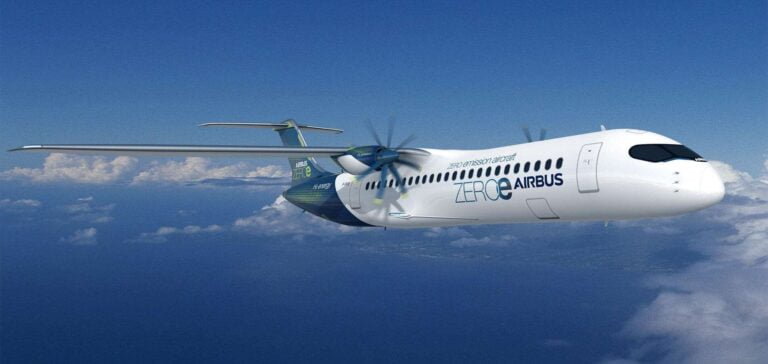
Hydrogen aircraft for commercial flights are of joint interest to the three giants Air Liquide, Airbus and Groupe ADP.|Hydrogen aircraft for commercial flights are of joint interest to the three giants Air Liquide, Airbus and Groupe ADP.

Share:

Comprehensive energy news coverage, updated nonstop

Annual subscription

8.25€/month*

*billed annually at 99€/year for the first year then 149,00€/year ​

Unlimited access • Archives included • Professional invoice

OTHER ACCESS OPTIONS

Monthly subscription

Unlimited access • Archives included

5.2€/month*
then 14.90€ per month thereafter

FREE ACCOUNT

3 articles offered per month

FREE

*Prices are excluding VAT, which may vary depending on your location or professional status

Since 2021: 35,000 articles • 150+ analyses per week

Hydrogen aircraft for commercial flights are of joint interest to the three giants Air Liquide, Airbus and Groupe ADP.
Together, the three companies want to prepare for the arrival of hydrogen at Paris airports by 2035.

Preparing airports for hydrogen-powered aircraft

This partnership supports the decarbonization of the aeronautical industry by defining the opportunities that hydrogen can bring to the aeronautical sector.
In addition, French airports will need to be adapted for the arrival of the first hydrogen-powered commercial aircraft.
Particularly when it comes to supplying liquid hydrogen.
This is why Air Liquide, Airbus and Groupe ADP are concentrating on carrying out feasibility studies aimed at modernizing airports in this direction.

Assess hydrogen supply possibilities

An initial study will be based on a representative panel of some 30 airports to assess potential configurations for liquid hydrogen supply.
Next, several scenarios and detailed plans will be drawn up for Paris-Charles de Gaulle and Paris-Orly airports.
This will enable engineers to determine the required infrastructure and integrate conditions relating to industrial and aviation safety standards.

The commitments of the three companies in the hydrogen era

Firstly, Air Liquide, a hydrogen pioneer, is committed to responding to the climate emergency, and in particular to the goal of carbon neutrality by 2050.
Over the past 50 years, the company has developed its expertise and today masters the entire hydrogen supply chain.
It is currently aiming for 3 GW of electrolysis capacity by 2030, and is investing 8 billion euros in the value chain by 2035.

What about the aerospace sector?

Secondly, Airbus is committed to leading the decarbonization of the aerospace sector, and limiting its industrial environmental footprint worldwide.
The company is thus helping to meet the aerospace industry’s key environmental performance targets.
As part of this commitment, Airbus is aiming to market the world’s first zero-emission commercial aircraft by 2035.

ADP Group to manage hydrogen integration at airports

Last but not least, the ADP Group has created a unique ecosystem for the gradual integration of hydrogen into Paris airports.
The company emphasizes the need to transform airports into hydrogen hubs, to welcome hydrogen aircraft by 2035.
According to the Group’s vision, sustainable solutions such as the development of hydrogen encourage the decarbonization of air transport.

A shared ambition for more sustainable aviation

Matthieu Giard, Vice-President of Air Liquide’s Hydrogen activities, recalls the need to act now, to accelerate “the development of the hydrogen sector”.
He explains that Air Liquide will contribute its unique expertise in “liquid hydrogen, which requires advanced mastery of extreme cryogenics”.
In conclusion, the three companies plan to work together “to accelerate the energy transition and build the future for more sustainable aviation”.

ABB invests in UK-based start-up OctaiPipe to strengthen its smart energy-saving solutions for data centre infrastructure.
The cross-border hydrogen transport network HY4Link receives recognition from the European Commission as a project of common interest, unlocking access to funding and integration into Europe’s energy infrastructure.
The withdrawal of Stellantis weakens Symbio, which is forced to drastically reduce its workforce at the Saint-Fons plant, despite significant industrial investment backed by both public and private stakeholders.
Axess Group has signed a memorandum of understanding with ARO Drilling to deliver asset integrity management services across its fleet, integrating digital technologies to optimise operations.
South African state utility Eskom expects a second consecutive year of profit, supported by tariff increases, lower debt levels and improved operations.
German steelmaker Thyssenkrupp plans to cut 11,000 jobs and reduce capacity by 25% as a condition to enable the sale of its steel division to India’s Jindal Steel.
Snam strengthens its position in hydrogen and CO₂ infrastructure with EU-backed SoutH2 corridor and Ravenna hub, both included in the 2025 list of strategic priorities for the European Union.
Equans Process Solutions brings together its expertise to support highly technical industrial sectors with an integrated offer covering the entire project lifecycle in France and abroad.
Zenith Energy centres its strategy on a $572.65mn ICSID claim against Tunisia, an Italian solar portfolio and uranium permits, amid financial strain and reliance on capital markets.
Ivanhoe Mines expects a 67% increase in electricity consumption at its copper mine in DRC, supported by new hydroelectric, solar and imported supply sources.
Driven by industrial demand and integration with renewable energy, the electrolyzer market is projected to grow 38.2% annually, rising from $2.08bn in 2025 to $14.48bn by 2031.
Q ENERGY France and the Association of Rural Mayors of France have entered a strategic partnership to develop local electrification and support France's energy sovereignty through rural territories.
ACWA Power, Badeel and SAPCO have secured $8.2bn in financing to develop seven solar and wind power plants with a combined capacity of 15 GW in Saudi Arabia, under the national programme overseen by the Ministry of Energy.
Hydro-Québec reports a 29% increase in net income over nine months in 2025, supported by a profitable export strategy and financial gains from an asset sale.
Antin Infrastructure Partners is preparing to sell Idex in early 2026, with four North American funds competing for a strategic asset in the European district heating market.
EDF could sell up to 100% of its US renewables unit, valued at nearly €4bn ($4.35bn), to focus on French nuclear projects amid rising debt and growing political uncertainty in the United States.
Norsk Hydro plans to shut down five extrusion plants in Europe in 2026, impacting 730 employees, as part of a restructuring aimed at improving profitability in a pressured market.
The City of Paris has awarded Dalkia the concession for its urban heating network, a €15bn contract, ousting long-time operator Engie after a five-year process.
BrightHy Solutions, a subsidiary of Fusion Fuel, has signed a €1.7mn contract to supply a hydrogen refuelling station and electrolyser to a construction company operating in Southern Europe.
NU E Power Corp. completed the purchase of 500 MW in energy assets from ACT Mid Market Ltd. and appointed Broderick Gunning as Chief Executive Officer, marking a new strategic phase for the company.

All the latest energy news, all the time

Annual subscription

8.25€/month*

*billed annually at 99€/year for the first year then 149,00€/year ​

Unlimited access - Archives included - Pro invoice

Monthly subscription

Unlimited access • Archives included

5.2€/month*
then 14.90€ per month thereafter

*Prices shown are exclusive of VAT, which may vary according to your location or professional status.

Since 2021: 30,000 articles - +150 analyses/week.