Hadron Energy anticipates nuclear compliance ahead of $1.2bn merger

Hadron Energy formalises its regulatory plan with U.S. nuclear authorities ahead of its $1.2bn merger with GigCapital7, relying on early compliance to accelerate the commercial deployment of its microreactor.

Share:

Comprehensive energy news coverage, updated nonstop

Annual subscription

8.25$/month*

*billed annually at 99$/year for the first year then 149,00$/year ​

Unlimited access • Archives included • Professional invoice

OTHER ACCESS OPTIONS

Monthly subscription

Unlimited access • Archives included

5.2$/month*
then 14.90$ per month thereafter

FREE ACCOUNT

3 articles offered per month

FREE

*Prices are excluding VAT, which may vary depending on your location or professional status

Since 2021: 35,000 articles • 150+ analyses per week

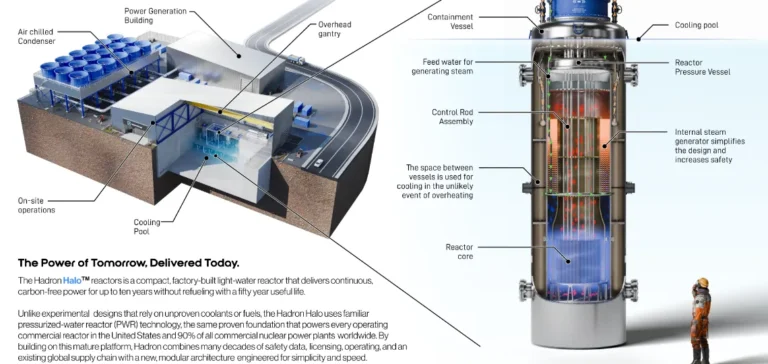
Hadron Energy, a company developing modular nuclear microreactors, has intensified its regulatory preparations as it nears its $1.2bn merger with special purpose acquisition company (SPAC) GigCapital7 Corp. The company has chosen to focus on light-water technology, which already benefits from a mature regulatory framework in the United States, overseen by the U.S. Nuclear Regulatory Commission (NRC), currently supervising 94 reactors of this type in operation.

An early-stage regulatory strategy

Since its founding, Hadron has pursued a structured relationship with the NRC, the civilian nuclear regulator. The company began participating in the commission’s public meetings in 2024 and has taken part in shaping policies related to advanced reactors. During a meeting in July 2025, Hadron was the only company to publicly support a more stringent safety framework for low-consequence microreactors—requirements its Halo MMR model is designed to meet.

In April 2025, the company submitted a Letter of Intent and a Regulatory Engagement Plan (REP), initiating a formal pre-application process with the NRC. The plan was subsequently updated to align with the regulator’s latest guidance. Hadron has submitted its Quality Assurance Program Description (QAPD) on schedule and plans to file a Topical Report on Principal Design Criteria (PDC) in the near future.

Maintaining targets despite government shutdown

The temporary federal government shutdown has not delayed Hadron’s strategy, as the company continues drafting technical reports and reinforcing its internal teams. It remains on track with its internal calendar, relying on a structured regulatory approach to support the development and commercial rollout of the Halo MMR.

Hadron has also initiated contact with the U.S. Department of Energy (DOE), aiming for potential collaboration under the Janus Project, a programme designed to prepare for the installation of microreactors on U.S. military bases. These discussions form part of a broader strategic alignment with federal agencies.

A key asset in the GigCapital7 merger

As the finalisation of the merger with GigCapital7 approaches, Hadron strengthens its investment appeal through advanced regulatory preparedness. The company is leveraging its technical and administrative groundwork to convince the market of its ability to industrialise its microreactors within a complex regulatory environment.


Bishkek plans to host a RITM-200N small modular reactor supplied by Rosatom to address electricity shortages and deepen energy ties with Moscow, despite the risks posed by Western sanctions.
The Niigata prefectural assembly will vote on the restart of Unit 6, potentially marking TEPCO’s first reactor relaunch since the 2011 Fukushima disaster.
The Norwegian government has initiated a consultation with neighbouring countries on its modular nuclear power plant project in Aure and Heim, in accordance with the Espoo Convention.
Türkiye and South Korea have signed a memorandum of understanding to jointly explore nuclear power plant projects, marking a strategic step in the long-term development of Türkiye's energy infrastructure.
Asian Development Bank has amended its energy policy to enable funding for civil nuclear projects in developing member countries across the Asia-Pacific region.
First Hydrogen begins research with the University of Alberta to identify molten-salt mixtures simulating nuclear fuels for SMR prototypes.
Framatome has completed the manufacturing of the first nuclear fuel assemblies for the Barakah power plant, marking a key milestone in the supply agreement signed with Emirates Nuclear Energy Company in July.
A government-commissioned report proposes 47 measures to simplify nuclear regulation, reduce decommissioning costs and accelerate delivery of civilian and military projects.
The Hualong One reactor at Zhangzhou nuclear power plant has been connected to the grid, marking a major milestone in the expansion of China’s civilian nuclear programme.
Russian state nuclear group Rosatom has validated the additive manufacturing of parts for its small modular reactors, marking an industrial first for RITM-200 SMR plant equipment.
California-based Maritime Fusion, backed by Y Combinator and Trucks VC, is betting on a decentralised approach to fusion to target maritime and off-grid applications.
Bayridge Resources secures a majority stake in an advanced uranium project in Canada, strengthening its strategic presence in a geologically promising region.
A significant volume of concrete from the dismantling of the Sizewell A nuclear power plant is being transferred to support the foundations of the Sizewell C project, under a partnership between UK nuclear sector stakeholders.
Korean group KEPCO and UAE-based ENEC have signed two memorandums of understanding to expand their cooperation in civil nuclear energy, artificial intelligence, and digital technologies targeting new international markets.
The Janus programme will deploy micro nuclear power plants across nine military bases to reinforce energy autonomy for critical U.S. Army installations.
The Idaho National Laboratory has started irradiation testing on uranium-zirconium fuel samples from Lightbridge in its experimental reactor, marking a key step toward the industrial validation of advanced nuclear fuel.
NexGen Energy has opened Canadian Nuclear Safety Commission hearings for the final approval of its Rook I uranium project, following more than six years of regulatory process.
Oklo has signed a binding agreement with Siemens Energy to accelerate manufacturing of the energy conversion system for its first advanced nuclear power plant in the United States.
A security document handling incident at the nuclear power plant renews concerns about TEPCO as a key decision on restarting reactors 6 and 7 approaches in Niigata.
An initial civil nuclear cooperation agreement was signed between the United States and Saudi Arabia, prompting calls from the US Congress for strict safeguards to prevent a Middle East arms race.

All the latest energy news, all the time

Annual subscription

8.25$/month*

*billed annually at 99$/year for the first year then 149,00$/year ​

Unlimited access - Archives included - Pro invoice

Monthly subscription

Unlimited access • Archives included

5.2$/month*
then 14.90$ per month thereafter

*Prices shown are exclusive of VAT, which may vary according to your location or professional status.

Since 2021: 30,000 articles - +150 analyses/week.