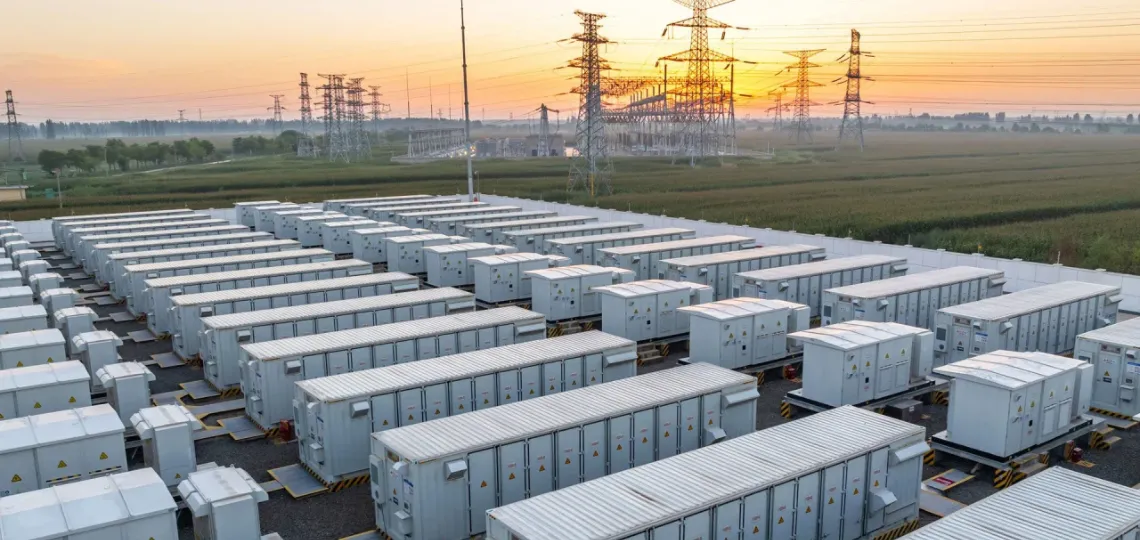
Germany is facing an unprecedented saturation of connection requests for battery energy storage systems (BESS), prompting authorities to consider a comprehensive reform of grid access rules. The number of pending projects far exceeds available capacity, even as the country seeks to accelerate system flexibility following its nuclear phase-out.
A massive and unrealistic queue
According to data published by the Federal Network Agency (Bundesnetzagentur), approximately 9,710 BESS connection requests were submitted in 2024, representing a theoretical volume of 400 GW and 661 GWh. These figures contrast sharply with the currently operational installations, which do not exceed 2.3 GW for medium and high-voltage capacities. This imbalance is fuelling a queue whose scale raises doubts about the actual viability of many projects.
The majority of requests reflect a strategy to secure grid positions, taking advantage of the “first come, first served” principle without any guarantee of actual execution. In the absence of strict maturity criteria – such as permits, secured land or confirmed financing – these projects act more as speculative options than structured investments.
Revenue signals under pressure
In parallel with infrastructure constraints, the economic outlook for BESS is shifting rapidly. The intraday arbitrage market is experiencing spread compression as installed capacity rises and price peaks are smoothed out. System services, such as frequency regulation, also show signs of saturation. These developments limit revenues from merchant projects and increase selection based on operational performance and digital optimisation.
Analysts observe a growing dispersion in returns: better-located assets or those with advanced dispatch technology capture a premium, while others see their margins shrink. In this context, the quality of the grid connection point becomes a key factor in project profitability.
Berlin initiates grid regulation reform
In response to the bottleneck, the Federal Ministry for Economic Affairs and Climate Action is working on a targeted reform of connection rules. A consultation is underway to remove large BESS projects (above 100 MW) from the regulatory framework applicable to power plants (KraftNAV). This move aims to adapt legal procedures to the specificities of storage assets, assigning them differentiated processes.
At the same time, a July 2025 ruling by the Federal Court of Justice (Bundesgerichtshof) allowed for differentiated pricing models for grid connection costs, potentially increasing investment variability depending on project location. This new “grid” CAPEX risk is altering financial assessment parameters and could impact active project pipelines.
Shift toward capacity market model
Germany plans to implement a capacity mechanism by 2028. This reform would introduce availability-based remuneration, which could stabilise revenues for BESS assets capable of providing dispatchable power on demand. However, participation in the mechanism will depend on compliance with strict performance criteria, potentially excluding some of the currently queued projects.
This strategic direction signals a move toward a more contract-based model, reducing exposure to market volatility. It may redefine the hierarchy of “bankable” assets, favouring those with secured grid access and technical profiles aligned with availability requirements.