TOPCon Modules Naturally Recover from UV Degradation Without Production Loss
Researchers from Nanchang University and Trina Solar demonstrate that TOPCon solar modules withstand ultraviolet-induced degradation through spontaneous recovery under natural light, with no measurable impact on energy production under real-world conditions.
Innovation & Transformation, Innovation sectorielle
Researchers from Nanchang University and solar module manufacturer Trina Solar have published a study demonstrating that tunnel oxide passivating contact (TOPCon) modules exhibit metastable resilience against ultraviolet (UV)-induced degradation. The work, published in the journal Solar Energy, confirms that performance losses related to UV irradiation naturally resolve under the effect of natural sunlight. According to the authors, these findings strengthen the bankability of this technology, now dominant in the photovoltaic sector.
A Degradation-Recovery Cycle Documented in Laboratory
The experiments used an accelerated aging chamber equipped with a metal halide lamp emitting in the 280–400 nm range. UV intensity was applied at 180 W/m², while module temperature was maintained between 60 and 65 °C, with the chamber set between 50 and 60 °C. Samples were exposed to a cumulative irradiation dose of 2 kWh/m² from a light source of 800 W/m², then subjected to a total UV fluence of 30 kWh/m². After irradiation, modules were stored in darkness for seven days before being exposed to natural light for one day.
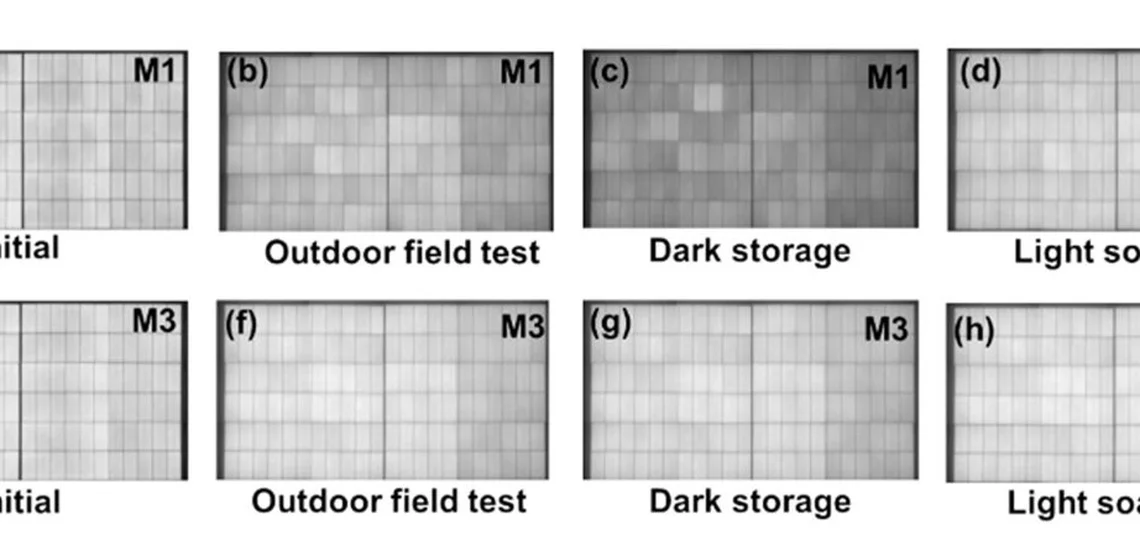
Three types of TOPCon cells (C1 to C3), equipped with aluminum oxide (Al₂O₃) and silicon nitride (SiNx) layers of different compositions, were studied, and corresponding modules (M1, M3) were manufactured from these cells. Researchers monitored the front surface of cells through current-voltage measurements and photoluminescence imaging at each stage of the protocol. The analysis reveals a systematic cycle of degradation followed by recovery, triggered by charge redistribution and hydrogen-mediated passivation, according to the authors.
Five Months of Real-World Monitoring in Changzhou
Outdoor testing was conducted in Changzhou, China, with modules installed at an inclination of 23° oriented due south. Meteorological sensors accompanied monitoring over five months. Laboratory solar simulators enabled quantification of degradation and recovery under standardized test conditions, while energy yield (EY) and performance ratio (PR) served as production indicators.
Results indicate that M1 modules, more sensitive to UV radiation, show an average EY over five months that differs by only 0.17% compared to M3 modules. All tested TOPCon modules maintained stable power under real-world conditions, with light-induced defect repair dynamics effectively compensating for UV degradation. "Our laboratory-to-field study confirms that UV degradation of TOPCon is a metastable effect recoverable by light, with no impact on real energy production," said Zhiwei Li, lead author of the study.
Toward a Revision of UV Test Standards for Photovoltaics
Researchers note that IEC 61215, which governs the qualification testing of photovoltaic modules, leaves room for improvement to better reflect the real impact of UV exposure on field production. They call on the scientific community and industry to identify UV dose thresholds that govern degradation and recovery across different technologies. This work aims to establish a standardized understanding of TOPCon module reliability, for the benefit of investors and solar project financing stakeholders.



Comments
Sign in to leave a comment.