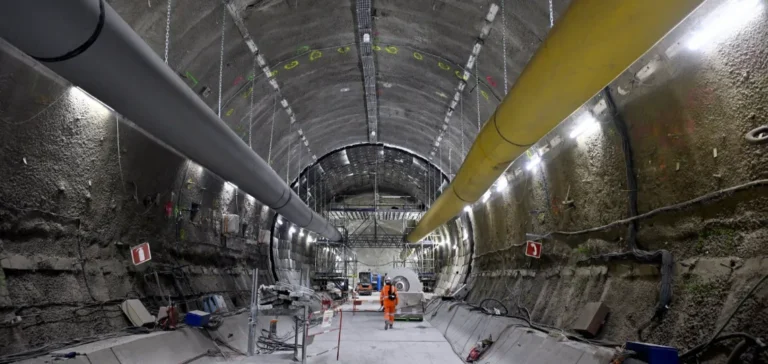

The Autorité de sûreté nucléaire et de radioprotection (ASNR) has issued a favourable opinion with conditions on the application for creation authorisation of Cigéo, the French deep geological repository for radioactive waste. This technical signal marks a critical step in the end-of-cycle nuclear policy, validating the principle of a phased deployment while requesting targeted additions on several safety aspects.
A regulatory lock lifted for the sector
Led by the Agence nationale pour la gestion des déchets radioactifs (Andra), Cigéo is intended to host high-level waste (HLW) and intermediate-level long-lived waste (ILW-LL) generated mainly by Électricité de France (EDF), Orano and the Commissariat à l’énergie atomique et aux énergies alternatives (CEA). The ASNR’s opinion removes a major regulatory risk, reducing exposure for producers whose long-term financial provisions rely on the legal stability of the project.
Deep geological storage is enshrined in law as the only solution for these waste types. It now forms an essential part of the nuclear relaunch programme, aligned with the June 2023 law accelerating the construction of new EPR2 reactors. Without Cigéo, the credibility of the French industrial model at European level would have been undermined.
Technical conditions and high-stakes project oversight
The ASNR has imposed several requirements on sensitive technical points, including fire risk control, management of bituminised waste packages, container corrosion and seal performance. These concerns will need to be addressed during the pilot industrial phase required by law before any large-scale deployment.
The project’s cost, updated in May 2025, is estimated between EUR26.1bn and EUR37.5bn ($28.3bn–$40.7bn) over 150 years. This figure includes design, operations, maintenance and taxation. Its sustainability depends on the provisions set aside by waste producers, but the Cour des comptes has called for a dedicated fund and regulatory clarification by 2027.
A local dynamic under pressure
The Meuse and Haute-Marne departments are financially tied to the project through support mechanisms and territorial development schemes. This dependency reinforces their commitment but limits their room for manoeuvre, within a local context marked by ongoing and organised opposition.
The ASNR’s opinion will be incorporated into the dossier for the public inquiry scheduled for 2026, the first step in a sequence that could lead to a creation decree by 2028. Until then, legal risks remain significant, particularly concerning the proportionality of technical responses to uncertainties and effective public participation in decision-making.
Wider industrial and geopolitical significance
For the nuclear industry, Cigéo represents a decades-long public procurement pipeline, mobilising sectors in specialised civil engineering, robotics, ventilation, materials and control systems. Involved companies benefit from rare long-term visibility, but any delay could trigger ripple effects on decommissioning costs, electricity tariffs and France’s reactor export strategy.
At the international level, France joins Finland and Sweden in the small group of countries with an advanced deep repository project. This reinforces its industrial diplomacy on nuclear energy, amid tensions over critical raw materials and growing European technological competition.