Allseas’ nuclear concept could inject EUR130bn into Dutch economy by 2050
A strategic report reveals the industrial and energy potential of Allseas’ offshore small modular reactor, which could create up to 40,000 jobs and reduce investment in the power grid.
| Sectors | Nuclear Energy, SMR |
|---|---|
| Themes | Investments & Transactions, Corporate Investment |
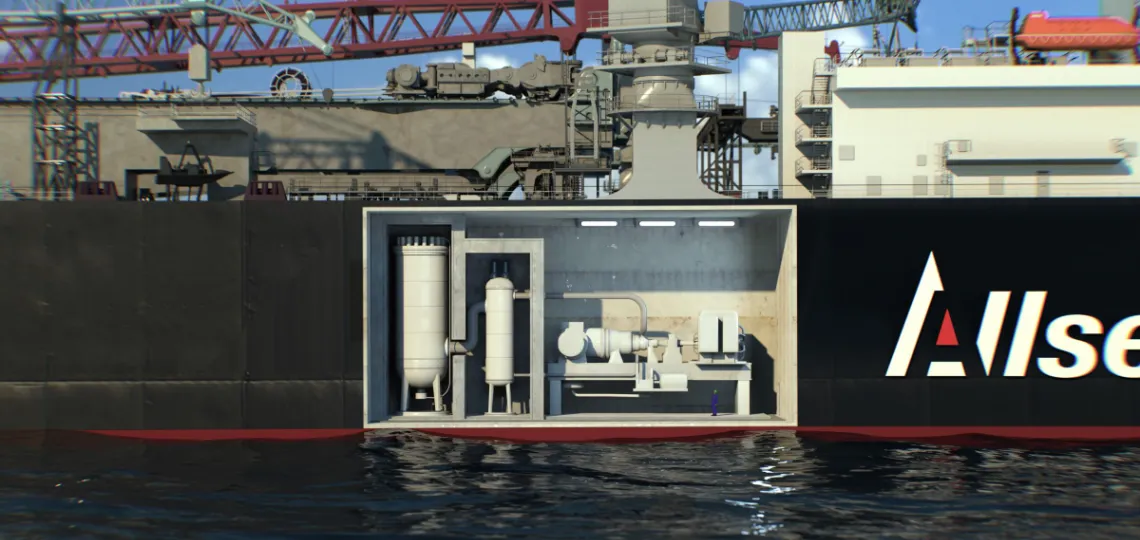
Dutch offshore engineering company Allseas has confirmed, through a study commissioned from consultancy firm Roland Berger, the major economic and energy impacts of its small modular reactor (SMR) project. Designed for deployment on ships or onshore sites, the concept could generate up to EUR130bn ($150bn) in value for the Netherlands by 2050.
A SMR designed for industrial and maritime flexibility
The selected reactor is based on high-temperature gas-cooled reactor (HTGR) technology using tri-structural isotropic (TRISO) fuel, with an output of 25 MWe or 70 MWt. This compact and modular design targets applications ranging from heavy industry and port infrastructure to data centres, defence sites, and commercial vessels. By generating energy directly at the point of use, the system would ease pressure on the national grid, enabling business expansion and attracting new operations.
According to the study, up to 110 units could be deployed in the Netherlands and 700 across the global maritime sector. Roland Berger estimates this rollout could preserve 10,000 to 15,000 jobs while creating between 35,000 and 40,000 skilled positions.
Grid savings and competitiveness gains
Local power generation could save up to EUR12bn ($13.8bn) in high-voltage infrastructure investments, a significant share of the EUR104bn projected by 2050. In addition, the report highlights potential for EUR40bn ($46bn) in added value through accelerated industrial projects freed from grid constraints.
Allseas’ SMR would offer electricity at competitive costs compared to fossil or renewable sources, while delivering industrial heat up to 650°C — 30% cheaper than gas turbines and 80% less than renewable heat solutions.
Institutional validation and export outlook
The study’s findings were validated by several Dutch institutions, including TNO, COVRA, Urenco and the Port of Rotterdam. Allseas is also working with nuclear research centre NRG-Pallas and Delft University of Technology as part of its five-year development programme.
The company plans to finalise initial design studies within the project’s first year, followed by prototype development and pre-licensing consultations. The programme includes close dialogue with safety authorities, classification bodies and industrial stakeholders.
The technology is positioned to meet growing energy demand in sectors such as semiconductors, artificial intelligence, quantum computing and high-performance data processing.