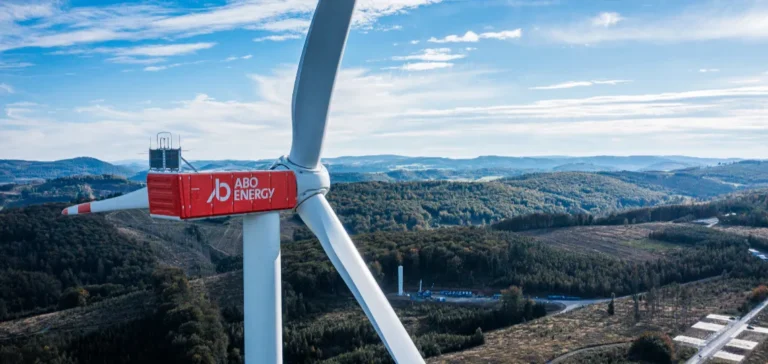
ABO Energy considers operating its own wind and solar parks

ABO Energy is assessing a shift to independent power production by operating its own renewable parks, signalling a major strategic move in a market that has become more favourable.

Share:

Comprehensive energy news coverage, updated nonstop

Annual subscription

8.25$/month*

*billed annually at 99$/year for the first year then 149,00$/year ​

Unlimited access • Archives included • Professional invoice

OTHER ACCESS OPTIONS

Monthly subscription

Unlimited access • Archives included

5.2$/month*
then 14.90$ per month thereafter

FREE ACCOUNT

3 articles offered per month

FREE

*Prices are excluding VAT, which may vary depending on your location or professional status

Since 2021: 35,000 articles • 150+ analyses per week

ABO Energy, a German company specialised in the development of renewable energy projects, is considering broadening its scope by directly operating its own generation parks. The Management Board believes that the current market environment offers opportunities to integrate the value chain by becoming an Independent Power Producer (IPP). This move would mark a shift for the company, historically positioned as a pure-play developer for three decades.

A strategy based on market evolution

According to Managing Director Dr Karsten Schlageter, the past two years have transformed sector dynamics, making integrated models more attractive. By combining wind and solar power generation with battery storage (Battery Energy Storage Systems, BESS), ABO Energy could make tailored offers to large industrial consumers. The company’s experience with Power Purchase Agreements (PPA) would support this strategy by enabling it to participate in the electricity market with baseload offers.

A substantial development pipeline

The company currently has a development pipeline of around 34 gigawatts across several countries. This volume would allow a significant share to be retained for own operation. Until now, all developed projects were sold, notably due to the lack of supply in the German wind market. Between 2019 and 2024, annually approved wind capacity rose from 1.9 to 14.1 gigawatts, enabling a better balance between supply and demand.

Financing needs to be filled

To deliver this strategic shift, ABO Energy will need to raise substantial funding. Dr Schlageter indicated that while technical and human capabilities are already in place, financing remains a hurdle. Discussions are under way with potential investors, but commitments are often contingent on securing shareholder rights.

Towards a legal restructuring

The Management Board could rely on an option already embedded in the company’s articles, allowing a return to a public limited company (Aktiengesellschaft) via a General Meeting decision. Founding families Ahn and Bockholt have expressed willingness to sell a portion of their shares if required. Such a legal change would facilitate capital opening and the arrival of strategic financial partners.

The coming weeks will be devoted to intensifying discussions with investors to examine all available options to enable ABO Energy to take this next step.
Ivanhoe Mines expects a 67% increase in electricity consumption at its copper mine in DRC, supported by new hydroelectric, solar and imported supply sources.
Q ENERGY France and the Association of Rural Mayors of France have entered a strategic partnership to develop local electrification and support France's energy sovereignty through rural territories.
ACWA Power, Badeel and SAPCO have secured $8.2bn in financing to develop seven solar and wind power plants with a combined capacity of 15 GW in Saudi Arabia, under the national programme overseen by the Ministry of Energy.
Hydro-Québec reports a 29% increase in net income over nine months in 2025, supported by a profitable export strategy and financial gains from an asset sale.
Antin Infrastructure Partners is preparing to sell Idex in early 2026, with four North American funds competing for a strategic asset in the European district heating market.
EDF could sell up to 100% of its US renewables unit, valued at nearly €4bn ($4.35bn), to focus on French nuclear projects amid rising debt and growing political uncertainty in the United States.
Norsk Hydro plans to shut down five extrusion plants in Europe in 2026, impacting 730 employees, as part of a restructuring aimed at improving profitability in a pressured market.
The City of Paris has awarded Dalkia the concession for its urban heating network, a €15bn contract, ousting long-time operator Engie after a five-year process.
NU E Power Corp. completed the purchase of 500 MW in energy assets from ACT Mid Market Ltd. and appointed Broderick Gunning as Chief Executive Officer, marking a new strategic phase for the company.
Commodities trader BB Energy has cut over a dozen jobs in Houston and will shift some administrative roles to Europe as part of a strategic reorganisation.
Ferrari has entered into an agreement with Shell for the supply of 650 GWh of renewable electricity until 2034, covering nearly half of the energy needs of its Maranello site.
By divesting assets in Mexico, France and Eastern Europe, Iberdrola reduces exposure to non-strategic markets to strengthen its positions in regulated networks in the United Kingdom, the United States and Brazil, following a targeted capital reallocation strategy.
Iberdrola offers to buy the remaining 16.2% of Neoenergia for 32.5 BRL per share, valuing the transaction at approximately €1.03bn to simplify its Brazilian subsidiary’s structure.
Paratus Energy Services collected $38mn via its subsidiary Fontis Energy for overdue invoices in Mexico, supported by a public fund aimed at stabilising supplier payments.
CrossBoundary Energy secures a $200mn multi-project debt facility, backed by Standard Bank and a $495mn MIGA guarantee, to supply solar and storage solutions for industrial and mining clients across up to 20 African countries.
Mercuria finalises an Asian syndicated loan refinancing with a 35% increase from 2024, consolidating its strategic position in the region.
Sixty Fortune 100 companies are attending COP30, illustrating a growing disconnect between federal US policy and corporate strategies facing international climate regulations.
Tanmiah Food Company signed three memorandums of understanding to reduce its emissions and launched the region’s first poultry facility cooled by geothermal energy, in alignment with Saudi Arabia’s industrial ambitions.
Subsea7 posted higher operating profit and a record order backlog, supported by long-term contracts in the Subsea and Renewables segments.
Adnoc signed multiple agreements with Chinese groups during CIIE, expanding commercial exchange and industrial cooperation with Beijing in oil, gas and petrochemical materials.

All the latest energy news, all the time

Annual subscription

8.25$/month*

*billed annually at 99$/year for the first year then 149,00$/year ​

Unlimited access - Archives included - Pro invoice

Monthly subscription

Unlimited access • Archives included

5.2$/month*
then 14.90$ per month thereafter

*Prices shown are exclusive of VAT, which may vary according to your location or professional status.

Since 2021: 30,000 articles - +150 analyses/week.