A drone damages the Chernobyl sarcophagus, Ukraine left alone to handle repairs

The drone strike confirmed by the IAEA on the Chernobyl site vault exposes Ukraine to a nuclear risk under armed conflict, forcing the EBRD to finance partial restoration while industry standards must now account for drone threats.

Share:

Comprehensive energy news coverage, updated nonstop

Annual subscription

8.25$/month*

*billed annually at 99$/year for the first year then 149,00$/year ​

Unlimited access • Archives included • Professional invoice

OTHER ACCESS OPTIONS

Monthly subscription

Unlimited access • Archives included

5.2$/month*
then 14.90$ per month thereafter

FREE ACCOUNT

3 articles offered per month

FREE

*Prices are excluding VAT, which may vary depending on your location or professional status

Since 2021: 35,000 articles • 150+ analyses per week

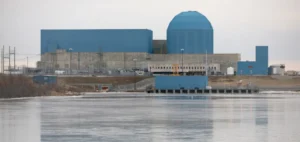
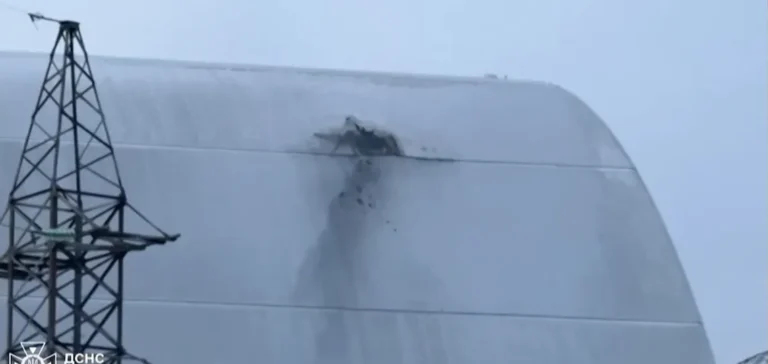
The International Atomic Energy Agency (IAEA) confirmed that the Chernobyl sarcophagus, originally built after the 1986 disaster and modernised under the New Safe Confinement (NSC) project, has lost its primary containment functions following an explosive drone strike. The attack caused visible structural damage to the site’s outer shell, although the internal load-bearing structures and monitoring systems remain intact, according to the agency’s report.

A nuclear site under direct military pressure

The infrastructure, designed for a 100-year lifespan, was hit in a peripheral area housing technical equipment. The projectile, identified as an explosive drone, pierced the roof and created an estimated six-metre-wide hole. Ukrainian teams later opened over 300 secondary access points to contain a fire outbreak, further weakening the building’s envelope and exposing it to external elements. These emergency operations compromised the structure’s airtightness, increasing the risk of accelerated corrosion.

EBRD reopens financing on a previously closed asset

The European Bank for Reconstruction and Development (EBRD), which had coordinated over €2.1bn ($2.3bn) in international funding for the NSC’s construction, confirmed its commitment to support repair efforts starting in 2026. Ukraine, operationally responsible for the site since 2019, must now oversee the works under heightened security constraints. The initial plan includes temporary measures in 2025, such as partial re-cladding and provisional membrane installation.

Nuclear companies required to adjust technical standards

The Novarka consortium, made up of Vinci Construction Grands Projets and Bouygues Travaux Publics, designed the NSC to withstand natural and industrial hazards, but not repeated drone attacks. This event marks a turning point in design assumptions. Future nuclear containment structures will need to address asymmetric threats, structurally and in terms of security, with both passive and active protection systems.

Insurance and multilateral lenders face new exposures

Reclassifying a civilian site as a military target forces a revision of insurance models. International insurers and reinsurers may reconsider their “construction damage” policies to explicitly exclude acts of war. This shift would increase the financial burden on states and lenders, exposed to higher guarantee costs in conflict zones. The EBRD may also have to revise its eligibility criteria for nuclear-related projects.

Geopolitical pressure on critical infrastructure

The Chernobyl strike follows a series of incidents targeting Ukrainian energy infrastructure since the war began. Targeting a symbolic, donor-funded site sends a strategic message to Ukraine’s Western allies. Although the short-term radioactive risk is limited, further incidents or extreme weather could worsen the exposure, potentially affecting neighbouring countries like Belarus and Poland.

Industry and diplomatic frameworks face new demands

The IAEA, with no enforcement authority, has officially acknowledged the NSC’s degradation as an international precedent. This recognition could reignite discussions within the European Union and the North Atlantic Treaty Organization (NATO) about introducing specific protection regimes for nuclear infrastructure during wartime. The focus lies on securing existing installations and embedding enhanced standards into future projects.
The full-scope simulator for the Lianjiang nuclear project has successfully passed factory acceptance testing, paving the way for its installation at the construction site in China's Guangdong province.
A coalition of Danish industry groups, unions and investors launches a platform in support of modular nuclear power, aiming to develop firm low-carbon capacity to sustain industrial competitiveness.
The United Kingdom and TAE Technologies create a joint venture in Culham to produce neutral beams, a key component of fusion, with strategic backing from Google.
Texas-based developer Natura Resources receives new federal funding to test key components of its 100-megawatt modular reactor in partnership with Oak Ridge National Laboratory.
The Niigata regional assembly is deliberating on restarting unit 6 of the world’s largest nuclear plant, thirteen years after operations ceased following the Fukushima disaster.
Reactor Doel 2 was taken offline, becoming the fifth Belgian reactor to cease operations under the country’s gradual nuclear phase-out policy.
Rolls-Royce SMR has expanded its partnership with ÚJV Řež to accelerate the deployment of small modular reactors, targeting the construction of several units in the Czech Republic and abroad.
The Indian government aims to amend legislation to allow private companies to participate in civil nuclear development, a move positioned as critical to achieving the country’s long-term energy targets.
The VVER-1200 nuclear reactor at Xudabao 4 in China has completed installation of its final passive water tank, marking the end of modular construction for the second phase of the project.
Ottawa and Edmonton commit to a nuclear production roadmap by 2050, through a memorandum of understanding also covering carbon capture and an Indigenous-led pipeline project.
Niamey asserts control over its uranium resources by authorising open market sales of Somaïr’s production, formerly operated by France’s Orano, amid ongoing legal disputes.
Equinix has signed a strategic agreement with French start-up Stellaria to reserve 500 MWe of advanced nuclear capacity to power its future European AI data centres starting in 2035.
Bishkek plans to host a RITM-200N small modular reactor supplied by Rosatom to address electricity shortages and deepen energy ties with Moscow, despite the risks posed by Western sanctions.
The Niigata prefectural assembly will vote on the restart of Unit 6, potentially marking TEPCO’s first reactor relaunch since the 2011 Fukushima disaster.
The Norwegian government has initiated a consultation with neighbouring countries on its modular nuclear power plant project in Aure and Heim, in accordance with the Espoo Convention.
Türkiye and South Korea have signed a memorandum of understanding to jointly explore nuclear power plant projects, marking a strategic step in the long-term development of Türkiye's energy infrastructure.
Asian Development Bank has amended its energy policy to enable funding for civil nuclear projects in developing member countries across the Asia-Pacific region.
First Hydrogen begins research with the University of Alberta to identify molten-salt mixtures simulating nuclear fuels for SMR prototypes.
Framatome has completed the manufacturing of the first nuclear fuel assemblies for the Barakah power plant, marking a key milestone in the supply agreement signed with Emirates Nuclear Energy Company in July.
A government-commissioned report proposes 47 measures to simplify nuclear regulation, reduce decommissioning costs and accelerate delivery of civilian and military projects.

All the latest energy news, all the time

Annual subscription

8.25$/month*

*billed annually at 99$/year for the first year then 149,00$/year ​

Unlimited access - Archives included - Pro invoice

Monthly subscription

Unlimited access • Archives included

5.2$/month*
then 14.90$ per month thereafter

*Prices shown are exclusive of VAT, which may vary according to your location or professional status.

Since 2021: 30,000 articles - +150 analyses/week.