Marvel Fusion seeks funding in France

Marvel Fusion, which specializes in laser-based inertial nuclear fusion, is seeking to raise hundreds of millions of euros in France to finance its experimental reactor. This revolutionary technology would make it possible to produce electricity without highly radioactive waste.

Share:

Comprehensive energy news coverage, updated nonstop

Annual subscription

8.25$/month*

*billed annually at 99$/year for the first year then 149,00$/year ​

Unlimited access • Archives included • Professional invoice

OTHER ACCESS OPTIONS

Monthly subscription

Unlimited access • Archives included

5.2$/month*
then 14.90$ per month thereafter

FREE ACCOUNT

3 articles offered per month

FREE

*Prices are excluding VAT, which may vary depending on your location or professional status

Since 2021: 35,000 articles • 150+ analyses per week

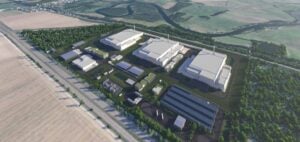
The German start-up Marvel Fusion, which specializes in laser-based inertial nuclear fusion, is currently seeking funding in France to carry out its revolutionary project. The company wants to raise 350 million euros to finance an experimental reactor in order to obtain scientific and technical validation for its research. Nicolas Burkardt, the start-up’s financial director, stresses that this search for funding in France could be an ambitious Franco-German project in a context where “we all need more electricity”.

A research partnership with Thales and links with American universities

Marvel Fusion has already entered into a research partnership with the French group Thales, which is one of the only manufacturers in the world able to supply high-power lasers adapted to its needs. The joint research is carried out in the Thales Nuclear Physics Laser Center in Romania. The start-up also has links with LMU Munich, Stanford and MIT in the United States.

German government provides financial support

The German government announced last Thursday that it would provide “up to 90 million euros” to support this project over the next five years, via the Federal Agency for Disruptive Innovations (SPRIND).

Inertial nuclear fusion by laser: a revolutionary technology

Laser inertial nuclear fusion is a competing technology to that of so-called magnetic confinement fusion, using plasma and magnets of the same type as the international experimental reactor Iter based in southeastern France. The futuristic solution of nuclear fusion is praised by its promoters, allowing them to obtain gigantic quantities of energy while avoiding the shortcomings of current power plants: long-lived highly radioactive waste and the risk of major accidents.

An ambitious project

Marvel Fusion differs from the majority of companies working on magnetic confinement nuclear fusion by focusing on laser inertial nuclear fusion technology, which its promoters believe is more efficient. This German start-up hopes to “produce electricity at 50 euros per megawatt-hour”.

With a growing demand for energy, this ambitious project could offer an interesting alternative to traditional energy sources.
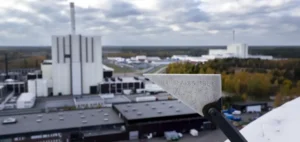

Videberg Kraft AB becomes the first company to request government support to build two new reactors at the Ringhals site, under the national nuclear investment framework adopted in 2025.
The European Commission opens an in-depth investigation into Prague's public funding of a major nuclear project, which could reach €30bn ($32.88bn), with guaranteed revenues over forty years.
Niigata's assembly officially backs the restart of the Kashiwazaki-Kariwa site, marking a key step in Japan’s return to nuclear energy following the 2011 Fukushima disaster.
The Japanese government plans to fund up to 30% of loans required for nuclear projects, aiming to accelerate reactor restarts and double the share of nuclear energy in its energy mix by 2040.
French nuclear reactor developer Newcleo has submitted its lead-cooled small modular reactor design to Euratom, initiating the first regulatory phase to integrate nuclear non-proliferation safeguards at the European level.
US-based Holtec has signed a memorandum of understanding with Hungary’s energy group MVM to assess the deployment of its SMR-300 technology, strengthening bilateral nuclear cooperation and opening prospects for a new market in Central Europe.
California-based startup Radiant has secured $300mn to build its first factory in Tennessee and prepare for the mass production of miniature nuclear reactors for off-grid applications.
Terra Innovatum has increased its interactions with the Nuclear Regulatory Commission to advance licensing of its SOLO™ micro-modular reactor, despite the partial shutdown of the US federal government.
The US nuclear regulator has extended the operating licences of three Illinois reactors by 20 years, strengthening Constellation's long-term industrial outlook for the Clinton and Dresden sites.
The SATURNE Industrial Chair aims to develop innovative uranium extraction methods, with joint funding from Orano and the National Research Agency over a four-year period.
US-based X-energy has signed a reservation agreement with South Korea's Doosan Enerbility to secure key components for its small modular nuclear reactors.
Niger expands its mining alliances with Uranium One to develop new sites, while the Dasa project continues seeking financing despite clear political backing.
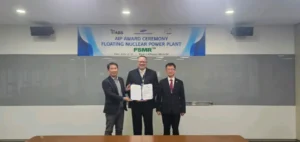
Samsung Heavy Industries has received Approval in Principle for a floating nuclear plant featuring two SMART100 reactors, marking a step toward the commercialisation of offshore small modular reactors.
The Indian government proposes a unified legal framework for nuclear energy, aiming to boost private investment and increase installed capacity to 100 GW by 2047.
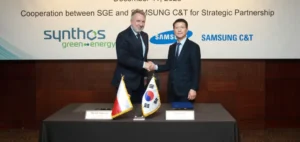
Samsung C&T strengthens its presence in modular nuclear energy in Europe by signing an agreement with Synthos Green Energy to develop up to 24 SMRs in Poland and several Central European countries.
Israeli firm nT-Tao and Ben-Gurion University have developed a nonlinear control system that improves energy stability in fusion plasmas, strengthening the technical foundation of their future compact reactors.
The Indian government has introduced a bill allowing private companies to build and operate nuclear power plants, ending a state monopoly in place for over five decades.
Natura Resources enters a new regulatory phase for its molten salt reactor MSR-1, following the signing of a framework agreement with the US Department of Energy under the Reactor Pilot Program.
Norwegian Nuclear Decommissioning is surveying 22 localities to assess their interest in hosting storage facilities for radioactive waste from the country’s former research reactors.
Electricité de France's Flamanville 3 reactor has reached full power for the first time, marking a key industrial milestone in the deployment of EPRs in Europe, despite cost overruns reaching EUR23.7bn ($25.7bn).

All the latest energy news, all the time

Annual subscription

8.25$/month*

*billed annually at 99$/year for the first year then 149,00$/year ​

Unlimited access - Archives included - Pro invoice

Monthly subscription

Unlimited access • Archives included

5.2$/month*
then 14.90$ per month thereafter

*Prices shown are exclusive of VAT, which may vary according to your location or professional status.

Since 2021: 30,000 articles - +150 analyses/week.