Europe’s solar sector to experience record growth in 2023

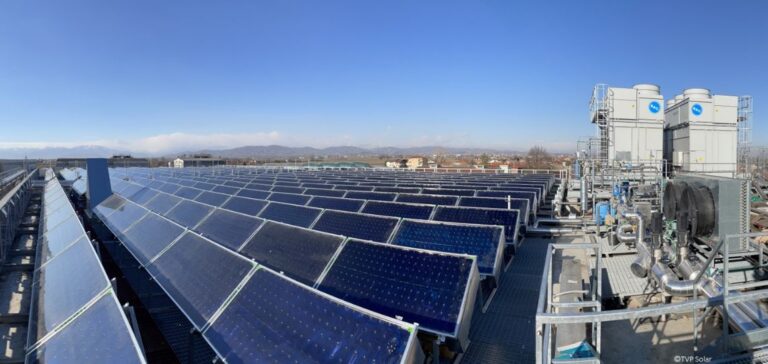
The solar sector in Europe is expected to continue to grow in 2023, with project viability improving despite inflation-related increases in project costs.

Share:

Comprehensive energy news coverage, updated nonstop

Annual subscription

8.25$/month*

*billed annually at 99$/year for the first year then 149,00$/year ​

Unlimited access • Archives included • Professional invoice

OTHER ACCESS OPTIONS

Monthly subscription

Unlimited access • Archives included

5.2$/month*
then 14.90$ per month thereafter

FREE ACCOUNT

3 articles offered per month

FREE

*Prices are excluding VAT, which may vary depending on your location or professional status

Since 2021: 35,000 articles • 150+ analyses per week

According to the industry association SolarPower Europe, 54 GW of new installations are expected. Despite the expected rebound in the discounted cost of energy, the share of solar in the European energy mix is expected to double.

The dawn of the solar age in Europe

Michael Schmela, Director of Market Intelligence at SolarPower Europe, states:

“Perhaps 2022 will be remembered in Europe as the dawn of the solar age.”

He notes the importance of the war in Ukraine and the palliatives needed for Russian gas. He adds that solar energy checks all three boxes of the energy trilemma: sustainability, affordability and security of supply.

Bruno Brunetti, global head of low-carbon power analysis at S&P states:

“Despite short-term uncertainty created by inflation, revenue caps, and market reform, the acceleration of distributed solar power and the resumption of projects are helping to sustain solar growth in Europe. Western Europe will thus continue to lead the solar boom. Solar’s share is expected to double from 8% currently to 20% in 2030.”… “Strong corporate renewable energy procurement targets are supporting the growth of the solar sector, both via APPs and GOs.”

Brunetti expects EU GOs to average 6 euros/MWh by 2023. In addition, S&P analysts are raising their forecast for solar additions from 5 to 6 GW/year over the 2022-2027 period. These additions will contribute to the growth of the solar sector in Europe.

PPA pricing platform Pexapark quoted a 10-year PPA index for European solar at 83.52 euros/MWh on December 20. This is an increase of 29% over previous levels.

However, regional prices may differ considerably, thus affecting the growth of the solar sector in Europe. The Pexapark index for Spain was set at 52.54 euros/MWh while the index for Germany was set at 92.86 euros/MWh.

Rising cost of solar projects linked to inflation

According to S&P, price increases for solar modules are expected to decline as supply chain bottlenecks are resolved and raw material costs fall. As an example, the price of polycrystalline silicon declined in Q4 2022 to 35.48 USD/kg. This represents an 8% decrease compared to Q3.

Another element is affecting the growth of the solar sector in Europe. The average capital expenditure for a solar project is increasing, especially in Germany. This increase is about 30% over the last two years, setting the average at 640,000 USD/MW. For example, photovoltaic modules alone account for 45% of the cost in Germany. However, Germany may lift its support for solar auctions for a variety of reasons, according to S&P.

In addition, S&P expects solar LCOEs to moderate again in 2023 and decline over the longer term. German LCOEs are expected to fall from USD 50/MWh in 2022 to USD 35/MWh in 2023. For comparison, Spanish LCOEs are expected to fall from around USD 40/MWh in 2022 to USD 20/MWh in 2023.

Solar energy back on the map in Europe

At the same time, the increasing dependence on China is becoming a problem for the growth of the solar sector in Europe. Ursula Von Der Leyen, President of the EC, proposes the creation of a raw materials club as a remedy. It provides additional support to counter the U.S. Inflation Reduction Act (IRA). Indeed, this one has similar objectives to Repower Eu.

Read on energynews.pro: ISB funding strengthens REPowerEU


According to S&P, strengthening network infrastructure and workforce skills are the most important areas beyond a stable regulatory framework. Moreover, two-thirds of the EU’s 209 GW of installed solar capacity is still on rooftops. This segment, which is growing faster than large-scale projects, will be of increasing importance according to Schmela.

S&P’s Schmela also believes the battery business will become viable in part because of rising electricity bills. S&P calculates that the battery market should reach 9.3 Gwh of capacity by the end of 2022, more than triple the 2020 level. 1 million European homes would then be equipped with batteries. Schmela states:

“A sometimes overlooked technology, batteries have essentially become a standard component of home solar systems in major markets.”


The mandatory solar panel requirements that the EU is putting in place will help accelerate the energy transition to photovoltaics. S&P’s Brunetti says that one major uncertainty remains for 2023, however: the planned reform of the EU’s gas and electricity market. The aim of this is to break the link between electricity and gas prices. A large number of models are being debated to define the modalities of solar growth in Europe. However, there is no clear guidance on how or whether to move away from the marginal price model.

 

EDF Power Solutions UK has appointed METLEN to lead engineering and construction for the 400MW Longfield solar farm in Essex, with commissioning scheduled for 2030.
Independent power producer Neoen has secured six agrivoltaic projects totalling 124 MWp, reinforcing its position as the leading winner in French solar tenders since 2021.
As the photovoltaic industry enters a phase of deep restructuring, the duel between TOPCon 4.0 and heterojunction technologies is redefining manufacturers’ margins. In 2026, reducing production costs becomes the primary strategic lever for global market leaders.
JA Solar and Trinasolar top Wood Mackenzie’s latest semiannual ranking despite a sector-wide net loss of $2.2 billion. Industrial leaders are strengthening their grip on global photovoltaic module supply through rigorous financial discipline.
BayWa r.e. has finalised the sale of a 46 MW floating solar park, the country’s largest, to a Dutch public-local consortium, marking a new step in the decentralised structuring of the solar market in the Netherlands.
The ATUM Solar industrial complex, located in Ain Sokhna, will include three factories—two of 2 GW capacity—backed by a $220mn investment from an international consortium.
AMEA Power has completed the commercial commissioning of a 120 MWp solar project in Kairouan, marking a national first in Tunisia for a renewable energy installation of this scale.
The Gerus plant becomes the first solar installation in Namibia to sell electricity directly on the Southern African Power Pool regional market.
Japanese conglomerate Tokyu teams up with Global Infrastructure Management and Clean Energy Connect to build 800 low-voltage solar plants totalling 70MWDC, under an off-site power purchase agreement for its facilities.
T1 Energy has begun construction of a solar cell facility in Milam County, Texas, representing an investment of up to $425mn, aimed at strengthening U.S. industrial autonomy in the photovoltaic supply chain.
Pivot Energy has secured $225mn in funding from three banking partners to support a portfolio of 60 community solar power plants across nine US states.
Voltalia has started building a 43-megawatt hybrid plant in Sainte-Anne, combining solar, battery storage and bioenergy to meet growing electricity demand in western French Guiana.
Masdar’s exit ends ReNew Energy's privatisation attempt, despite offer rising to $8.15 per share.
California surpassed 52.3% of electricity from renewables and large hydro in 2024, marking a major energy milestone while increasing pressure on storage, permitting and curtailed production.
European Energy France has secured two wins in tenders issued by the French Energy Regulatory Commission for its agrivoltaic parks in Saint-Voir, with a combined capacity of 14.3 MWp and commissioning expected by late 2027.
TotalEnergies will supply Google with 1TWh of renewable electricity from a 20MW solar plant in Malaysia under a 21-year power purchase agreement.
Enviromena secured approval for its Fillongley solar farm after a local council’s refusal was overturned, despite conflicts of interest tied to public funds used to oppose the project.
According to Wood Mackenzie, the global solar inverter market will face two consecutive years of contraction after record shipments in 2024, driven by regulatory tensions in China, Europe and the United States.
The UK government has assigned a GBP135mn ($180mn) budget for solar energy in its seventh CfD auction round, aiming to support up to 4 GW of installed capacity.
SEG Solar launches a strategic industrial project in Indonesia with 3GW capacity to support the supply chain of its photovoltaic modules for the US market.

All the latest energy news, all the time

Annual subscription

8.25$/month*

*billed annually at 99$/year for the first year then 149,00$/year ​

Unlimited access - Archives included - Pro invoice

Monthly subscription

Unlimited access • Archives included

5.2$/month*
then 14.90$ per month thereafter

*Prices shown are exclusive of VAT, which may vary according to your location or professional status.

Since 2021: 30,000 articles - +150 analyses/week.