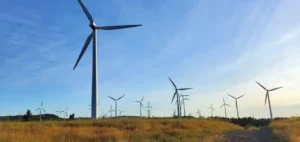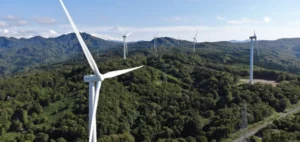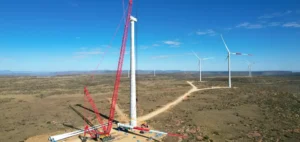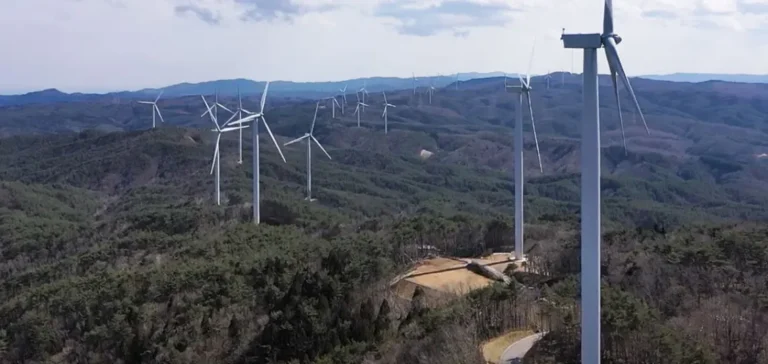

The Kagurayama onshore wind farm, located in Japan’s Fukushima prefecture, has officially commenced commercial operations with a grid injection capacity of 61.1 MW. The project benefits from a guaranteed purchase tariff of JPY22 per kWh, certified in 2017 under the Feed-in Tariff (FIT) scheme, ensuring a stable 20-year revenue stream. This revenue structure protects the project from market fluctuations, with estimated annual revenue of around JPY3.6bn ($25mn) based on a projected output of 165 GWh.
Project constrained by grid limitations
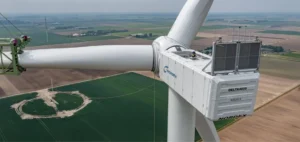
Although equipped with 16 turbines rated at 4.3 MW each, totalling 68.8 MW of installed capacity, the project’s grid injection is capped at 61.1 MW. This limitation reflects the structural constraints of Japan’s eastern electricity grid, where congestion continues to hinder large-scale renewable energy integration. The economic cost of lost output during high wind periods represents a recurring technical and financial loss.
The total capital expenditure (Capex) is estimated at JPY34.7bn ($241mn), or roughly JPY0.57bn ($4mn) per installed MW — a level consistent with Japan’s topography and regulatory context. The site’s implied capacity factor is approximately 31 %, based on the injected capacity. Regulatory approval processes began in 2016 and concluded in 2021, highlighting the significant permitting timelines typical in Japan.
Local structure and regional leadership
The project is managed by Iwaki Kagurayama Fukko Energy LLC, a standard project finance Special Purpose Company (SPC). JR-EAST Energy Development acts as operator and representative of the consortium. Shareholders include Fukushima Electric Power and several regional industrial firms such as Banei Unso, Kamata Sangyo, and Joban Kosan, reflecting a governance model aligned with post-2011 reconstruction objectives and local economic integration.
The municipalities of Iwaki and Kawauchi are involved in planning and permitting, while national authorities — notably the Ministry of Economy, Trade and Industry (METI) — oversaw the FIT certification and environmental assessment. The injection limit suggests a centralised grid operator’s role in managing regional capacity constraints.
Technical risks and exposed supply chain
Key short-term risks include turbine availability and evolving curtailment regulations. Local operations and maintenance (O&M) needs are expected to increase demand for spare parts and specialised labour. Critical component costs may rise if geopolitical or commercial factors disrupt supply chains for metals and electronics.
O&M costs must be monitored closely amid inflationary pressures and a technician shortage. While the project is protected by a grandfathered FIT, additional restrictions may arise if regional grid congestion worsens.
Strategic value for JR-EAST Energy Development
For JR-EAST Energy Development, Kagurayama represents a significant milestone in regional portfolio building. The asset generates stable cash flows comparable to a bond-like investment, supporting financing for upcoming projects. This execution strengthens the company’s credibility for future wind farms in Fukushima, including Iwaki Miwa and Abukuma.
However, multi-stakeholder governance entails slower decision-making due to varied interests, ESG compliance, and local return expectations. The project also remains exposed to reputational risks related to noise, biodiversity, and landscape — common concerns for onshore wind projects in Japan.
Energy symbolism and market signals
At the national level, Kagurayama’s contribution to energy supply is limited, but it supports reduced fossil fuel imports and generation diversification. The project also reinforces Fukushima’s post-disaster trajectory, where renewables serve as instruments for economic recovery and territorial legitimacy. Local authorities view the project as a symbol of resilience, although its operational performance will depend on the grid’s adaptability.
Japanese authorities will need to monitor actual curtailment levels and regional dispatch policies to refine market signals. Kagurayama may serve as a model for future developments in Fukushima, provided that permitting delays and interconnection issues can be mitigated.