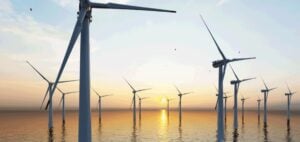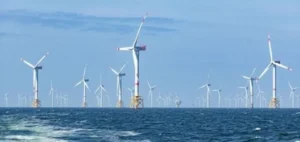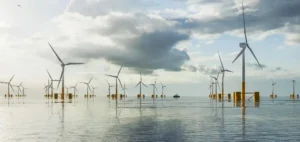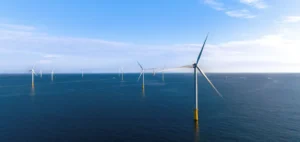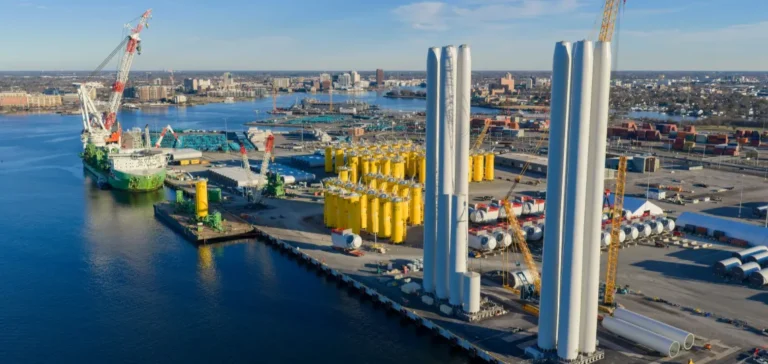

The United States federal administration has announced the immediate suspension of five major offshore wind projects under construction along the East Coast, citing reasons linked to national security. The decision, communicated by the Department of the Interior, applies exclusively to installations located in the Atlantic, including the Coastal Virginia Offshore Wind (CVOW), one of the most advanced projects. It is set for a 90-day duration, according to the authorities, to “assess the possibility of mitigating the risks” identified by the Department of Defense.
Radar interference at the origin of the decision
Federal authorities justify the measure by the occurrence of “radar interferences” caused by the movement of turbine blades and the highly reflective structures, which could potentially disrupt military or intelligence operations. A prior government report, published in 2024, had already flagged these effects, without leading to regulatory adjustments at the time. The current suspension follows a new risk assessment, although technical details have not been publicly disclosed.
The Secretary of the Interior emphasised that this decision was made in coordination with the Department of Defense and is part of a precautionary framework intended to ensure the continuity of strategic capabilities. Minister Doug Burgum, also involved in the announcement, defended the decision as a “common-sense” measure, stating that “a single gas pipeline supplies as much energy as these five projects combined.”
Economic reactions and market impact
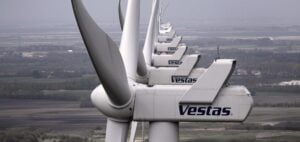
The construction halt directly affects several companies, including Dominion Energy, Ørsted, and Vestas. Dominion Energy, leading the Virginia project, stated that this suspension could impact “the reliability of the power grid for some of the country’s most important military, civil, and artificial intelligence equipment” and would “endanger thousands of jobs.” The energy producer’s stock fell by 3.72% to $57.22 on the New York Stock Exchange.
In Copenhagen, Ørsted’s shares dropped by over 12%, while Danish turbine manufacturer Vestas lost 2.65%. No clear timeline has been provided for the potential resumption of work, increasing uncertainty for subcontractors and supply chains involved in these projects.
Political consequences and local opposition
The decision has drawn criticism from several Democratic lawmakers, notably Senator Sheldon Whitehouse, who said, “this looks more like the kind of vindictive harassment we’ve come to expect from the Trump administration than anything legitimate.” He recalled that the project off the coast of Rhode Island had been “meticulously reviewed and fully approved” by federal authorities.
Although the offshore wind sector remains limited in the United States compared to Europe, it accounted for approximately 10% of the country’s total electricity production in 2023, more than double that of solar power. This interruption comes as several coastal states were relying on these projects to diversify their energy mix and support regional economic development.