Trump imposes total blockade on sanctioned tankers bound for Venezuela

The United States has implemented a full blockade on sanctioned tankers linked to Venezuela, escalating restrictions on the South American country's oil flows.

Share:

Comprehensive energy news coverage, updated nonstop

Annual subscription

8.25$/month*

*billed annually at 99$/year for the first year then 149,00$/year ​

Unlimited access • Archives included • Professional invoice

OTHER ACCESS OPTIONS

Monthly subscription

Unlimited access • Archives included

5.2$/month*
then 14.90$ per month thereafter

FREE ACCOUNT

3 articles offered per month

FREE

*Prices are excluding VAT, which may vary depending on your location or professional status

Since 2021: 35,000 articles • 150+ analyses per week

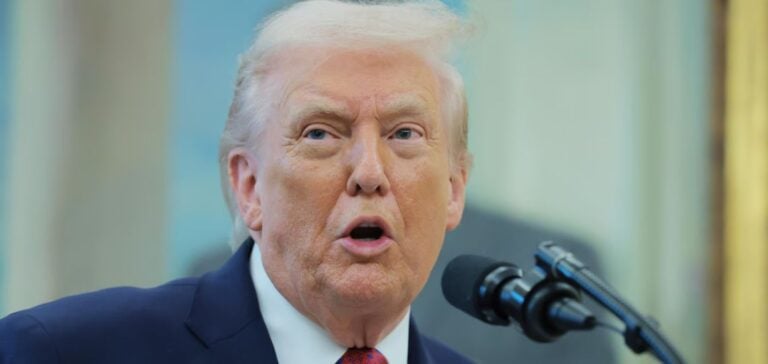
U.S. President Donald Trump has ordered a total blockade on all sanctioned tankers heading to or departing from Venezuela, significantly increasing economic pressure on President Nicolas Maduro’s government. The measure comes amid growing tensions between Washington and Caracas, with bilateral relations remaining frozen for several years.

Increased military and economic pressure in the Caribbean

In recent months, the United States has strengthened its naval presence in the Caribbean, conducting targeted interceptions of vessels suspected of transporting Venezuelan oil. According to U.S. authorities, these actions aim to combat drug trafficking and prevent the funding of illicit activities through crude exports. President Trump mentioned an “armada” encircling the country and stated that the deployment would intensify until the return of “stolen assets”, without elaborating on the accusations.

The recent seizure of the tanker Skipper en route to Cuba illustrates this strategy. The vessel, carrying between one and two million barrels of Venezuelan crude valued between $50mn and $100mn, had been listed under U.S. sanctions since 2022 for alleged ties to the Islamic Revolutionary Guard Corps and Lebanese Hezbollah.

Impact on exports and reactions from oil operators

American company Chevron confirmed that its operations in Venezuela, conducted under a sanctions waiver, are continuing in compliance with applicable laws. Chevron remains one of the few foreign companies authorised to operate in the country despite sanctions imposed since 2019. However, this exemption is subject to strict conditions periodically renewed by the U.S. Department of the Treasury.

The Venezuelan government condemned Trump’s announced blockade as a “grotesque threat”, accusing the United States of attempting to “steal the country’s resources”. Opposition leader Maria Corina Machado, recently awarded the Nobel Peace Prize, welcomed the decision and called for increased international pressure.

Legal implications and internal U.S. government debates

The announcement came as the U.S. Secretaries of Defense and State defended at Congress the maritime strikes carried out since September, officially numbering at least 26. These operations have resulted in the deaths of at least 95 individuals, although no evidence of their involvement in drug trafficking has been made public.

The legal consequences of seizing sanctioned oil cargoes, such as that aboard the Skipper, remain debated within federal agencies. Effectively controlling Venezuelan crude flows to markets like China or Cuba, often through shadow networks, continues to pose a persistent challenge for U.S. enforcement authorities.

Chevron remains the only operator shipping oil from Venezuela, while cargoes bound for China have been halted for a fifth consecutive day, increasing pressure on local storage capacity.
Donald Trump says US oil companies could restart production in Venezuela within two years following the removal of Nicolás Maduro, despite the scale of investment required.
Nexera Energy has acquired producing oil properties in South Texas as part of a financial settlement with Hagco Energy and Hugocellr involving more than $600,000 in unpaid fees.
The group of major oil producers extends its stability strategy despite a drop in prices of more than 18% in 2025 and projected supply surplus for the coming year.
Amid Venezuela’s political transition, the African Energy Chamber urges international players to prioritise stability to secure oil investment and restore national production.
The Libya Energy & Economic Summit 2026 will host five leaders from the legal and advisory sectors to support the opening of the national oil market and strengthen regional cooperation.
Norwegian group Borr Drilling has announced two contractual commitments for its Ran and Odin rigs, extending its activities in the Americas through 2027.
Lane42 Investment Partners has completed the acquisition of Aqua Terra Permian, a wastewater infrastructure operator in the Permian Basin, aiming to expand its footprint in strategic midstream services.
Brent crude fell to its lowest level since 2021, as persistent oversupply throughout 2025 weighed on prices despite isolated geopolitical tensions and China’s strategic stockpiling.
India’s crude imports from Russia could hit an eighteen-month low as Reliance Industries anticipates no shipments in January due to logistical and commercial disruptions.
Former Vaalco executive Clotaire Kondja takes over as Gabon’s Oil and Gas Minister as the country faces declining investment and stagnant crude output.
Phillips 66 Limited has reached an agreement to acquire Lindsey Oil Refinery assets, which will be absorbed into the Humber Refinery to reinforce fuel supply across the United Kingdom.
The United States is pressing major American oil firms to commit significant capital in Venezuela to recover billions lost during the expropriations of the 2000s.
Beijing maintains investments and crude imports from Venezuela, while several Chinese state-owned and private companies seek to secure stakes in Caracas' reserves.
Serbia is aiming for a quick agreement between Gazprom and Hungarian group MOL on the sale of Russian-held NIS shares, key to restarting its only refinery shut down by US sanctions.
Washington has crossed a historic threshold by capturing Nicolas Maduro after years of sanctions and embargo. A look back at two decades of tensions and their implications for the global oil market.
Canadian group Saturn Oil & Gas has consolidated its subsidiaries into a single structure to optimise oil investments and reduce long-term administrative costs.
PBF Energy delays full resumption of operations at its Martinez, California refinery to February 2026 following a 2025 fire, while releasing throughput guidance for its entire refining network.
Chinese company CNOOC has started production at the Buzios6 project, raising the total capacity of the pre-salt oilfield to 1.15 million barrels per day.
Tema refinery has resumed operations at reduced capacity following a prolonged shutdown and targeted maintenance work on critical infrastructure.

All the latest energy news, all the time

Annual subscription

8.25$/month*

*billed annually at 99$/year for the first year then 149,00$/year ​

Unlimited access - Archives included - Pro invoice

Monthly subscription

Unlimited access • Archives included

5.2$/month*
then 14.90$ per month thereafter

*Prices shown are exclusive of VAT, which may vary according to your location or professional status.

Since 2021: 30,000 articles - +150 analyses/week.