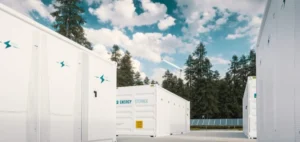
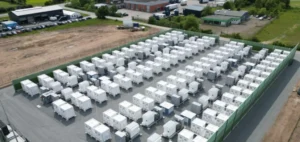
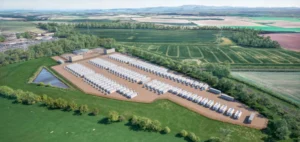
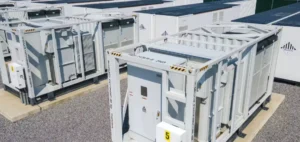
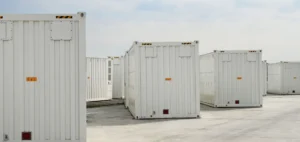
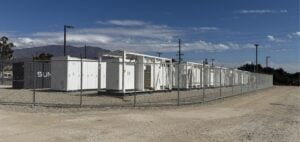
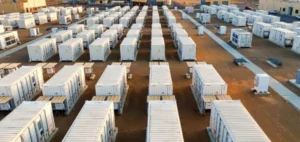
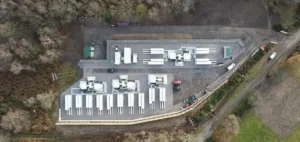
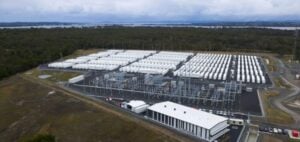
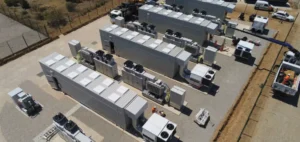
French renewable electricity producer Akuo has begun construction of a high-capacity energy storage centre in Boulouparis, in New Caledonia’s South Province. Once operational, the facility will be able to deliver 50 MW for three hours daily, over a 12-year contractual period. More than 200 MWh of storage capacity is currently being installed, making it one of the largest projects of its kind in France.
A response to grid needs and solar variability
The site is scheduled to come online in the third quarter of 2027. Its effective capacity of 150 MWh will cover the equivalent of three hours of electricity consumption for Nouméa, the capital. The goal is to store solar power during the day and inject it back during evening peak demand. The system will also contribute to frequency and voltage regulation, using grid-forming technology capable of restarting supply in the event of a major outage.
Established presence in Boulouparis
Akuo is already active in the region, operating three solar power plants in New Caledonia, including the Kwita Wije plant in Boulouparis, which also has its own storage unit. In parallel, the company supports local social initiatives, including an educational greenhouse project managed by a community association. Educational visits of the existing facility are regularly organised for schools.
A lever in the local energy transition plan
The government of New Caledonia aims to reduce greenhouse gas emissions by 75% by 2035. This target requires accelerated decarbonisation of the metallurgy sector, which accounts for nearly two-thirds of the island’s electricity consumption. The development of storage capacity is considered essential to enable the large-scale integration of renewable energy into the local energy mix.
Diversified public-private financing structure
The project is financed by several banking institutions, including Caisse d’Épargne Île-de-France, Banque de Nouvelle-Calédonie, Agence Française de Développement, Banque Calédonienne d’Investissement and BPI France. Two local customary groups, Wiwa and Wije, representing three customary tribes, are also shareholders. Their involvement aims to ensure local economic redistribution over the facility’s operational lifespan.
The project benefits from two tax mechanisms: one, specific to New Caledonia and approved by local authorities, will raise funds starting in December 2025; the other, national, is based on the LODEOM law (Overseas Economic Development Law), enabling mainland investors to contribute to the financing through to commissioning. The contract signed with Enercal, the grid management company, includes reduced charges supported by these incentives.