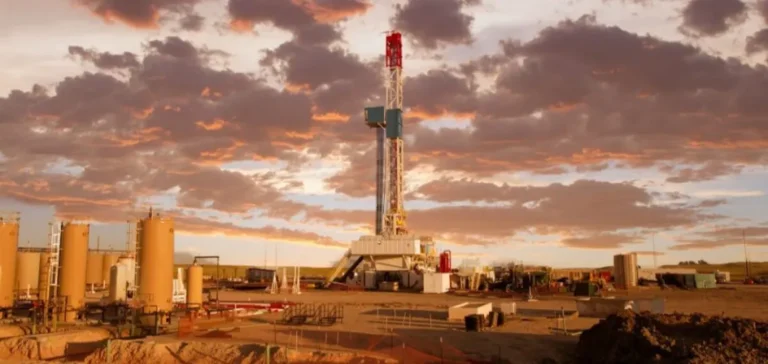
Diamondback Energy generates $1.8bn in free cash flow in Q3 2025

With average oil production of 503,750 barrels per day, Diamondback Energy strengthens its profitability and continues its share buyback and strategic asset divestment programme.

Share:

Comprehensive energy news coverage, updated nonstop

Annual subscription

8.25$/month*

*billed annually at 99$/year for the first year then 149,00$/year ​

Unlimited access • Archives included • Professional invoice

OTHER ACCESS OPTIONS

Monthly subscription

Unlimited access • Archives included

5.2$/month*
then 14.90$ per month thereafter

FREE ACCOUNT

3 articles offered per month

FREE

*Prices are excluding VAT, which may vary depending on your location or professional status

Since 2021: 35,000 articles • 150+ analyses per week

Diamondback Energy, an independent oil and gas producer based in the Permian Basin, recorded adjusted free cash flow of $1.8bn in the third quarter of 2025. The company achieved an average daily oil production of 503,750 barrels, equivalent to 942,946 barrels of oil equivalent per day, confirming stable operational performance in a moderate pricing environment.

Capital returns and asset refocusing

During the quarter, the company returned $892mn to shareholders through dividends and share repurchases, representing 50% of its adjusted free cash flow. A total of 4,286,080 shares were repurchased for approximately $603mn at an average price of $140.70 per share.

At the same time, Diamondback completed the sale of its 27.5% stake in EPIC Crude Holdings, LP, generating $504mn in cash, with an additional contingent consideration of $96mn tied to a possible future capacity expansion. Another transaction was closed on October 1 with the divestment of its subsidiary Environmental Disposal Systems for $694mn, while retaining a 30% equity interest in the acquirer, Deep Blue Midland Basin LLC.

Revised guidance and capital discipline

For the full year 2025, Diamondback now expects oil production between 495,000 and 498,000 barrels per day, up from a previous range of 485,000 to 492,000. Capital expenditure guidance has been narrowed to $3.45bn to $3.55bn, consistent with earlier forecasts.

The company plans to drill between 445 and 465 gross horizontal wells and complete 510 to 520 wells during the year. The average completed lateral length stands at approximately 11,500 feet. In the third quarter, 108 wells were drilled and 137 completed, mostly in the Midland Basin, with development costs estimated at $550 to $580 per foot.

Robust financial indicators despite price decline

Net income attributable to Diamondback reached $1.02bn, or $3.51 per diluted share. The company generated $2.4bn in operating cash flow, including $2.5bn before changes in working capital. Total revenues amounted to $3.92bn, including $3.45bn from oil, natural gas and liquids sales.

Despite a lower average oil price of $64.60 per barrel compared to $73.13 a year earlier, Diamondback maintained its margins by reducing operating costs to $10.05 per barrel of oil equivalent.

Financial structure and buyback strategy

Consolidated net debt stood at $15.89bn as of September 30, with total liquidity of $2.43bn. Since the start of the fourth quarter, the company has already repurchased $87mn in shares and $203mn in long-term debt at a discount.

The authorised share repurchase programme, increased to $8bn in July, had $3bn in remaining capacity as of October 31. Diamondback stated it will continue buybacks opportunistically using available cash, free cash flow, and proceeds from asset sales.

Chevron remains the only operator shipping oil from Venezuela, while cargoes bound for China have been halted for a fifth consecutive day, increasing pressure on local storage capacity.
Donald Trump says US oil companies could restart production in Venezuela within two years following the removal of Nicolás Maduro, despite the scale of investment required.
Nexera Energy has acquired producing oil properties in South Texas as part of a financial settlement with Hagco Energy and Hugocellr involving more than $600,000 in unpaid fees.
The group of major oil producers extends its stability strategy despite a drop in prices of more than 18% in 2025 and projected supply surplus for the coming year.
Amid Venezuela’s political transition, the African Energy Chamber urges international players to prioritise stability to secure oil investment and restore national production.
The Libya Energy & Economic Summit 2026 will host five leaders from the legal and advisory sectors to support the opening of the national oil market and strengthen regional cooperation.
Norwegian group Borr Drilling has announced two contractual commitments for its Ran and Odin rigs, extending its activities in the Americas through 2027.
Lane42 Investment Partners has completed the acquisition of Aqua Terra Permian, a wastewater infrastructure operator in the Permian Basin, aiming to expand its footprint in strategic midstream services.
Brent crude fell to its lowest level since 2021, as persistent oversupply throughout 2025 weighed on prices despite isolated geopolitical tensions and China’s strategic stockpiling.
India’s crude imports from Russia could hit an eighteen-month low as Reliance Industries anticipates no shipments in January due to logistical and commercial disruptions.
Former Vaalco executive Clotaire Kondja takes over as Gabon’s Oil and Gas Minister as the country faces declining investment and stagnant crude output.
The United States is pressing major American oil firms to commit significant capital in Venezuela to recover billions lost during the expropriations of the 2000s.
Beijing maintains investments and crude imports from Venezuela, while several Chinese state-owned and private companies seek to secure stakes in Caracas' reserves.
Serbia is aiming for a quick agreement between Gazprom and Hungarian group MOL on the sale of Russian-held NIS shares, key to restarting its only refinery shut down by US sanctions.
Washington has crossed a historic threshold by capturing Nicolas Maduro after years of sanctions and embargo. A look back at two decades of tensions and their implications for the global oil market.
Canadian group Saturn Oil & Gas has consolidated its subsidiaries into a single structure to optimise oil investments and reduce long-term administrative costs.
PBF Energy delays full resumption of operations at its Martinez, California refinery to February 2026 following a 2025 fire, while releasing throughput guidance for its entire refining network.
Chinese company CNOOC has started production at the Buzios6 project, raising the total capacity of the pre-salt oilfield to 1.15 million barrels per day.
Tema refinery has resumed operations at reduced capacity following a prolonged shutdown and targeted maintenance work on critical infrastructure.
Caspian Pipeline Consortium suspended loading and intake operations due to a storm and full storage capacity.

All the latest energy news, all the time

Annual subscription

8.25$/month*

*billed annually at 99$/year for the first year then 149,00$/year ​

Unlimited access - Archives included - Pro invoice

Monthly subscription

Unlimited access • Archives included

5.2$/month*
then 14.90$ per month thereafter

*Prices shown are exclusive of VAT, which may vary according to your location or professional status.

Since 2021: 30,000 articles - +150 analyses/week.