Aramco’s net profit drops for the eleventh consecutive quarter

Aramco reported a 2.3% decrease in its net profit for the third quarter, amid global economic uncertainties and an oversupply of oil, although its adjusted earnings showed a slight increase.

Share:

Comprehensive energy news coverage, updated nonstop

Annual subscription

8.25$/month*

*billed annually at 99$/year for the first year then 149,00$/year ​

Unlimited access • Archives included • Professional invoice

OTHER ACCESS OPTIONS

Monthly subscription

Unlimited access • Archives included

5.2$/month*
then 14.90$ per month thereafter

FREE ACCOUNT

3 articles offered per month

FREE

*Prices are excluding VAT, which may vary depending on your location or professional status

Since 2021: 35,000 articles • 150+ analyses per week

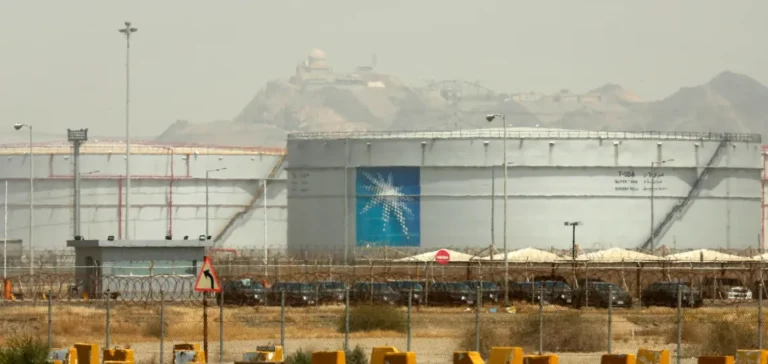
Saudi Arabian Oil Company (Aramco) reported a net profit of $26.94 billion (SAR 101 billion) in the third quarter, compared to $27.56 billion for the same period last year. This marks the eleventh consecutive quarterly decline in the company’s net profit. The global macroeconomic environment, along with increased production levels from members of the Organization of the Petroleum Exporting Countries and their allies (OPEC+), continued to exert downward pressure on crude oil prices.

Adjusted results show slight growth

Excluding exceptional items, Aramco’s adjusted net income increased by 1% year-on-year, reaching $27.98 billion, exceeding market expectations. Fifteen analysts surveyed by the company had forecast a median value of $26.5 billion. This performance can be partly attributed to cost management and operational adaptation to changing prices.

Global demand remains under pressure from persistent trade tensions, while concerns over a recession weigh on price outlooks. The decision by several OPEC+ members to increase production quotas contributed to an influx of supply in the markets. Saudi Arabia continues to produce below its maximum capacity of 12 million barrels per day (Mb/d), maintaining a strategic buffer.

Deployment of digital solutions and budgetary pressure

Aramco continues to roll out digital solutions to enhance the efficiency of its operations. CEO Amin Nasser confirmed the company’s intention to accelerate the adoption of advanced artificial intelligence (AI) technologies. A recent minority stake acquisition in the Saudi AI company, Humain, was announced.

Despite its high profits, Aramco’s contribution to the Saudi budget remains critical. The government forecasts a budget deficit equivalent to 5.3% of GDP in 2025. The link between Aramco’s results and the fiscal health of the state remains a key factor in the kingdom’s production and investment policies.

Fragile balance amid market volatility

Saudi Arabia’s energy strategy, which relies on targeted production increases and competitive positioning in the global market, is set against a backdrop of significant volatility. Geopolitical tensions, particularly U.S. sanctions on Russian energy companies, have helped prevent a more pronounced decline in prices.

Market players anticipate continued downward pressure on prices as 2026 approaches, with several producing countries gradually increasing their export volumes. In this context, Aramco’s quarterly performance is closely monitored by analysts and fiscal policymakers in the kingdom.

Plains All American Pipeline and Plains GP Holdings announce a 10% increase in quarterly distributions ahead of their fourth quarter 2025 financial results release.
Eni has transferred its traditional refining branch to Eni Industrial Evolution, a new company dedicated to managing its industrial assets in Europe and the Middle East.
Ecovyst has divested its Advanced Materials & Catalysts segment to Technip Energies, generating $530mn in net proceeds and reducing debt while refocusing on strategic priorities.
Baker Hughes has completed the transfer of its surface pressure control business to Cactus in a majority joint venture, receiving $344.5 million to strengthen its liquidity and realign its industrial portfolio.
Occidental has completed the sale of its chemical subsidiary OxyChem to Berkshire Hathaway for $9.7bn, refocusing its activities on oil and gas. The transaction excludes the company’s historical environmental liabilities.
With electricity demand accelerating, Asia-Pacific utilities must manage massive investment needs, volatile revenues and geopolitical tensions as the energy transition advances in a rapid but disorderly manner.
NU E Power Corp. closed a first financing tranche of $625,003 to support interconnection projects in Alberta and international feasibility studies, marking a new phase in the deployment of its energy infrastructure network.
Octopus sells a minority stake in Kraken for $1 billion in a deal valuing the tech platform at $8.65 billion, initiating its spin-off and strengthening its position among international energy suppliers.
India’s public sector SECI seeks to outsource the design and management of an energy trading software platform, including technical support and human resources for five years at its New Delhi headquarters.
BayWa r.e. continues its strategic transformation with the sale of 2.2 GW of projects, a withdrawal from Asian markets, internal reorganisation, and a rebranding planned for 2026.
CB&I acquires Petrofac's Asset Solutions division, targeting revenue diversification and geographic expansion, with nearly 3,000 new employees expected to join the group.
French group Nexans initiates the sale of its Autoelectric subsidiary to India’s Motherson for €207mn ($227mn), marking its full exit from non-electrification activities.
Bourbon enters a new strategic phase following the arrival of Davidson Kempner and Fortress, who have become majority shareholders after a financial restructuring approved by the French courts.
US-based Armada has signed a memorandum of understanding with the Department of Energy to participate in the Genesis Mission, aimed at accelerating scientific research and reinforcing national energy and technology sovereignty.
Solar Energy Corporation of India signed a strategic agreement with Global Energy Alliance to strengthen grid resilience and support the expansion of storage and smart management technologies.
Le fonds souverain omanais a validé 141 projets en 2025 pour un engagement total de $1.2bn, visant à renforcer l’indépendance énergétique et l’industrialisation nationale à travers un programme d’investissement de $5.2bn.
The Norwegian energy group rejects the sanction imposed for illegal gas discharges at Mongstad, citing disagreement over maintenance obligations and the alleged financial benefit.
Alpine Power Systems announces the acquisition of Chicago Industrial Battery to expand its regional presence and support the growth of its PowerMAX line of used and rental batteries and chargers.
HASI and KKR strengthen their strategic partnership with an additional $1bn allocation to CarbonCount Holdings 1, bringing the vehicle’s total investment capacity to nearly $5bn.
EDF is considering selling some of its subsidiaries, including Edison and its renewables activities in the United States, to strengthen its financial capacity as a €5bn ($5.43bn) savings plan is underway.

All the latest energy news, all the time

Annual subscription

8.25$/month*

*billed annually at 99$/year for the first year then 149,00$/year ​

Unlimited access - Archives included - Pro invoice

Monthly subscription

Unlimited access • Archives included

5.2$/month*
then 14.90$ per month thereafter

*Prices shown are exclusive of VAT, which may vary according to your location or professional status.

Since 2021: 30,000 articles - +150 analyses/week.