Putin and Pezeshkian to discuss Iranian nuclear program under European pressure

Russia and Iran seek to strengthen their nuclear cooperation as the E3 activates the sanctions mechanism against Tehran, reigniting tensions over compliance with the 2015 Vienna agreement.

Share:

Comprehensive energy news coverage, updated nonstop

Annual subscription

8.25$/month*

*billed annually at 99$/year for the first year then 149,00$/year ​

Unlimited access • Archives included • Professional invoice

OTHER ACCESS OPTIONS

Monthly subscription

Unlimited access • Archives included

5.2$/month*
then 14.90$ per month thereafter

FREE ACCOUNT

3 articles offered per month

FREE

*Prices are excluding VAT, which may vary depending on your location or professional status

Since 2021: 35,000 articles • 150+ analyses per week

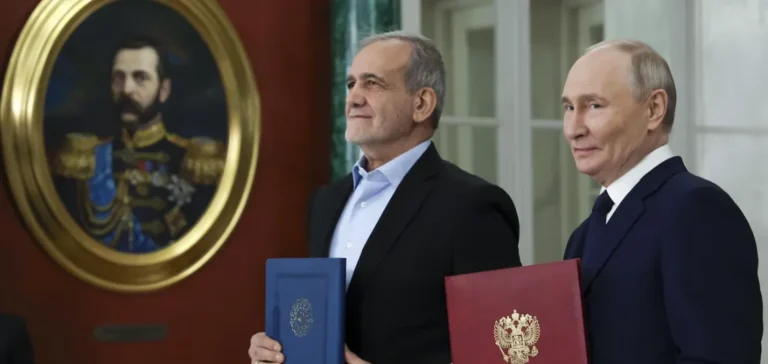
Russian President Vladimir Putin will meet his Iranian counterpart Massoud Pezeshkian in China on Monday to discuss Iran’s nuclear program. The Kremlin’s announcement comes amid growing tensions over compliance with the 2015 Vienna agreement, known as the Joint Comprehensive Plan of Action (JCPOA). The European E3 countries — France, Germany and the United Kingdom — believe Iran has failed to meet its obligations and have triggered the snapback mechanism to restore sanctions.

A reactivated sanctions mechanism

In a letter to the United Nations Security Council, the three European powers stressed that available evidence shows significant non-compliance by Iran. The mechanism opens a 30-day period at the end of which all sanctions lifted ten years ago could be reinstated. The European Union, also a party to the JCPOA, participated in the latest talks in Geneva but was unable to prevent the decision announced by the E3.

Russia steps in

Moscow reacted strongly, denouncing a destabilizing decision and calling for a return to negotiations. The Russian Foreign Ministry warned that the reimposition of sanctions could have irreversible consequences for regional and international stability. Russia, which cooperates closely with Iran on several energy and geopolitical issues, insists on the need for constructive dialogue to avoid further escalation.

Tehran’s position

Tehran denies any military ambition and recalls its right to develop a civilian nuclear program. According to the International Atomic Energy Agency (IAEA), Iran has already enriched uranium to 60%, well beyond the 3.67% limit set by the JCPOA. The IAEA also confirmed in February 2023 a one-time enrichment level of 84%, presented by Iran as a technical error linked to the accumulation of highly enriched uranium in some centrifuge cascades. Although Tehran claimed it did not intend to reach this level, the incident confirmed its technical ability to approach the military threshold.

The stages of enrichment

Natural uranium contains only 0.7% uranium-235, the fissile isotope sought for energy or military purposes. Raising this concentration to 3.67%, the threshold authorized for civilian use, represents the longest and most complex stage of enrichment. Once this step is achieved, progressing to 20% and then 60% requires far less additional work. Finally, reaching 90% — the level required for the manufacture of a nuclear weapon — becomes technically much faster. Crossing the 20% threshold, which is not necessary for civilian purposes, therefore raises absolute distrust from the International Atomic Energy Agency (IAEA), the European E3 countries, Israel, and the United States, as it is viewed as a potential signal of military intentions.

A major strategic issue

The contrast between civilian and military uses of enriched uranium highlights the sensitivity of Iran’s program. While fuel for nuclear power plants usually ranges between 3 and 5%, the technical proximity to the 90% required for a weapon fuels international concern. The meeting planned in China between Vladimir Putin and Massoud Pezeshkian takes place in a sequence where diplomatic and military balances converge. The future of the JCPOA, already weakened since the withdrawal of the United States in 2018, now depends on the ability of the parties to reach a compromise.

Work has begun at the Bailong and Lufeng sites with concrete poured for the nuclear islands, marking the start of construction for two CAP1000 reactors.
French group Orano receives USD900mn in public support to establish a new uranium enrichment facility in Tennessee, as part of a broader US nuclear sector revival plan.
Japan’s nuclear restart effort stalls after Chubu Electric acknowledged a possibly flawed seismic risk estimate at its Hamaoka facility under regulatory review.
Russia has connected its first 1,250 MW VVER-TOI reactor at the Kursk II nuclear power plant to the grid, signalling a key step toward full commissioning by 2034.
Chubu Electric acknowledged a methodological discrepancy in the seismic evaluation of two nuclear reactors, a situation that could weigh on the restart of nuclear operations in Japan.
Denison Mines is set to commit CAD600mn ($437mn) to build Phoenix, the first large-scale uranium mine developed in Canada in over a decade, with production expected by mid-2028.
A memorandum of understanding between four companies opens the way for industrial development around compact nuclear reactors, integrating hydrogen production, synthetic fuels, and digital infrastructure.
The Idaho Advanced Energy Consortium secured approval for its five strategic projects, now competing for $75mn in funding under the US Tech Hub programme.
Duke Energy has filed a permit application to assess the feasibility of a nuclear reactor in Stokes County on an existing power generation site, without committing to immediate construction.
The South Korean nuclear regulator has approved the launch of the 1,400-megawatt Saeul 3 reactor, beginning with a six-month pilot phase before full commercial operation.
Ankara confirmed new Russian funding for the Akkuyu project, Turkey’s first nuclear site, strengthening its energy ties with Moscow and advancing its domestic nuclear ambitions.
Niger’s military regime disputes theft allegations by French prosecutors after uranium stock vanished from a nationalised site previously operated by Orano.
Rosatom successfully completed a series of tests on its high-temperature gas-cooled reactor fuel, validating its performance at up to 1,700 °C under prolonged irradiation conditions.
Videberg Kraft AB becomes the first company to request government support to build two new reactors at the Ringhals site, under the national nuclear investment framework adopted in 2025.
The European Commission opens an in-depth investigation into Prague's public funding of a major nuclear project, which could reach €30bn ($32.88bn), with guaranteed revenues over forty years.
Niigata's assembly officially backs the restart of the Kashiwazaki-Kariwa site, marking a key step in Japan’s return to nuclear energy following the 2011 Fukushima disaster.
The Japanese government plans to fund up to 30% of loans required for nuclear projects, aiming to accelerate reactor restarts and double the share of nuclear energy in its energy mix by 2040.
French nuclear reactor developer Newcleo has submitted its lead-cooled small modular reactor design to Euratom, initiating the first regulatory phase to integrate nuclear non-proliferation safeguards at the European level.
French state utility EDF has increased the maximum estimated cost for building six new nuclear reactors to €72.8 billion ($85.29 billion), representing a 40% rise over the original figure.
US-based Holtec has signed a memorandum of understanding with Hungary’s energy group MVM to assess the deployment of its SMR-300 technology, strengthening bilateral nuclear cooperation and opening prospects for a new market in Central Europe.

All the latest energy news, all the time

Annual subscription

8.25$/month*

*billed annually at 99$/year for the first year then 149,00$/year ​

Unlimited access - Archives included - Pro invoice

Monthly subscription

Unlimited access • Archives included

5.2$/month*
then 14.90$ per month thereafter

*Prices shown are exclusive of VAT, which may vary according to your location or professional status.

Since 2021: 30,000 articles - +150 analyses/week.