Uranium price surges 9% following major fund raise

Uranium spot price hits its highest level of 2025 following a significant fundraising announcement by a specialized Canadian investment fund, prompting vigorous trading and strong reactions in the international market.

Share:

Comprehensive energy news coverage, updated nonstop

Annual subscription

8.25$/month*

*billed annually at 99$/year for the first year then 149,00$/year ​

Unlimited access • Archives included • Professional invoice

OTHER ACCESS OPTIONS

Monthly subscription

Unlimited access • Archives included

5.2$/month*
then 14.90$ per month thereafter

FREE ACCOUNT

3 articles offered per month

FREE

*Prices are excluding VAT, which may vary depending on your location or professional status

Since 2021: 35,000 articles • 150+ analyses per week

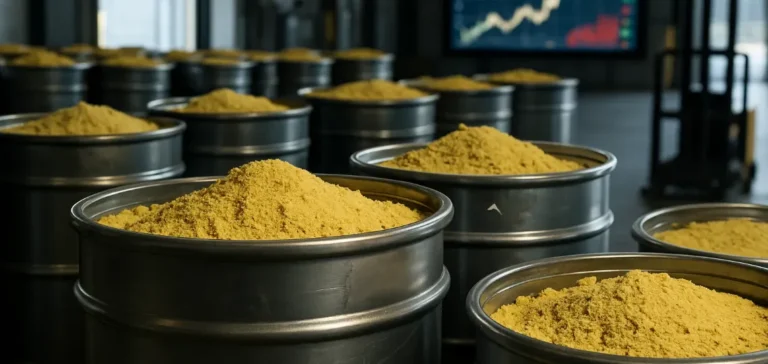
The spot price for uranium oxide (U3O8) surged nearly 9% on June 16, driven by a major fundraising effort by a fund specialized in the physical acquisition of this strategic commodity. The rapid price increase directly reflects investor expectations surrounding this significant financial operation, led by a prominent Canadian financial institution.

Major fundraising triggers trading activity

This investment fund, recognised as one of the world’s largest physical holders of uranium, raised around $100 million through a share issue fully subscribed by a major Canadian investment bank. The explicit objective of this capital increase is the additional acquisition of uranium stocks, directly influencing demand on the spot market. This financial operation, precisely valued at $100.1 million, will enable significant additional purchases of U3O8.

Several important transactions immediately followed the announcement. An intermediary reported that four transactions totaling 400,000 pounds of uranium were concluded at progressively higher prices during early trading hours in the US markets. Among these deals, a notable delivery will be made to France, with 100,000 pounds scheduled for delivery in August at a set price of $76.25 per pound.

A tight market context driving fluctuations

Alongside the momentum generated by the fund raise, another situation has amplified upward movements: an Australian uranium mining company’s contractual cancellation of future deliveries. The company announced it had agreed with international energy companies to cancel three contracts totaling nearly two million pounds of uranium scheduled over eight years. Delays in commissioning a central processing plant in the United States explain these significant contractual adjustments.

These unexpected changes to delivery schedules heighten perceived future scarcity, indirectly contributing to the observed price increase. The volumes involved, coupled with expected production decreases, intensify short-term pressures on the global supply available.

Unprecedented fluctuations since December 2024

The current price of $75.45 per pound is the highest point reached since December 2024. Uranium price levels have fluctuated between $63 and $71.50 per pound since last January, illustrating notable volatility in recent months. This instability reflects frequent and pronounced market reactions to news regarding inventories and significant transactions by key global nuclear sector players.

International markets thus remain attentive to major financial decisions and significant operational and contractual changes directly affecting the pricing of critical raw materials for nuclear energy. This combination of financial and operational factors creates an environment conducive to closely monitoring future developments.
Duke Energy has filed a permit application to assess the feasibility of a nuclear reactor in Stokes County on an existing power generation site, without committing to immediate construction.
The South Korean nuclear regulator has approved the launch of the 1,400-megawatt Saeul 3 reactor, beginning with a six-month pilot phase before full commercial operation.
Ankara confirmed new Russian funding for the Akkuyu project, Turkey’s first nuclear site, strengthening its energy ties with Moscow and advancing its domestic nuclear ambitions.
Niger’s military regime disputes theft allegations by French prosecutors after uranium stock vanished from a nationalised site previously operated by Orano.
Rosatom successfully completed a series of tests on its high-temperature gas-cooled reactor fuel, validating its performance at up to 1,700 °C under prolonged irradiation conditions.
Videberg Kraft AB becomes the first company to request government support to build two new reactors at the Ringhals site, under the national nuclear investment framework adopted in 2025.
The European Commission opens an in-depth investigation into Prague's public funding of a major nuclear project, which could reach €30bn ($32.88bn), with guaranteed revenues over forty years.
Niigata's assembly officially backs the restart of the Kashiwazaki-Kariwa site, marking a key step in Japan’s return to nuclear energy following the 2011 Fukushima disaster.
The Japanese government plans to fund up to 30% of loans required for nuclear projects, aiming to accelerate reactor restarts and double the share of nuclear energy in its energy mix by 2040.
French nuclear reactor developer Newcleo has submitted its lead-cooled small modular reactor design to Euratom, initiating the first regulatory phase to integrate nuclear non-proliferation safeguards at the European level.
French state utility EDF has increased the maximum estimated cost for building six new nuclear reactors to €72.8 billion ($85.29 billion), representing a 40% rise over the original figure.
US-based Holtec has signed a memorandum of understanding with Hungary’s energy group MVM to assess the deployment of its SMR-300 technology, strengthening bilateral nuclear cooperation and opening prospects for a new market in Central Europe.
California-based startup Radiant has secured $300mn to build its first factory in Tennessee and prepare for the mass production of miniature nuclear reactors for off-grid applications.
Terra Innovatum has increased its interactions with the Nuclear Regulatory Commission to advance licensing of its SOLO™ micro-modular reactor, despite the partial shutdown of the US federal government.
The US nuclear regulator has extended the operating licences of three Illinois reactors by 20 years, strengthening Constellation's long-term industrial outlook for the Clinton and Dresden sites.
The SATURNE Industrial Chair aims to develop innovative uranium extraction methods, with joint funding from Orano and the National Research Agency over a four-year period.
US-based X-energy has signed a reservation agreement with South Korea's Doosan Enerbility to secure key components for its small modular nuclear reactors.
Niger expands its mining alliances with Uranium One to develop new sites, while the Dasa project continues seeking financing despite clear political backing.
Samsung Heavy Industries has received Approval in Principle for a floating nuclear plant featuring two SMART100 reactors, marking a step toward the commercialisation of offshore small modular reactors.
The Indian government proposes a unified legal framework for nuclear energy, aiming to boost private investment and increase installed capacity to 100 GW by 2047.

All the latest energy news, all the time

Annual subscription

8.25$/month*

*billed annually at 99$/year for the first year then 149,00$/year ​

Unlimited access - Archives included - Pro invoice

Monthly subscription

Unlimited access • Archives included

5.2$/month*
then 14.90$ per month thereafter

*Prices shown are exclusive of VAT, which may vary according to your location or professional status.

Since 2021: 30,000 articles - +150 analyses/week.